
Autism Awareness – Health & Social Care
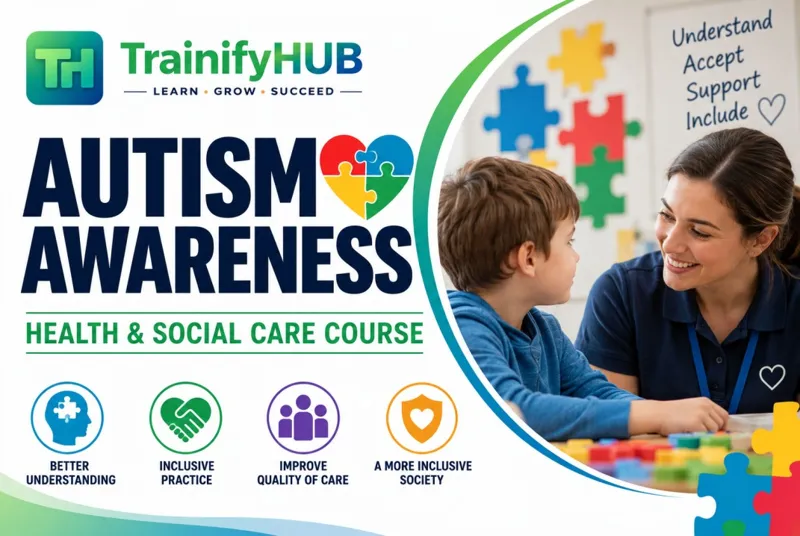
An Autism Awareness course designed for health and social care professionals. Learn how autism affects individuals, how to provide person-centred support, and how to meet UK legal and regulatory standards including the Care Act 2014, Autism Act 2009, and Equality Act 2010.
No ratings yet
2.00 CPD Points
MODULES
7
DURATION
2h
STUDENTS
5+
LEVEL
beginner
Course Price
GBP 25.00
One-time payment - Lifetime access
This course includes:
7 comprehensive modules
2h of video content
PDF, PPT & Infographics included
Final assessment included
Lifetime access on mobile & desktop
Certificate of completion
2.00 CPD Points
CATEGORY
Health & SafetyLAST UPDATED
Jul 2026
Course Price
GBP 25.00
One-time payment - Lifetime access
This course includes:
7 comprehensive modules
2h of video content
PDF, PPT & Infographics included
Final assessment included
Lifetime access on mobile & desktop
Certificate of completion
2.00 CPD Points
CATEGORY
Health & SafetyLAST UPDATED
Jul 2026
About this course
This Autism Awareness course is designed for professionals working in care homes, domiciliary care, nursing homes, hospitals, and wider health and social care environments.
The course provides a clear and practical understanding of autism as a lifelong neurodevelopmental difference. It explores how autism affects communication, behaviour, sensory processing, and daily living, while emphasising dignity, respect, and person-centred care.
Aligned with UK legislation and guidance — including the Autism Act 2009, Care Act 2014, Equality Act 2010, NICE guidance, Skills for Care framework, and CQC standards — this course supports staff in delivering safe, lawful, and inclusive care.
Learners will develop the knowledge and confidence to understand autistic individuals, avoid stereotypes, recognise behaviour as communication, and make reasonable adjustments in care settings.
Learning Outcomes
Module 1: Introduction to Autism Awareness
By the end of this module, learners will be able to:
• Define autism and understand it as a lifelong neurodevelopmental difference
• Explain how autism may affect communication, social interaction, and daily experiences
• Recognise why autism awareness is important in health and social care settings
• Understand the importance of avoiding misunderstandings related to autistic behaviour
• Identify the role of person-centred support in delivering safe and respectful care
Module 2: Understanding the Autism Spectrum
By the end of this module, learners will be able to:
• Explain what is meant by autism being a spectrum condition
• Recognise that autistic individuals experience differences in unique ways
• Understand how communication, sensory processing, and routines vary among individuals
• Identify why personalised support is essential in health and social care settings
• Recognise the importance of avoiding stereotypes when supporting autistic people
Module 3: Characteristics of Autism: Recognising Traits and Responding with Dignity
By the end of this module, learners will be able to:
• Identify common characteristics associated with autism
• Recognise differences in communication and social interaction
• Understand repetitive behaviours and the importance of routines for autistic individuals
• Interpret behaviour as communication rather than “challenging behaviour”
• Respond respectfully and appropriately to autistic individuals in care environments
Module 4: Communication and Autism in Health and Social Care
By the end of this module, learners will be able to:
• Understand how autistic individuals may process language differently
• Recognise the challenges created by ambiguous or abstract language
• Apply clear and specific communication strategies in care environments
• Support informed decision-making and valid consent through effective communication
• Promote dignity, trust, and autonomy through respectful interaction
Module 5: Sensory Processing Differences and Environmental Adjustments in Care
By the end of this module, learners will be able to:
• Identify common sensory processing differences experienced by autistic individuals
• Understand how environmental factors can trigger distress or sensory overload
• Recognise signs of sensory discomfort in care settings
• Apply reasonable adjustments to support sensory needs
• Promote wellbeing by creating supportive and comfortable care environments
Module 6: Behaviour as Communication and Positive Support in Care
By the end of this module, learners will be able to:
• Understand behaviour as a form of communication rather than misconduct
• Identify underlying causes of distress such as anxiety, confusion, or sensory overload
• Apply principles of Positive Behaviour Support in care practice
• Respond to behaviours calmly, respectfully, and empathetically
• Reduce restrictive practices while maintaining safety and dignity in care settings
Accreditation & Recognition
This course is officially recognised and certified
2.00
CPD
Points Awarded
All accreditations are verified and recognised by relevant industry bodies. Upon successful completion, your certificate will display the appropriate accreditation marks.
Frequently Asked Questions
6 questions answered
This course is suitable for care assistants, support workers, nurses, healthcare professionals, and anyone working in residential care, domiciliary care, supported living, hospitals, or wider health and social care settings.
Yes. The course aligns with UK legislation and guidance including the Autism Act 2009, Care Act 2014, Equality Act 2010, NICE guidance, Skills for Care framework, and CQC fundamental standards.
No. Autism is a lifelong neurodevelopmental difference. Some autistic individuals may also have a learning disability, but autism itself is not a learning disability.
The course promotes understanding behaviour as communication. It focuses on identifying underlying causes such as anxiety, sensory overload, or confusion, rather than labelling behaviour as “challenging.”
The course takes approximately 3 hours to complete. Learners can pause and resume at any time.
Yes. After successful completion, learners can download a digital Level 2 Autism Awareness certificate for CPD and compliance records.
What You'll Learn
What autism is and how it affects individuals
The meaning of the autism spectrum
Common characteristics of autism
Sensory processing differences and sensory overload
Behaviour as communication
How to provide person-centred support
How to make reasonable adjustments in line with the Equality Act 2010
How autism awareness improves safeguarding and care quality
Why This Course
Autistic individuals access residential care, supported living, domiciliary services, mental health support, and acute hospital settings. Without proper awareness, behaviours may be misunderstood, leading to inappropriate responses or even neglect.
CQC expects providers to understand the conditions affecting those they support. This course helps staff:
Avoid stereotypes and assumptions
Deliver respectful, dignified care
Reduce restrictive or punitive practices
Meet safeguarding and regulatory requirements
Promote inclusion and wellbeing
Autism awareness is not optional — it is essential for safe and lawful care delivery.
Certificate of Completion
Upon successful completion of this course and passing the final assessment, learners will receive a:
Certificate in Autism Awareness – Health & Social Care
This certification confirms that the learner has demonstrated knowledge of:
• Core principles of autism awareness and neurodiversity
• Understanding autism as a spectrum condition and recognising individual differences
• Key characteristics of autism including communication differences and sensory sensitivities
• Adapting communication approaches to support autistic individuals effectively
• Identifying sensory processing differences and making reasonable environmental adjustments
• Understanding behaviour as communication and applying positive support approaches
• Delivering respectful, person-centred support in line with NHS, NICE, and CQC guidance
The certificate supports professional awareness, inclusive care practice, and compliance with health and social care standards when supporting autistic individuals.
Course Highlights
5+
Students Enrolled
New
Be the first!
2h
Total Duration
Student Reviews
0.0
0 stars
Based on 0 reviews
5
0
4
0
3
0
2
0
1
0
🔒 Log In to Review
You must be logged in to submit a review. Please log in or create an account.