
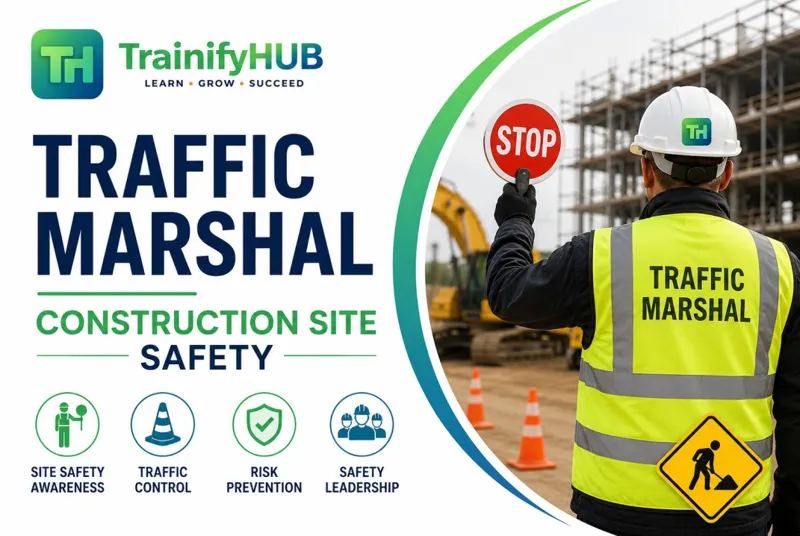
Traffic Marshal – Construction Site Safety
UK Traffic Marshal (Banksman) awareness training covering safe vehicle movements, blind spots, communication, and site transport risk reduction. Includes certificate and 4 CPD hours.
No ratings yet
4.00 CPD PointsCPD StandardSkills for Care
MODULES
10
DURATION
4h
STUDENTS
7+
LEVEL
intermediate
Course Price
GBP 30.00
One-time payment - Lifetime access
This course includes:
10 comprehensive modules
4h of video content
PDF, PPT & Infographics included
Final assessment included
Lifetime access on mobile & desktop
Certificate of completion
4.00 CPD Points
CATEGORY
ConstructionLAST UPDATED
Jul 2026
Course Price
GBP 30.00
One-time payment - Lifetime access
This course includes:
10 comprehensive modules
4h of video content
PDF, PPT & Infographics included
Final assessment included
Lifetime access on mobile & desktop
Certificate of completion
4.00 CPD Points
CATEGORY
ConstructionLAST UPDATED
Jul 2026
About this course
Construction sites are busy, noisy, and constantly changing — and vehicle movements remain one of the leading causes of serious injury and fatal incidents.
A Traffic Marshal (also known as a Banksman) plays a vital role in keeping pedestrians and plant safely separated, guiding vehicles clearly, and preventing avoidable collisions and reversing incidents.
This course provides clear, practical awareness training for those involved in controlling or supporting vehicle movements on construction sites. It explains:
Why transport incidents happen
How blind spots and reversing risks lead to serious harm
Safe positioning principles
Clear communication and signalling basics
The importance of planned traffic routes and separation
This course is designed around UK construction site environments and supports safer working practices aligned with employer responsibilities to control site transport risks.
Important:
This is an awareness-level course. It does not replace site-specific induction, practical training, or employer competency assessments where required.
Learning Outcomes
Module 1: Traffic Marshal Principles – Controlling Risk and Saving Lives
By the end of this module, learners will be able to:
• Explain the role and responsibilities of a Traffic Marshal (Banksman)
• Identify the main causes of vehicle-related accidents on construction sites
• Recognise hazards such as driver blind spots and reversing risks
• Understand the importance of safe pedestrian and vehicle segregation
• Apply the hierarchy of control in workplace transport safety
• Explain how Traffic Marshals contribute to preventing serious accidents and fatalities
Module 2: Statutory Frameworks and Legal Responsibilities for Vehicle Marshalling
By the end of this module, learners will be able to:
• Identify key UK legislation governing workplace transport safety
• Understand the legal responsibilities of employers, site managers and Traffic Marshals
• Recognise the role of traffic management plans in reducing risk
• Apply safe working practices in accordance with regulatory requirements
• Identify the consequences of poor safety planning and lack of competence
• Understand the importance of compliance with workplace transport regulations
Module 3: Site Traffic Hazards and Risk Management
By the end of this module, learners will be able to:
• Identify common traffic hazards present on construction sites
• Recognise risks associated with reversing vehicles and limited visibility
• Understand hazards related to heavy plant machinery such as excavators and forklifts
• Identify environmental hazards including uneven ground and adverse weather
• Recognise risks to nearby structures and underground services
• Apply hazard awareness principles to reduce site traffic risks
Module 4: Traffic Management Plans and Site Design Control
By the end of this module, learners will be able to:
• Understand the purpose of Traffic Management Plans (TMPs)
• Identify vehicle routes, pedestrian pathways and entry/exit points on site
• Explain the hierarchy of control for traffic management
• Recognise the role of barriers, bollards and signage in site safety
• Understand how structured site design reduces collision risk
• Apply traffic management principles to improve workplace safety
Module 5: Communication, Signalling and Safe Marshalling Procedures
By the end of this module, learners will be able to:
• Identify and use standard hand signals for vehicle marshalling
• Understand the importance of clear communication with drivers
• Maintain correct positioning and eye contact during vehicle guidance
• Apply alternative communication methods such as radios and whistles
• Recognise the rule that drivers must stop if the marshal is not visible
• Apply the “Stop, Brake, Check” procedure during reversing operations
Module 6: Safe Positioning and Precision Marshalling Techniques
By the end of this module, learners will be able to:
• Maintain safe positioning while guiding vehicles
• Ensure visibility between the marshal and driver at all times
• Avoid blind spots and maintain a safe working distance from vehicles
• Keep escape routes clear during vehicle movement operations
• Recognise high-risk manoeuvres such as reversing and tight turns
• Exercise stop-work authority if conditions become unsafe
Module 7: PPE Requirements and Safe Vehicle & Plant Operations
By the end of this module, learners will be able to:
• Identify required personal protective equipment for Traffic Marshals
• Understand the importance of high-visibility clothing compliant with EN ISO 20471
• Recognise risks associated with heavy plant and vehicle operations
• Apply control measures such as mirrors, alarms and vehicle checks
• Secure stationary vehicles safely using appropriate control measures
• Reinforce the importance of safe systems of work alongside PPE
Module 8: Safe Reversing Operations and PPE Maintenance
By the end of this module, learners will be able to:
• Understand why reversing operations are high-risk activities
• Apply safe systems of work for controlling reversing vehicles
• Identify reversing safety equipment such as alarms and cameras
• Maintain effective use of high-visibility clothing and PPE
• Conduct basic safety checks on communication equipment and vehicles
• Apply safe reversing practices to reduce collision risks
Module 9: Emergency Procedures and Incident Response
By the end of this module, learners will be able to:
• Identify the correct response during workplace emergencies
• Stop vehicle movements and secure the incident area safely
• Raise alarms and assist injured persons where appropriate
• Maintain safe access routes for emergency services
• Control traffic during emergency situations
• Follow proper reporting procedures for incidents and near-misses
Accreditation & Recognition
This course is officially recognised and certified
4.00
CPD
Points Awarded
Accredited
CPD Standard
Accredited
Skills for Care
All accreditations are verified and recognised by relevant industry bodies. Upon successful completion, your certificate will display the appropriate accreditation marks.
Frequently Asked Questions
6 questions answered
Anyone working as a Traffic Marshal (Banksman), supervising vehicle movements, or regularly working around moving vehicles and plant on construction sites.
Yes. The course is designed around UK construction site practices and supports employer duties to manage and control site transport risks. It is an awareness course and should be used alongside site procedures and supervision.
No. This is awareness training only. Practical instruction and site-specific authorisation must be completed through your employer or training provider where required.
Reversing incidents, blind spot collisions, pedestrians mixing with vehicles, poor visibility, unclear communication, and unplanned site traffic routes.
Yes. Once you complete the course, you can download a digital certificate of completion.
Many employers refresh Traffic Marshal training regularly — often annually or sooner if site layouts or conditions change significantly.
What You'll Learn
Key Traffic Marshal Safety Knowledge
Practical understanding for safer site vehicle control
The Traffic Marshal role and key responsibilities
Common site transport risks and why incidents occur
Safe positioning and maintaining visibility
Blind spots and reversing dangers
Safe control points and exclusion zones
Clear communication with drivers and site teams
Pedestrian safety and vehicle separation principles
Basic signalling awareness and safe guidance routines
When to stop work and report unsafe conditions
Why This Course
Vehicle movement remains one of the biggest causes of serious incidents on construction sites.
Without proper control, reversing vehicles, restricted visibility, and poor communication can quickly lead to life-changing injuries.
This course helps strengthen awareness, improve communication standards, and promote safer traffic management routines across construction environments.
It supports:
Safer site coordination
Reduced near-misses
Better supervision practices
Stronger workplace training records
Certificate of Completion
Upon successful completion of this course and passing the final assessment, learners will receive a:
Certificate in Traffic Marshal (Banksman) Safety and Workplace Transport Management
This certification confirms that the learner has demonstrated knowledge of:
• The role and responsibilities of Traffic Marshals (Banksmen) in controlling vehicle movements on construction sites
• Workplace transport hazards including reversing risks, blind spots, and pedestrian interaction
• Legal responsibilities under the Health and Safety at Work Act 1974, Management Regulations 1999, Workplace Regulations 1992, and CDM 2015
• Traffic management planning including segregation, vehicle routes, pedestrian walkways, and site control measures
• Standard communication and signalling procedures used during vehicle marshalling operations
• Safe positioning techniques and risk awareness during vehicle guidance activities
• Personal protective equipment requirements and safe vehicle operation practices
• Safe reversing procedures and maintenance of safety equipment
• Emergency response procedures and incident reporting in construction site environments
The certificate supports workplace transport safety compliance, construction site safety training requirements, and evidence of competence for individuals responsible for managing vehicle movements and protecting pedestrians in high-risk environments.
Accredited By
CPD Standard
Skills for Care
Course Highlights
7+
Students Enrolled
New
Be the first!
4h
Total Duration
Student Reviews
0.0
0 stars
Based on 0 reviews
5
0
4
0
3
0
2
0
1
0
🔒 Log In to Review
You must be logged in to submit a review. Please log in or create an account.