Working at Height Safety and Risk Management
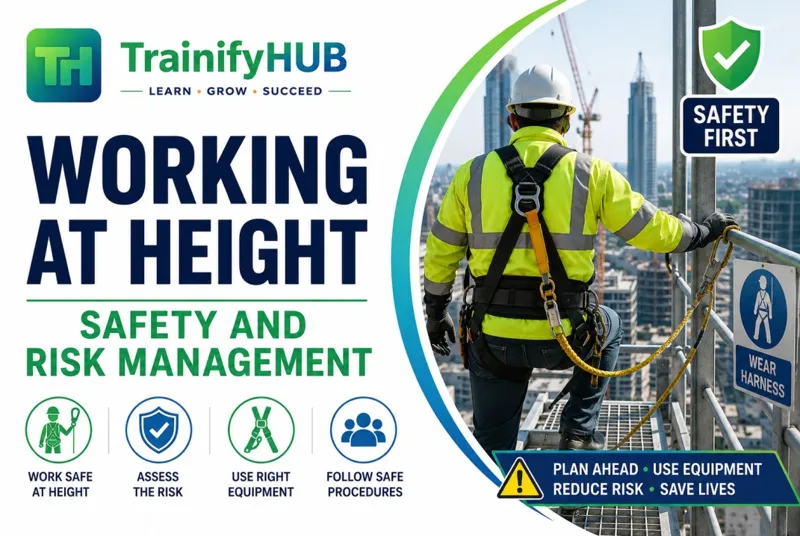
This course provides essential knowledge on safe working practices when performing tasks at height. Learners will understand hazard identification, risk assessment procedures, safe use of ladders and access equipment, fall protection systems, dropped object prevention, and incident response protocols to ensure safe and compliant work environments.
11
4h
13+
beginner
Course Price
GBP 25.00
One-time payment • Lifetime access
This course includes:
CATEGORY
Health & SafetyLAST UPDATED
Jul 2026
Course Price
GBP 25.00
One-time payment • Lifetime access
This course includes:
CATEGORY
Health & SafetyLAST UPDATED
Jul 2026
About this course
Working at height remains one of the leading causes of serious workplace injuries and fatalities across construction, maintenance, and industrial environments. This course provides a structured introduction to the safety principles, risk management procedures, and operational controls required to perform work at height safely.
Learners will explore how hazards arise in elevated work environments and how effective planning, correct equipment selection, and safe site practices help reduce these risks. The training covers the hierarchy of fall protection, ladder safety, mobile access tower use, scaffold awareness, and the role of safe site planning and supervision.
The course also addresses dropped object prevention, safe lifting practices, emergency response procedures, and incident reporting protocols that help organisations maintain strong safety cultures and regulatory compliance.
By the end of the training, learners will understand how to recognise hazards, implement control measures, follow safe working procedures, and contribute to safer working environments when carrying out tasks at height.
Learning Outcomes
Module 1: UK Work at Height Regulations and Safety Responsibilities
By the end of this module, learners will learn:
• The legal framework governing work at height safety
• Employer and employee responsibilities for safe operations
• The hierarchy of control used to manage fall risks
• Why planning and competence are critical for safe work
• How safety regulations protect workers and organisations
Module 2: Hazard Identification and Risk Assessment for Work at Height
By the end of this module, learners will learn:
• How to identify structural and environmental hazards
• The five-step risk assessment process
• How RAMS translate safety planning into work instructions
• The role of inspection and documentation in risk management
• How dynamic risk assessment supports safe decision making
Module 3: Work at Height Planning and Site Safety Control
By the end of this module, learners will learn:
• How to plan safe work at height operations
• The importance of worker competence and method selection
• How exclusion zones and access control protect workers
• Safe housekeeping practices that prevent accidents
• The role of supervision during work activities
Module 4: Ladder Safety, Selection and Safe Use Procedures
By the end of this module, learners will learn:
• How to select the correct ladder for tasks
• Proper ladder setup including the 4:1 stability rule
• Safe climbing practices and three points of contact
• Common ladder hazards and misuse risks
• Environmental factors that affect ladder safety
Module 5: Mobile Access Tower Safety and Operational Checks
By the end of this module, learners will learn:
• Pre-use inspection procedures for access towers
• Safe access using internal ladders and platforms
• Stability components such as outriggers and locking castors
• Safe movement and loading practices
• Ground and environmental safety checks
Module 6: MEWP and Scaffold Safety Essentials
By the end of this module, learners will learn:
• Common hazards associated with MEWPs and scaffolding
• How to identify structural defects in access equipment
• Safe access verification and scaffold integrity checks
• Harness requirements and fall protection systems
• Competency requirements for modifying structures
Module 7: Fall Protection Systems and Harness Safety
By the end of this module, learners will learn:
• The hierarchy of fall protection systems
• Differences between prevention, restraint and arrest systems
• Correct harness, lanyard and anchor usage
• Calculating safe fall distances and clearance
• Equipment inspection procedures
Module 8: Dropped Object Prevention and Vertical Risk Control
By the end of this module, learners will learn:
• How dropped object hazards occur on site
• Safety barriers such as toe boards and debris netting
• Safe lifting and loading limits for platforms
• Use of tool lanyards and exclusion zones
• Communication practices that protect workers below
Module 9: Site Safety Coordination and Operational Risk Control
By the end of this module, learners will learn:
• How to manage vertical work zones safely
• Load control procedures during lifting operations
• Safe pedestrian and worker access routes
• Communication protocols between site teams
• How coordinated site safety prevents incidents
Module 10: Incident Response, Investigation and Safety Improvement
By the end of this module, learners will learn:
• Immediate emergency response procedures
• How to secure incident scenes safely
• Incident and near-miss reporting procedures
• Root cause analysis and corrective actions
• How safety reporting helps prevent future accidents
Accreditation & Recognition
This course is officially recognised and certified
CPD
Points Awarded
All accreditations are verified and recognised by relevant industry bodies. Upon successful completion, your certificate will display the appropriate accreditation marks.
Frequently Asked Questions
5 questions answered
This course is suitable for workers, supervisors, and anyone involved in tasks performed at height in construction, maintenance, engineering, or facilities management.
No prior experience is required. The course is designed for beginners and individuals seeking basic work-at-height safety knowledge.
The course covers hazard identification, risk assessment, ladder safety, fall protection systems, mobile access equipment, dropped object prevention, and emergency response procedures.
The estimated duration is approximately 3 hours, depending on the learner’s pace.
Yes. Learners who successfully complete the course and pass the final assessment will receive a certificate confirming their understanding of working at height safety practices.
What You'll Learn
• The legal and safety principles governing work at height
• How to identify hazards and perform structured risk assessments
• Safe use of ladders, scaffolds, MEWPs and mobile access towers
• The hierarchy of fall protection and correct PPE use
• How to prevent dropped objects and manage vertical risks
• Emergency response procedures and incident reporting practices
• How workplace safety culture reduces accidents and injuries
Why This Course
• Work at height remains a major cause of workplace accidents
• Understanding hazards helps prevent falls and serious injuries
• Employers require workers to follow safe procedures and risk controls
• Proper training improves awareness and reduces operational risks
• Safe practices protect workers, colleagues, and the public
• Knowledge of emergency response procedures improves site safety
Certificate of Completion
Upon successful completion of this course and passing the final assessment, learners will receive a:
Certificate in Working at Height Safety and Risk Management
This certification confirms that the learner has demonstrated knowledge of:
• Work at height safety principles and risk management procedures
• Hazard identification and structured risk assessment methods
• Safe use of ladders and access equipment
• Fall protection systems including prevention, restraint and arrest
• Dropped object prevention and site safety controls
• Incident response, reporting procedures and safety improvement practices
The certificate supports workplace compliance, safety training requirements, and evidence of competence for individuals working in environments where tasks are performed at height.
Course Highlights
13+
Students Enrolled
New
Be the first!
4h
Total Duration
Student Reviews
Based on 0 reviews
🔒 Log In to Review
You must be logged in to submit a review. Please log in or create an account.