
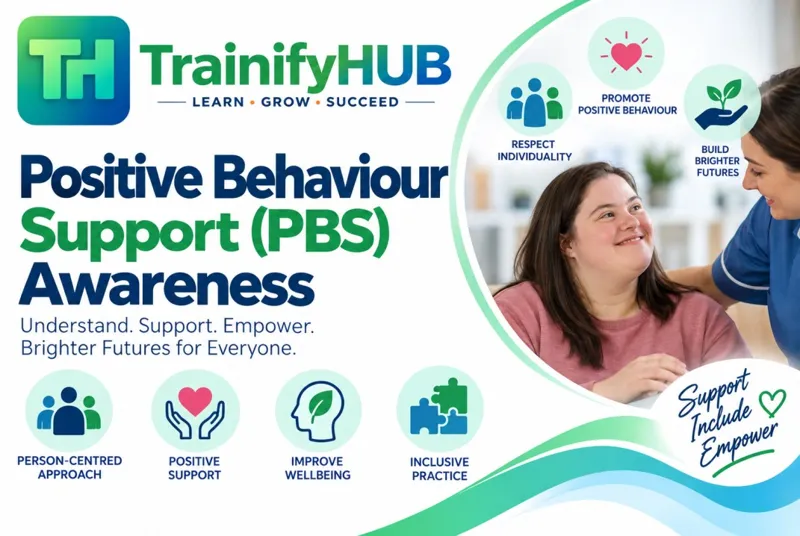
Positive Behaviour Support (PBS) Awareness
Learn how Positive Behaviour Support (PBS) promotes dignity, independence and quality of life by understanding behaviour, identifying unmet needs and using person-centred, least restrictive support strategies.
No ratings yet
2.00 CPD Points
MODULES
9
DURATION
2h
STUDENTS
0+
LEVEL
beginner
Course Price
GBP 15.00
One-time payment - Lifetime access
This course includes:
9 comprehensive modules
2h of video content
PDF, PPT & Infographics included
Final assessment included
Lifetime access on mobile & desktop
Certificate of completion
2.00 CPD Points
CATEGORY
Health & Social CareLAST UPDATED
Sep 2026
Course Price
GBP 15.00
One-time payment - Lifetime access
This course includes:
9 comprehensive modules
2h of video content
PDF, PPT & Infographics included
Final assessment included
Lifetime access on mobile & desktop
Certificate of completion
2.00 CPD Points
CATEGORY
Health & Social CareLAST UPDATED
Sep 2026
About this course
Positive Behaviour Support (PBS) Awareness is designed to help health and social care professionals understand behaviour as a form of communication rather than simply something that needs to be controlled.
The course introduces the principles of person-centred support, functional behaviour assessment, the ABC model, proactive strategies, positive risk-taking and least restrictive practice. Learners will explore how physical health, communication difficulties, sensory needs, environmental factors and unmet needs can influence behaviour.
The training also explains how effective PBS plans can support greater independence, meaningful choice, community participation and quality of life. It highlights the importance of working collaboratively with individuals, families, support workers and multidisciplinary professionals.
The course provides awareness-level guidance relevant to care and support environments in the UK, including the principles underpinning the Mental Capacity Act 2005, Human Rights Act 1998 and Care Act 2014.
Learning Outcomes
By the end of the course, learners should be able to:
Define Positive Behaviour Support and explain its purpose.
Describe the relationship between behaviour, communication and unmet needs.
Recognise common functions and triggers of behaviour.
Explain the Antecedent–Behaviour–Consequence (ABC) model.
Distinguish objective behavioural observations from subjective descriptions.
Identify potential physical, sensory, environmental and emotional influences on behaviour.
Explain the importance of proactive and preventative support.
Apply person-centred principles when considering behavioural support.
Explain the importance of consistency across care teams.
Recognise the role of families and multidisciplinary professionals in PBS.
Explain the concept of least restrictive practice.
Promote independence, choice and positive risk-taking.
Recognise how PBS can support improved quality of life.
Use reflective practice to consider how support approaches can be improved.
Accreditation & Recognition
This course is officially recognised and certified
2.00
CPD
Points Awarded
All accreditations are verified and recognised by relevant industry bodies. Upon successful completion, your certificate will display the appropriate accreditation marks.
Frequently Asked Questions
5 questions answered
Positive Behaviour Support is a person-centred approach that seeks to understand why behaviour occurs and develop supportive strategies that improve quality of life.
The course is suitable for health and social care workers, support workers, carers, supervisors, managers and others involved in supporting people with behavioural needs.
Yes. The course is designed as an awareness-level programme and introduces key PBS concepts in a clear and accessible way.
You will learn about behavioural functions, triggers, the ABC model, proactive support, person-centred care, restrictive practices, positive risk-taking and quality of life.
No. PBS focuses on understanding the reasons behind behaviour and addressing underlying needs while promoting dignity, choice, independence and wellbeing.
What You'll Learn
By completing this course, learners will understand:
The meaning, principles and purpose of Positive Behaviour Support (PBS).
Why behaviour should be understood rather than simply controlled.
How behaviour can communicate unmet needs, distress or preferences.
The main functions of behaviour and common behavioural triggers.
How the ABC model can be used to understand behavioural patterns.
The importance of objective and evidence-based behavioural recording.
How physical health, sensory needs and environmental factors can affect behaviour.
How to develop proactive, person-centred support strategies.
The importance of communication, consistency and multidisciplinary teamwork.
How to promote independence, choice and positive risk-taking.
The principles of least restrictive practice.
How PBS can contribute to improved quality of life and meaningful participation.
How to reflect on practice and use learning to improve future support.
Why This Course
Positive Behaviour Support helps care professionals move beyond simply responding to challenging behaviour and focus on why behaviour happens and what the person may be communicating.
Understanding PBS can help organisations create safer, more respectful and person-centred environments. It can also support more consistent approaches to behaviour, reduce avoidable distress and encourage independence.
This awareness course is particularly useful for professionals who support people with learning disabilities, autism, dementia, mental health needs or communication difficulties.
It can help learners develop a more compassionate and evidence-informed approach while recognising individual rights, dignity, preferences and quality of life.
Certificate of Completion
Certificate of Completion
Learners who successfully complete the course and meet the assessment requirements can receive a certificate confirming completion of Positive Behaviour Support (PBS) Awareness training.
The certificate demonstrates awareness of key PBS principles, person-centred support, behavioural understanding, proactive strategies, restrictive practice and positive risk-taking.
Course Highlights
0+
Students Enrolled
New
Be the first!
2h
Total Duration
Student Reviews
0.0
0 stars
Based on 0 reviews
5
0
4
0
3
0
2
0
1
0
🔒 Log In to Review
You must be logged in to submit a review. Please log in or create an account.