
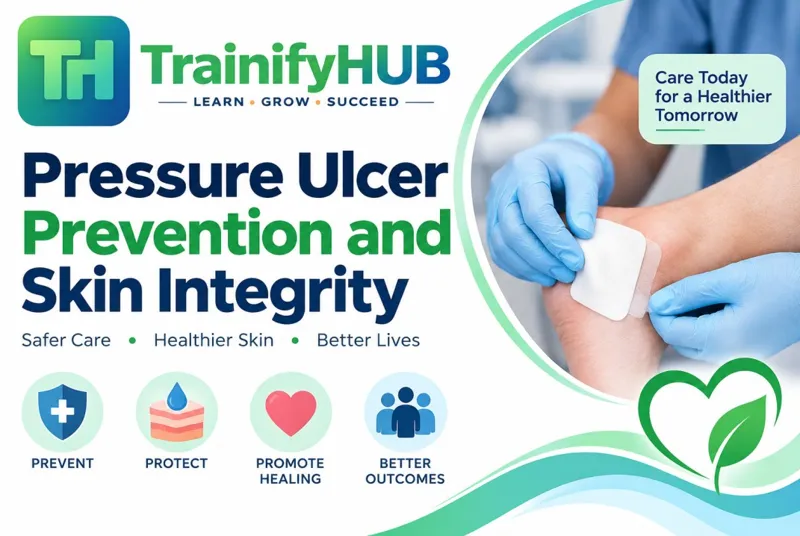
Pressure Ulcer Prevention and Skin Integrity
Develop essential skills in pressure ulcer prevention, skin assessment, repositioning, nutrition, hydration, documentation and person-centred care to support safer healthcare and social care practice.
No ratings yet
3.00 CPD Points
MODULES
11
DURATION
3h
STUDENTS
0+
LEVEL
beginner
Course Price
GBP 20.00
One-time payment - Lifetime access
This course includes:
11 comprehensive modules
3h of video content
PDF, PPT & Infographics included
Final assessment included
Lifetime access on mobile & desktop
Certificate of completion
3.00 CPD Points
CATEGORY
Health & SafetyLAST UPDATED
Sep 2026
Course Price
GBP 20.00
One-time payment - Lifetime access
This course includes:
11 comprehensive modules
3h of video content
PDF, PPT & Infographics included
Final assessment included
Lifetime access on mobile & desktop
Certificate of completion
3.00 CPD Points
CATEGORY
Health & SafetyLAST UPDATED
Sep 2026
About this course
Pressure ulcers can develop when prolonged pressure, shear, friction or other risk factors compromise the skin and underlying tissue. Early recognition and consistent preventive care are essential for protecting skin integrity and reducing avoidable harm.
This Pressure Ulcer Prevention and Skin Integrity course provides practical knowledge for healthcare and social care staff who support people with reduced mobility, frailty, illness or other factors that may increase pressure ulcer risk.
The course explores pressure damage, risk factors, skin inspection, risk assessment, repositioning, pressure-relieving equipment, nutrition and hydration, skin protection, early recognition, escalation, documentation and effective communication.
Learners will also develop an understanding of person-centred care, professional responsibilities and the importance of maintaining accurate records and communicating changes promptly.
The course is designed to support safe practice in settings such as care homes, hospitals, domiciliary care and other health and social care environments. It should complement, rather than replace, local policies, clinical procedures, professional guidance and individual care plans.
Learning Outcomes
By the end of this course, learners should be able to:
Explain what pressure ulcers are and how pressure damage develops.
Identify common factors that increase pressure ulcer risk.
Recognise early signs of skin and tissue damage.
Describe appropriate approaches to pressure ulcer risk assessment.
Explain why regular repositioning and movement are important.
Identify the purpose of pressure-relieving equipment and positioning aids.
Explain how friction, shear, moisture and medical devices can affect skin integrity.
Describe how nutrition and hydration contribute to healthy skin and tissue repair.
Recognise changes that may require prompt reporting or escalation.
Apply principles of accurate documentation and effective communication.
Demonstrate an understanding of person-centred pressure ulcer prevention.
Recognise the importance of professional, legal and ethical responsibilities in safe care.
Accreditation & Recognition
This course is officially recognised and certified
3.00
CPD
Points Awarded
All accreditations are verified and recognised by relevant industry bodies. Upon successful completion, your certificate will display the appropriate accreditation marks.
Frequently Asked Questions
5 questions answered
A pressure ulcer is damage to the skin and underlying tissue caused by sustained pressure, often over a bony area or around a medical device.
The course is suitable for healthcare and social care workers, including care assistants, support workers and other staff involved in supporting people at risk of pressure damage.
You will learn about risk factors, skin inspection, risk assessment, repositioning, pressure-relieving equipment, nutrition, hydration, documentation, communication and escalation.
Regular skin inspection can help identify early changes such as persistent discolouration, swelling, temperature changes, pain or other signs of pressure damage so appropriate action can be taken promptly.
Many pressure ulcers can be prevented or their risk reduced through appropriate assessment, regular movement, skin care, pressure redistribution, nutrition, hydration and person-centred preventive care.
What You'll Learn
By completing this course, learners will develop knowledge of:
The causes and mechanisms of pressure damage.
Common pressure ulcer risk factors and vulnerable individuals.
The importance of maintaining healthy skin and skin integrity.
Early warning signs of pressure damage across different skin tones.
Pressure ulcer categories and increasing levels of tissue damage.
Pressure ulcer risk assessment and appropriate reassessment.
The role of clinical judgement alongside recognised assessment tools.
Safe repositioning and movement strategies.
Pressure-relieving surfaces, mattresses, cushions and positioning aids.
The effects of friction, shear, moisture and medical devices.
The relationship between nutrition, hydration and skin health.
Appropriate approaches to preventing moisture-associated skin damage.
Recognition of deterioration, infection and other concerns requiring escalation.
Accurate, objective and timely documentation.
Effective communication and structured handovers.
Person-centred approaches to pressure ulcer prevention and care.
Professional, legal and ethical responsibilities in maintaining skin integrity.
Continuous improvement and collaborative approaches to pressure ulcer prevention.
Why This Course
Pressure ulcers can cause significant pain, infection, reduced quality of life and prolonged recovery. Many risks can be reduced through early recognition, appropriate repositioning, skin inspection, nutrition, hydration and consistent preventive care.
This course helps healthcare and social care workers recognise risks earlier, understand practical prevention strategies and respond appropriately when skin changes occur. It also reinforces the importance of accurate documentation, communication and person-centred care.
Whether you work in a care home, hospital, community setting or domiciliary care, understanding pressure ulcer prevention can help you contribute to safer care and better outcomes.
The course is particularly useful for staff who regularly support people with limited mobility, prolonged bed or chair use, frailty, nutritional concerns, continence needs or other factors associated with pressure damage.
Certificate of Completion
Upon successful completion of the course and required assessment, learners can receive a TrainifyHUB certificate confirming completion of the Pressure Ulcer Prevention and Skin Integrity training.
The certificate records the learner's course completion and can support professional learning and continuing development. Learners should retain the certificate according to their employer's training and professional development requirements.
This course is intended as educational training and does not replace employer-specific procedures, clinical supervision, competency assessments or professional registration requirements.
Course Highlights
0+
Students Enrolled
New
Be the first!
3h
Total Duration
Student Reviews
0.0
0 stars
Based on 0 reviews
5
0
4
0
3
0
2
0
1
0
🔒 Log In to Review
You must be logged in to submit a review. Please log in or create an account.