 Often bought together
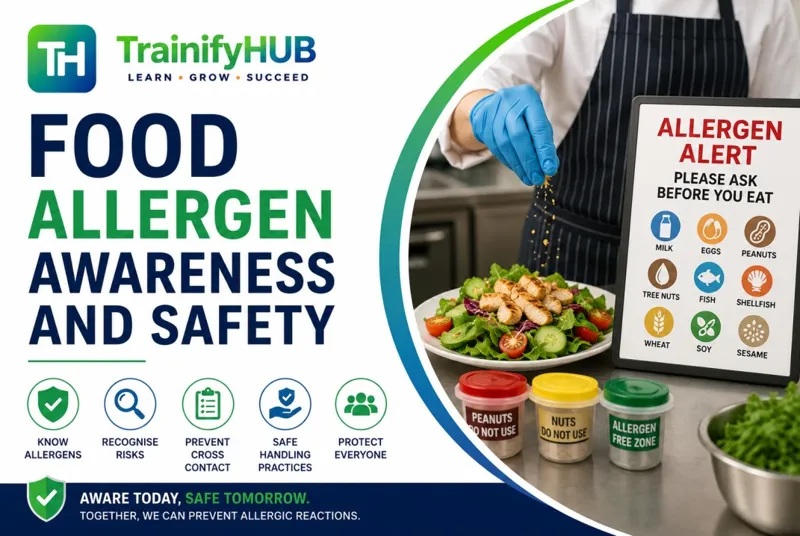
Food Allergen Awareness and Safety
Understand food allergen risks, PPDS labelling, cross-contact controls and clear customer communication. Online awareness learning for people who prepare, handle or serve food.
4.6 (20 reviews)
2.00 CPD Points
MODULES
6
ESTIMATED DURATION
2h
STUDENTS
104+
LEVEL
intermediate
Course Price
GBP 25.00
One-time payment - 9 months' access
Buying for your team?
Up to 30% off per seat: 10+ seats 10%, 25+ seats 20%, 50+ seats 30%.
This course includes:
6 comprehensive modules
5 video lessons
5 downloadable resources (PPT)
Final assessment included
9 months’ access on mobile & desktop
Certificate of completion
2.00 CPD Points
CATEGORY
Health & SafetyLAST UPDATED
Nov 2026
About this course
An allergen question needs an accurate answer, even during a busy service. Food Allergen Awareness and Safety connects ingredient knowledge, preparation controls and customer communication so staff can recognise when to verify information rather than guess.
Five teaching themes cover food allergy risks, recognition of serious reactions, PPDS labelling, allergen cross-contact controls and clear communication. The learning is intended to support the food business’s own procedures, records, staff instruction and emergency arrangements.
🥣 Programme highlights
✓ The 14 allergens that must be declared under food law.
✓ Allergy, intolerance and hidden ingredient risks.
✓ PPDS labelling and accurate ingredient information.
✓ Storage, segregation, cleaning and cross-contact controls.
✓ Customer questions, verification and clear records.
👥 Who this course is for
Food handlers, catering teams, serving staff, supervisors and others involved in preparing, handling or communicating information about food. Apply it to the actual food business and the responsibilities of the role.
💻 What you need
Use a suitable internet-connected device and sufficient English for the teaching and assessment. Have access to current ingredient information, allergen records and the business’s procedures when applying the learning.
⏱ Learning time and completion
Allow approximately two hours overall, including teaching, self-study and the final assessment. Learning is self-paced and individual completion times vary.
✓ Complete the required teaching and supporting learning.
✓ Review relevant self-study and food-business procedures.
✓ Complete the separate final assessment.
✓ Use verified ingredient information and follow local controls.
Learning Outcomes
This online assessment checks food-allergen knowledge. It does not replace business-specific procedures, practical first-aid training or emergency medical assistance.
📘 Module 1 – Food Allergen Awareness and Safety
Distinguish food allergy and intolerance and recognise why accurate ingredient information matters. Hidden ingredients and assumptions can make an everyday preparation or serving decision unsafe.
By the end of this module, learners will be able to explain:
✓ Identify the 14 major food allergens
✓ Understand allergy and intolerance differences
✓ Recognise hidden allergen risks
✓ Understand impact of allergen exposure
📘 Module 2 – Anaphylaxis Awareness and Emergency Response
Recognise signs of a possible allergic reaction and the need to follow the emergency arrangements promptly. Awareness learning does not establish practical clinical competence.
By the end of this module, learners will be able to explain:
✓ Identify mild and severe allergic reactions
✓ Recognise symptoms of anaphylaxis
✓ Understand emergency response procedures
✓ Take immediate action in critical situations
📘 Module 3 – Natashas Law and Allergen Labelling
Consider food packaged before a customer orders or selects it and how the relevant PPDS labelling requirements apply. Connect the full ingredients list with clear allergen emphasis.
By the end of this module, learners will be able to explain:
✓ Understand Natasha Law requirements
✓ Identify PPDS food labelling rules
✓ Ensure accurate ingredient disclosure
✓ Recognise risks of non compliance
📘 Module 4 – Allergen Control and Cross Contamination
Follow ingredients through storage, preparation and cleaning to identify opportunities for allergen cross-contact. Link segregation and cleaning with the business’s actual controls.
By the end of this module, learners will be able to explain:
✓ Identify cross contamination risks
✓ Apply safe storage and segregation methods
✓ Use cleaning protocols effectively
✓ Prevent allergen mixing in food preparation
📘 Module 5 – Allergen Safety and Communication
Connect kitchen records with the person answering a customer’s question. Clear communication, verification and updated information are safer than guessing or offering an unsupported reassurance.
By the end of this module, learners will be able to explain:
✓ Communicate allergen information clearly
✓ Ask the right questions to customers
✓ Avoid assumptions and verify details
✓ Maintain allergen records and charts
✓ Promote a safe food culture
📝 Final knowledge assessment
The final knowledge assessment contains 20 single-answer multiple-choice questions, with four options and one correct answer each. The pass mark is 80% (16 out of 20), with up to ten attempts, 30 minutes per attempt and randomised questions.
Accreditation & Recognition
This course is officially recognised and certified
2.00
CPD
Points Awarded
All accreditations are verified and recognised by relevant industry bodies. Upon successful completion, your certificate will display the appropriate accreditation marks.
Frequently Asked Questions
14 questions answered
Food handlers, kitchen teams, serving staff, supervisors and others who prepare food or communicate allergen information. Apply the learning to the responsibilities and procedures of the actual business.
Yes. The teaching introduces the 14 allergens that must be declared under food law, alongside the importance of checking ingredients and accurate records.
No. The course distinguishes them and explains why staff should take a customer’s information seriously rather than make assumptions about their needs.
Prepacked for direct sale food is packaged before the customer orders or selects it and meets the relevant sale and packaging conditions. Check the official guidance for the particular product and business arrangement.
It concerns allergen labelling for PPDS food, including a full ingredients list with the required allergenic ingredients emphasised. It should not be treated as the only allergen-information rule applying to every type of food.
No. Use current verified ingredient information and the business’s checking procedure. If uncertain, seek appropriate assistance rather than reassure a customer without evidence.
It is unintended transfer of an allergen into another food. The teaching connects this risk with preparation, storage, segregation and cleaning controls.
They can change ingredient information and make an old record or a remembered answer unreliable. Follow the process for checking changes and keeping information current.
Yes. It introduces recognition and emergency response awareness. Follow the emergency procedures and seek urgent help where required; online completion does not replace practical first-aid training.
No. The certificate records the learner’s awareness training, not the absence of allergens or the adequacy of every business control.
Allow approximately two hours overall, including teaching, self-study and the final assessment. Study is self-paced and completion time varies.
Yes. The course is available online across the UK with a suitable device and reliable internet connection. Use the legislation and official guidance relevant to your food business and location.
Current recipes, ingredient records and allergen information help staff verify answers and communicate changes. They must reflect what is actually being prepared and served.
Successful completion of the required learning and final assessment leads to a TrainifyHUB certificate of completion. Continue to follow workplace instruction and review information when ingredients or procedures change.
What You'll Learn
✓ Identify major food allergens and their risks
✓ Understand allergy vs intolerance
✓ Prevent cross contamination effectively
✓ Follow proper labelling and legal requirements
✓ Communicate allergen information clearly
✓ Respond to allergic emergencies confidently
Why Take This Course
A recipe change, substituted ingredient or unclear handover can make yesterday’s answer unreliable. This course helps staff connect accurate records with practical controls and clear communication, reducing the temptation to rely on memory alone.
🌐 Available online across the UK
Study online from England, Scotland, Wales or Northern Ireland using a suitable device and reliable internet connection. Follow the applicable food-law requirements and your business procedures; use Food Standards Scotland guidance where relevant to work in Scotland.
Certificate of Completion
🏅 Completion and training records
A TrainifyHUB certificate of completion is available after successful completion of the learning and final assessment. The course page records 2 CPD points.
The certificate records online awareness learning. It does not certify a food business as allergen-free, replace role-specific instruction or demonstrate practical first-aid competence.
The final knowledge assessment contains 20 single-answer multiple-choice questions, with four options and one correct answer each. The pass mark is 80% (16 out of 20), with up to ten attempts, 30 minutes per attempt and randomised questions.
Course Highlights
104+
Students Enrolled
4.6
20 Reviews
2h
Estimated Duration

Why book with TrainifyHUB
- CPD accredited training content
- Delivered UK-wide at your workplace
- Certificate of completion included
- Secure, encrypted online payments
Accredited & Trusted
 CPD Accredited Provider
 Secure Payments
Need help choosing a course?
+44 7405 005823 support@trainifyhub.co.uk
Our team can advise on the right training package for your organisation.
Keep learning
Related courses
Picked from what learners take alongside this course.
Often bought together Often bought together
 Often bought together
Health & Social Care
Level 2 Food Safety and Hygiene for Health and Social Care
4.7(20)
6 modules2h67
GBP30.00
 Often bought together
 Often bought together
Construction
Hand and Power Tool Safety Compliance and Operational Risk Control
4.8(20)
7 modules3h97
GBP25.00
 Often bought together
 Often bought together
 Often bought together
Student Reviews
4.6
5 stars
Based on 20 reviews
5
0
4
0
3
0
2
0
1
0
🔒 Log In to Review
You must be logged in to submit a review. Please log in or create an account.