 More in Health & Social Care
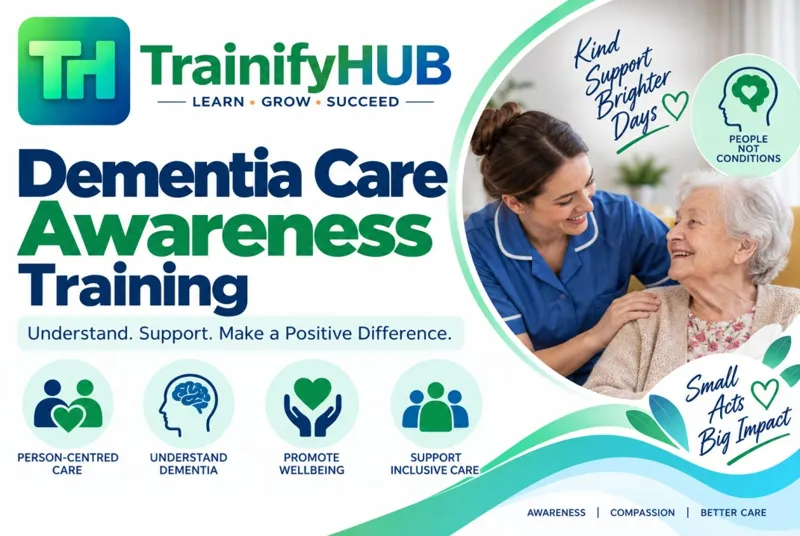
Dementia Care Awareness Training – CPD Certified (Updated 2026)
Build a person-centred understanding of dementia, communication and wellbeing. Explore respectful responses to distress, everyday independence, safeguarding and working with families and professionals.
4.6 (20 reviews)
3.00 CPD Points
MODULES
11
ESTIMATED DURATION
3h
STUDENTS
83+
LEVEL
beginner
Course Price
GBP 20.00
One-time payment - 9 months' access
Buying for your team?
Up to 30% off per seat: 10+ seats 10%, 25+ seats 20%, 50+ seats 30%.
This course includes:
11 comprehensive modules
10 video lessons
10 downloadable resources (PPT)
Final assessment included
9 months’ access on mobile & desktop
Certificate of completion
3.00 CPD Points
CATEGORY
Health & Social CareLAST UPDATED
Nov 2026
About this course
🧠 Know the person beyond the diagnosis
Dementia can affect memory, communication and everyday experiences, but people do not all experience it in the same way. This course introduces common types and symptoms while keeping the person’s identity, routines and preferences central.
Learners explore communication, wellbeing, independence, distressed behaviour, safeguarding and collaboration. The aim is to support thoughtful day-to-day care, not to diagnose dementia or assume that every new change is part of its progression.
Programme highlights
✓ An introduction to dementia types, symptoms and individual experiences.
✓ Communication that supports understanding, dignity and participation.
✓ Consider unmet needs when a person is distressed.
✓ Connect everyday support with safeguarding and professional advice.
What you need
Use a suitable internet-connected device. Follow the person’s current plan and your employer’s procedures, and only carry out tasks for which you have the necessary training, competence and authorisation.
Learning time
Allow approximately 3 hours for the learning, self-study and final assessment. This is an estimate; work through the online course at your own pace.
Learning Outcomes
Module 1: Understanding Dementia: Beyond Memory Loss
Learn what dementia is, how it differs from normal ageing, and recognise the early signs, common types, and importance of early diagnosis.
By the end of this module, learners will be able to:
✓ Explain what dementia is.
✓ Identify common types of dementia.
Module 2: How Dementia Affects the Brain and Memory
Explore how dementia changes the brain, affects different types of memory, and influences thinking, behaviour, and everyday life.
By the end of this module, learners will be able to:
✓ Recognise symptoms and progression.
✓ Describe how changes in memory and thinking may affect everyday tasks and experiences.
Module 3: Person-Centred Dementia Care: Putting the Individual First
Discover how to provide compassionate, person-centred care that respects individuality, promotes dignity, and supports independence.
By the end of this module, learners will be able to:
✓ Deliver person-centred dementia care.
✓ Use individual history, preferences and strengths to guide respectful support.
Module 4: Effective Communication in Dementia Care
Develop practical communication techniques to build trust, reduce anxiety, and support people living with dementia at every stage.
By the end of this module, learners will be able to:
✓ Communicate effectively at different stages of dementia.
✓ Adapt the pace, clarity and method of communication to the person’s needs.
Module 5: Understanding and Responding to Behaviour in Dementia Care
Learn why behaviours are often a form of communication and how to respond using person-centred strategies that reduce distress and improve wellbeing.
By the end of this module, learners will be able to:
✓ Respond positively to distressed behaviours.
✓ Consider communication, unmet needs and the environment when responding to distress.
Module 6: Supporting Physical Health and Wellbeing in Dementia Care
Understand how nutrition, hydration, pain management, mobility, and physical health influence dementia care and overall quality of life.
By the end of this module, learners will be able to:
✓ Recognise how nutrition, hydration, mobility and comfort contribute to wellbeing.
✓ Report relevant new physical changes and seek appropriate professional advice.
Module 7: Safeguarding, Mental Capacity and Legal Responsibilities in Dementia Care
Gain an understanding of safeguarding principles, mental capacity, legal responsibilities, and how to protect the rights and safety of people living with dementia.
By the end of this module, learners will be able to:
✓ Apply safeguarding procedures.
✓ Understand legal and ethical responsibilities.
Module 8: Promoting Independence and Enhancing Quality of Life
Discover practical ways to encourage independence, meaningful activities, assistive technology, and dementia-friendly environments that improve daily living.
By the end of this module, learners will be able to:
✓ Promote wellbeing and independence.
✓ Consider meaningful activities and environmental adjustments that support participation.
Module 9: Collaborative Working and Family Support in Dementia Care
Learn how multidisciplinary teams, family carers, and community services work together to deliver coordinated, person-centred dementia support.
By the end of this module, learners will be able to:
✓ Work collaboratively with families and healthcare professionals.
✓ Recognise the value of coordinated information sharing within appropriate consent and confidentiality arrangements.
Module 10: Professional Development and Excellence in Dementia Care
Explore reflective practice, quality improvement, assistive technology, and continuous professional development to deliver outstanding dementia care.
By the end of this module, learners will be able to:
✓ Use reflection and feedback to identify improvements in dementia support.
✓ Understand how supervision and ongoing learning help staff remain within current practice standards.
Accreditation & Recognition
This course is officially recognised and certified
3.00
CPD
Points Awarded
All accreditations are verified and recognised by relevant industry bodies. Upon successful completion, your certificate will display the appropriate accreditation marks.
Frequently Asked Questions
14 questions answered
Dementia is not an inevitable part of ageing. It describes symptoms caused by diseases affecting the brain.
No. Symptoms, strengths, preferences and support requirements differ and may change over time.
No. Diagnosis requires appropriate clinical assessment.
Allow time, use clear language, reduce avoidable distractions and respond to the person’s preferred way of communicating.
Respond calmly and consider communication, discomfort, unmet needs and the environment. Seek appropriate advice rather than applying a judgemental label.
No. A new or sudden change may need assessment. Report the change and follow the relevant escalation procedure.
Use the individual care plan to support choices and meaningful activity while considering relevant risks and adjustments.
They may know the person’s history, preferences and communication well. Involvement should respect the person’s rights, consent and appropriate information sharing.
The course is relevant to care and support staff learning about dementia or refreshing their understanding.
The estimated total learning time is 3 hours, including learning activities, self-study and the final assessment. Individual study time can vary.
Yes. The course is online. Apply the law, national guidance and workplace procedures relevant to your service and role.
No. A completion certificate records learning. Your employer or relevant professional must arrange the practical training, supervision and competency assessment required for the tasks you undertake.
No. Use the person’s current agreed plan and seek the relevant professional’s advice when needs change or instructions are unclear.
Work within your role, consult the current procedure or plan and seek appropriate support. Urgent concerns should follow the relevant emergency or escalation route.
What You'll Learn
✓ Explain dementia as a group of symptoms associated with different underlying diseases.
✓ Recognise that symptoms and support needs vary between individuals.
✓ Adapt communication to support understanding and choice.
✓ Consider the person’s needs and environment when responding to distress.
✓ Promote meaningful activity, independence and wellbeing.
✓ Recognise safeguarding responsibilities and seek appropriate help for concerns.
✓ Work respectfully with families and healthcare professionals.
Why Take This Course
🌿 Preserve identity in everyday support
A familiar routine, an unhurried explanation or a meaningful activity can matter as much as a task being completed. The course encourages learners to understand what helps the person feel secure and involved.
It supports awareness for care practice while maintaining the need for individual assessment, care planning and prompt advice about new concerns.
Available online across the UK
Access this self-paced course from a suitable internet-connected device anywhere in the UK, including England, Scotland, Wales and Northern Ireland. Apply the legislation, regulator guidance and workplace procedures relevant to your nation and service; online availability does not extend the scope of your professional role.
Certificate of Completion
A certificate of completion is available after the course and assessment requirements are met. It records learning in this subject and does not confer professional registration, a regulated qualification or practical authorisation for tasks outside your role.
Course Highlights
83+
Students Enrolled
4.6
20 Reviews
3h
Estimated Duration


Why book with TrainifyHUB
- CPD accredited training content
- Delivered UK-wide at your workplace
- Certificate of completion included
- Secure, encrypted online payments
Accredited & Trusted
 CPD Accredited Provider
 Secure Payments
Need help choosing a course?
+44 7405 005823 support@trainifyhub.co.uk
Our team can advise on the right training package for your organisation.
Keep learning
Related courses
Picked from what learners take alongside this course.
More in Health & Social Care More in Health & Social Care
Health & Social Care
Diabetes Awareness: Essential Knowledge for Care Professionals
4.8(20)
11 modules3h97
GBP20.00
 More in Health & Social Care
 More in Health & Social Care
Health & Social Care
Care Certificate Standard 16: Awareness of Learning Disability and Autism
4.7(20)
11 modules4h93
GBP20.00
 More in Health & Social Care
 More in Health & Social Care
 More in Health & Social Care
Health & Social Care
Catheter Care Update: Safe, Person-Centred Practice
4.8(20)
11 modules3h61
GBP20.00
 More in Health & Social Care
Student Reviews
4.6
5 stars
Based on 20 reviews
5
0
4
0
3
0
2
0
1
0
🔒 Log In to Review
You must be logged in to submit a review. Please log in or create an account.