 More in Health & Social Care
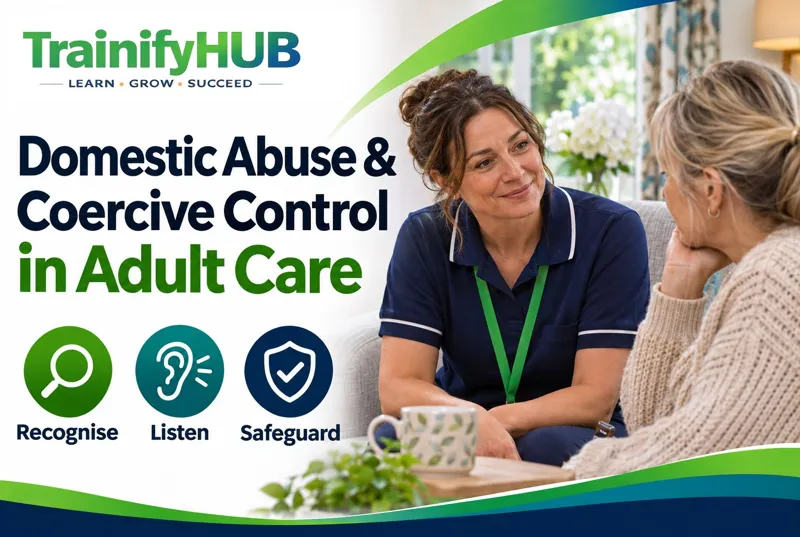
Domestic Abuse & Coercive Control in Adult Care
Develop adult-care awareness to recognise possible domestic abuse and respond safely within your role. Explore eight Modules with fictional examples, independent activities and a final knowledge assessment.
No ratings yet
3.00 CPD Points
MODULES
9
ESTIMATED DURATION
2h 35m
STUDENTS
1+
LEVEL
beginner
Course Price
£20.00
One-time payment - 9 months' access
Buying for your team?
Up to 30% off per seat: 10+ seats 10%, 25+ seats 20%, 50+ seats 30%.
This course includes:
9 comprehensive modules
8 video lessons
1 downloadable resource (PDF)
Final assessment included
9 months’ access on mobile & desktop
Certificate of completion
3.00 CPD Points
CATEGORY
Health & Social CareLAST UPDATED
Nov 2026
About this course
Explore possible patterns of domestic abuse and coercive control, safe listening, urgent help, supported choices, factual records and appropriate safeguarding communication. The course uses adult-care situations to practise respectful responses without investigating, making legal findings or promising outcomes.
Learn through adult-care examples in an England core context, using official source guidance. This self-paced, non-regulated awareness course supports person-centred thinking and communication within role; it does not award legal, clinical or practical competence.
Learning Outcomes
Module 1 - Understanding Domestic Abuse and the Adult Care Context
Domestic abuse can include physical or sexual abuse, threatening behaviour, controlling or coercive behaviour, economic abuse and psychological or emotional abuse. A visible injury is not required before a concern deserves attention. The Home Office statutory definition has relationship and age conditions: the people must be personally connected and each aged 16 or over. This adult-care course is not authority to determine whether a criminal offence has been proved.
Describe forms of domestic abuse beyond physical violence.
Explain how care dependency can affect access to help.
Distinguish a concern from a proven criminal offence.
Recognise that statutory relationship definitions need careful application.
Applied fictional scenario: Mina receives home care. Her nephew controls shopping money and tells staff not to ask about bank access. Mina has not described abuse, and the worker has not established the full circumstances. Separate observations, concerns and unknowns; identify an appropriate internal safeguarding route. Use only the supplied facts, identify unknowns and distinguish proposed actions from completed events. Explain your reasoning and check it against the learner workbook review guide; do not add a diagnosis, permission or outcome.
Module 2 - Recognising Patterns of Control and Barriers to Support
Controlling or coercive behaviour is understood through its pattern and context, rather than a checklist that proves an offence. The Home Office describes restrictions, threats, humiliation, isolation and economic control; abuse can continue after a relationship has ended. Care workers contribute factual concerns and changes over time. They do not decide criminal guilt or apply offence tests as a substitute for the police and authorised specialists.
Identify possible patterns of restriction, intimidation and economic control.
Recognise control involving care, equipment or communication.
Explain how stereotypes and barriers can obscure abuse.
Describe why one observation cannot establish a whole pattern.
Applied fictional scenario: Joel uses a communication board. His partner repeatedly takes it away and answers for him. The worker knows nothing about private conversations or earlier incidents. List factual concerns and accessible questions for authorised safe enquiry without filling in unknown history. Use only the supplied facts, identify unknowns and distinguish proposed actions from completed events. Explain your reasoning and check it against the learner workbook review guide; do not add a diagnosis, permission or outcome.
Module 3 - Safe Enquiry and Responding to a Disclosure
A disclosure belongs to the adult; it is not permission to investigate. Listen without blame, express that the concern matters and avoid pressing for a full account. A person may disclose only part of what is happening or decide not to continue. Respect communication needs and the pace of the conversation while taking immediate danger seriously.
Identify conditions for a private, accessible conversation.
Use listening responses that avoid blame or pressure.
Explain confidentiality limits without promising secrecy.
Recognise when continuing a conversation may increase risk.
Applied fictional scenario: While her partner is outside, Nadia tells a worker she can spend money only with permission. She asks staff not to leave phone messages. Her partner may return soon. Draft a supportive first response and a safe communication check without pressing for details. Use only the supplied facts, identify unknowns and distinguish proposed actions from completed events. Explain your reasoning and check it against the learner workbook review guide; do not add a diagnosis, permission or outcome.
Module 4 - Immediate Safety and Obtaining Urgent Help
Immediate danger requires emergency help. Threats, violence or a serious concern for immediate safety do not require a completed checklist or proof of an offence before calling 999. Use the service needed for the circumstances, give the actual known location and describe what you can hear or see. Follow the emergency operator’s instructions. Do not wait for a manager’s permission when emergency help is required.
Distinguish immediate danger from a concern needing prompt safeguarding advice.
Describe the 999 route and importance of operator instructions.
Explain why safe devices and contact choices matter.
Prioritise safety without waiting for completed records.
Applied fictional scenario: A home-care worker hears threats and breaking objects from the next room. The worker does not know whether anyone is injured and has not established a safe exit. Identify immediate help priorities and factual information for 999; do not invent a rescue plan. Use only the supplied facts, identify unknowns and distinguish proposed actions from completed events. Explain your reasoning and check it against the learner workbook review guide; do not add a diagnosis, permission or outcome.
Module 5 - Choice, Consent and Safeguarding Responsibilities
Support the adult to express their wishes and take part in decisions using accessible communication. Under the Mental Capacity Act guidance, presume capacity unless established otherwise, give practicable support and do not equate an unwise choice with lack of capacity. Capacity concerns relate to a particular decision at the relevant time. Coercion, consent and capacity require careful consideration; observing fear or disagreement does not automatically establish incapacity or give a care worker power to force a move.
Support the adult’s wishes and accessible decision-making.
Explain why coercion or an unwise choice does not automatically prove lack of capacity.
Recognise the three Care Act safeguarding conditions as local-authority duties.
Describe when to seek authorised safeguarding or capacity advice.
Applied fictional scenario: Ellen wants to stay at home but does not want her partner handling her bank card. A colleague says she must be moved because her decision is unwise. No capacity assessment or legal order is provided. Challenge unsupported assumptions, record Ellen’s wishes and identify who needs to be consulted. Use only the supplied facts, identify unknowns and distinguish proposed actions from completed events. Explain your reasoning and check it against the learner workbook review guide; do not add a diagnosis, permission or outcome.
Module 6 - Factual Records, Confidentiality and Safe Information Sharing
A useful safeguarding record allows the next authorised person to understand what is known and what remains uncertain. Distinguish what you directly observed, what the adult or another person said, your concern and information not yet checked. Quote only words actually supplied. Do not turn an inference into a fact, add a measurement, time, injury, confession or future plan that the brief does not give, or describe someone as guilty.
Record observations and the adult’s own words accurately.
Separate evidence, opinion and information not yet known.
Share relevant concerns through authorised safeguarding routes.
Explain why records and contact notes need safe access controls.
Applied fictional scenario: During a fictional care visit, a worker observes a partner answer a question addressed to the adult and sees the partner holding the adult’s bank card. The adult says, “Please do not send letters to my home.” No reason for holding the card, authority for the arrangement, visit time, injury or leaving plan is supplied. A draft note nevertheless says, “The partner is guilty and the adult will leave on Friday.” Rewrite a factual record with unknowns and safe-contact preferences; identify a necessary recipient. Use only the supplied facts, identify unknowns and distinguish proposed actions from completed events. Explain your reasoning and check it against the learner workbook review guide; do not add a diagnosis, permission or outcome.
Module 7 - Working with Specialist Services and Reviewing Concerns
Specialist domestic-abuse services, adult safeguarding services, police and health professionals have different roles. Specialist support may help with safe options and advocacy; local-authority adult safeguarding considers its statutory duties; police address criminal concerns and emergencies. A care worker contributes factual observations, the adult’s wishes and continuing changes, rather than assuming responsibility for investigation, legal advice or a specialist safety plan.
Identify specialist domestic-abuse and safeguarding service roles.
Describe safe signposting that respects communication needs.
Explain why children or other adults may need separate safeguarding attention.
Recognise the importance of following up unresolved concerns.
Applied fictional scenario: A manager has received a concern, but the worker does not know whether it has been read. The adult cannot privately use her usual phone and asks for accessible information. Plan appropriate follow-up and a safe referral conversation without inventing local contacts or outcomes. Use only the supplied facts, identify unknowns and distinguish proposed actions from completed events. Explain your reasoning and check it against the learner workbook review guide; do not add a diagnosis, permission or outcome.
Module 8 - Applying Safe and Person-Centred Responses
Apply the course as connected decisions, not an inflexible sequence. Notice the facts and any immediate danger; consider safe communication; listen to the adult; seek proportionate help; record and hand over what is known and still unresolved. An emergency can interrupt any part of that process. A worker does not have to finish all observations or notes before obtaining urgent help.
Apply recognition and safe-listening principles to a fictional visit.
Choose proportionate escalation from the facts given.
Explain how to respect wishes while addressing safety concerns.
Produce a factual handover with unresolved questions.
Applied fictional scenario: Sam receives care and uses a screen reader. His sister controls account passwords, reads his messages and says workers must not speak to him alone. Sam feels watched but does not want an unscheduled call. No immediate threat or injury is stated. Work through safe communication, observations, wishes, escalation and recording without inventing a violent ending. Use only the supplied facts, identify unknowns and distinguish proposed actions from completed events. Explain your reasoning and check it against the learner workbook review guide; do not add a diagnosis, permission or outcome.
Accreditation & Recognition
This course is officially recognised and certified
3.00
CPD
Points Awarded
All accreditations are verified and recognised by relevant industry bodies. Upon successful completion, your certificate will display the appropriate accreditation marks.
Frequently Asked Questions
16 questions answered
It covers possible patterns of physical and non-physical abuse, safe responses to concerns and appropriate reporting. The worker does not determine whether a criminal offence has been proved.
No. The statutory definition includes age and personally connected relationship conditions. A paid role alone neither establishes nor rules out a separate personal relationship; broader safeguarding concerns may still require attention.
Listen without blame or pressure. Check whether communication is safe and accessible, respect the person’s pace and avoid detailed enquiry when it could increase risk.
Do not promise absolute secrecy or a guaranteed outcome. Explain relevant confidentiality limits and follow safe, proportionate information-sharing and safeguarding arrangements.
Obtain appropriate emergency help without waiting for managerial permission, routine care or completed records. Protect your own safety and follow emergency instructions and trained procedures.
No. Support the adult’s own decision-making and communication. Capacity, consent and safeguarding questions require decision-specific consideration and authorised advice; this course gives no power to force a move.
No. Reporting a concern is not proof that statutory conditions are met, a referral has been accepted or an outcome is secured. Record actual actions and follow up unresolved concerns through the appropriate route.
Adult care workers, agency staff and support workers in care homes, nursing homes, home care and supported living. The main legal and provider context is England; online availability does not make England law uniform across the UK.
No formal qualification is required for this awareness learning. You need suitable access to the teaching and written activities and must follow your employer’s current arrangements in real work.
Eight teaching Modules are paired with complete fictional briefs, independent written activities and source-aligned review in a learner workbook, followed by a separate final knowledge assessment. No real care records, employer visit or practical test is required.
Approximately 2 hours 35 minutes. You can pause the teaching, complete the written activities and review your learning at your own pace.
There are 15 single-answer multiple-choice questions with four options each. Pass with at least 12 correct answers out of 15 (80%). The assessment allows 30 minutes per attempt and up to 10 attempts, with randomised questions; follow the actual on-screen instructions.
Yes. Complete your own answers after learning, read every option, use a quiet place and a working device and connection, and use only permitted resources. Another person must not answer for you.
Learner access is nine months from assignment. Company entitlements that have not been assigned do not expire.
A TrainifyHUB certificate of completion follows a passing knowledge assessment, with platform validity of one year from passing. This non-regulated awareness course awards no RQF level, accreditation, registration or clinical or practical competence.
Ask for accessible support or an alternative format if needed, and take time to pause and review. Actual captions, playback and available support arrangements must be checked when access is arranged.
What You'll Learn
Describe forms of domestic abuse beyond physical violence.
Identify possible patterns of restriction, intimidation and economic control.
Identify conditions for a private, accessible conversation.
Distinguish immediate danger from a concern needing prompt safeguarding advice.
Support the adult’s wishes and accessible decision-making.
Record observations and the adult’s own words accurately.
Identify specialist domestic-abuse and safeguarding service roles.
Apply recognition and safe-listening principles to a fictional visit.
Why Take This Course
Use realistic fictional decisions to practise clear observations, respectful communication and appropriate review or escalation. Complete the written activities to distinguish facts from assumptions and recognise the limits of your authority.
Follow current employer safeguarding and emergency arrangements. Do not confront an alleged perpetrator, force disclosure, promise secrecy, impose a move or decide criminal guilt.
🌍 Available Online Across the UK
This course is available online from England, Scotland, Wales and Northern Ireland using a suitable device and internet connection. Locations include:
✓ London ✓ Birmingham ✓ Leicester
✓ Coventry ✓ Nottingham ✓ Derby
✓ Manchester ✓ Liverpool ✓ Leeds
✓ Sheffield ✓ Bradford ✓ Newcastle
✓ Bristol ✓ Southampton ✓ Portsmouth
✓ Brighton ✓ Oxford ✓ Cambridge
✓ Norwich ✓ Glasgow ✓ Edinburgh
✓ Aberdeen ✓ Dundee ✓ Cardiff
✓ Swansea ✓ Newport ✓ Wrexham
✓ Belfast ✓ Derry/Londonderry
Online access does not extend the course’s stated legal or care-setting scope. Follow applicable local requirements, employer policies and role boundaries; practical training, assessment and authorisation remain separate.
Certificate of Completion
A TrainifyHUB certificate of completion follows a passing knowledge assessment: at least 12 correct answers out of 15 (80%). Certificate validity is one year from passing. This non-regulated awareness course awards no RQF level, accreditation, registration or clinical or practical competence.
Learner access is nine months from assignment. Unassigned company entitlements do not expire.
Course Highlights
1+
Students Enrolled
New
Be the first!
2h 35m
Estimated Duration


Why book with TrainifyHUB
- CPD accredited training content
- Delivered UK-wide at your workplace
- Certificate of completion included
- Secure, encrypted online payments
Accredited & Trusted
 CPD Accredited Provider
 Secure Payments
Need help choosing a course?
+44 7405 005823 support@trainifyhub.co.uk
Our team can advise on the right training package for your organisation.
Keep learning
Related courses
Picked from what learners take alongside this course.
More in Health & Social Care More in Health & Social Care
Health & Social Care
Advanced Adult Care Principles and Professional Practice
4.9(20)
13 modules4h66
£40.00
 More in Health & Social Care
Health & Social Care
Meaningful Activities & Activity Co-ordinator Awareness
New course
9 modules2h 26m1
£20.00
 More in Health & Social Care
 More in Health & Social Care
Health & Social Care
Diabetes Awareness: Essential Knowledge for Care Professionals
4.8(20)
11 modules3h97
£20.00
 More in Health & Social Care
 More in Health & Social Care
Health & Social Care
Care Certificate Standard 16: Awareness of Learning Disability and Autism
4.7(20)
11 modules4h93
£20.00
 More in Health & Social Care
Student Reviews
0.0
0 stars
Based on 0 reviews
5
0
4
0
3
0
2
0
1
0
🔒 Log In to Review
You must be logged in to submit a review. Please log in or create an account.