 More in Health & Social Care
Health & Social Care
Diabetes Awareness: Essential Knowledge for Care Professionals
4.8(20)
11 modules3h97
£20.00
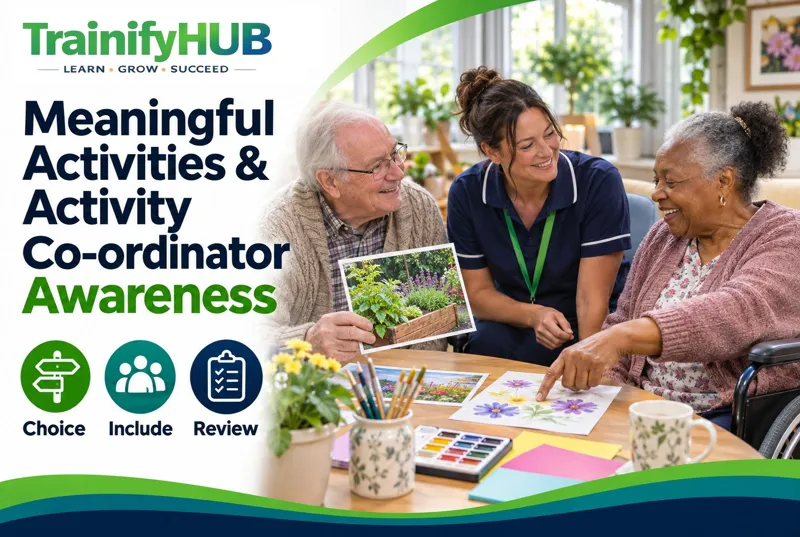
Support person-defined meaningful activity through accessible choices, respectful everyday engagement and accurate feedback. Explore eight Modules with fictional examples, written activities and a final knowledge assessment.
9
2h 26m
1+
beginner
Course Price
£20.00
One-time payment - 9 months' access
Buying for your team?
Up to 30% off per seat: 10+ seats 10%, 25+ seats 20%, 50+ seats 30%.
CATEGORY
Health & Social CareLAST UPDATED
Nov 2026
Course Price
£20.00
One-time payment - 9 months' access
Buying for your team?
Up to 30% off per seat: 10+ seats 10%, 25+ seats 20%, 50+ seats 30%.
CATEGORY
Health & Social CareLAST UPDATED
Nov 2026
Meaningful activity can include everyday contributions, quiet one-to-one contact, spontaneous interests and group opportunities. Explore how to listen to what matters to the person, adapt access and review their actual experience.
Learn through adult-care examples using official sources in an England core context. This self-paced non-regulated awareness course supports safe observation, communication and role-appropriate support; it does not confer clinical or hands-on competence.
Explain why meaning differs between people.
Distinguish everyday occupation from a fixed events timetable.
Recognise activity coordination as shared person-centred work.
State care-worker and course competence limits.
Fictional brief: Alex likes helping with familiar household tasks but dislikes large group games. No assessment or permission for new practical tasks is supplied. Propose and compare two activity offers with Alex’s stated interests; write why each may or may not be meaningful and identify missing safety information. In your response, distinguish known facts from proposed actions and identify missing information. Link both offers to Alex’s stated preferences; identify what is unknown about safety and support. Do not infer permission for a new practical task. Explain why the next step stays within role; do not add consent, a diagnosis, measurements, contacts, treatment or outcomes that are not supplied. Review your reasoning against the source-based teaching and current individual support arrangements.
Ask respectful questions about interests and routines.
Distinguish the person’s wishes from others’ assumptions.
Include supporters when the person wishes.
Record uncertain preferences as unknown.
Fictional brief: Bea used to enjoy gardening but now says she prefers listening to birds. A relative wants her to attend a gardening group. Draft six respectful questions and a preference summary; separate Bea’s actual words, the relative’s view and points needing confirmation. In your response, distinguish known facts from proposed actions and identify missing information. Distinguish Bea’s current words from the relative’s view. Ask about present interests and how Bea wishes the relative involved. Explain why the next step stays within role; do not add consent, a diagnosis, measurements, contacts, treatment or outcomes that are not supplied. Review your reasoning against the source-based teaching and current individual support arrangements.
Explain choice to join, observe or decline.
Adapt information to communication needs.
Recognise barriers linked to culture or disability.
Seek appropriate advice about unresolved consent concerns.
Fictional brief: Chris declines a noisy group and asks for a quiet conversation. A worker says everyone must attend. Rewrite the invitation into an accessible dialogue; propose two quieter options and explain why refusal is not proof of incapacity. In your response, distinguish known facts from proposed actions and identify missing information. Make access and choice real, respect a refusal and do not infer incapacity from it. Identify any individual-plan question. Explain why the next step stays within role; do not add consent, a diagnosis, measurements, contacts, treatment or outcomes that are not supplied. Review your reasoning against the source-based teaching and current individual support arrangements.
Distinguish individual and group activity opportunities.
Offer planned and spontaneous participation.
Check accessibility and existing support arrangements.
Identify practical tasks needing competent review.
Fictional brief: Dev enjoys music and conversation, has an existing support plan and asks about a small group. Staff availability and venue access are unknown. Build a two-option activity outline; list the checks, resources and roles needed before offering it, without inventing staffing or access. In your response, distinguish known facts from proposed actions and identify missing information. Describe varied options and the support to clarify; do not promise resources, transport, consent or a successful outing. Explain why the next step stays within role; do not add consent, a diagnosis, measurements, contacts, treatment or outcomes that are not supplied. Review your reasoning against the source-based teaching and current individual support arrangements.
Recognise continuing opportunities with dementia.
Adapt pace and complexity to individual needs.
Notice comfort, fatigue or distress during an activity.
Avoid assuming a therapy or safe physical technique.
Fictional brief: Ellis has dementia and enjoys familiar songs but becomes tired during a long session. A colleague says later-stage dementia prevents all activity. Compare two adaptations and explain your choice; draft a respectful response to the colleague and a note about Ellis’s actual response. In your response, distinguish known facts from proposed actions and identify missing information. Suggest adaptation to a preferred experience with consent and role limits; no taste, massage or exercise prescription contrary to the plan. Explain why the next step stays within role; do not add consent, a diagnosis, measurements, contacts, treatment or outcomes that are not supplied. Review your reasoning against the source-based teaching and current individual support arrangements.
Identify potential community connections without promising access.
Include family or volunteers with appropriate agreement.
Share relevant information through authorised routes.
Keep risk and support questions visible to the team.
Fictional brief: Fran wants to reconnect with a community group. Transport, costs and current support arrangements have not been confirmed. Write a proportionate planning request with the person’s goal, missing arrangements and appropriate team questions; do not invent a booking. In your response, distinguish known facts from proposed actions and identify missing information. Identify relevant people and information to check with consent; distinguish a possible local opportunity from confirmed access. Explain why the next step stays within role; do not add consent, a diagnosis, measurements, contacts, treatment or outcomes that are not supplied. Review your reasoning against the source-based teaching and current individual support arrangements.
Record offers, choices and actual participation.
Distinguish attendance from meaningful experience.
Seek accessible feedback on the person’s terms.
Use factual review information to improve future offers.
Fictional brief: A record says every resident enjoyed a group, but Gia attended briefly and asked to leave. No further feedback is known. Correct the record using only supplied facts; design three accessible feedback prompts and a team review note. In your response, distinguish known facts from proposed actions and identify missing information. Keep participation and enjoyment separate. Use factual records and accessible feedback rather than invented benefit. Explain why the next step stays within role; do not add consent, a diagnosis, measurements, contacts, treatment or outcomes that are not supplied. Review your reasoning against the source-based teaching and current individual support arrangements.
Apply preferences to a home-care activity offer.
Identify coercion in a care-home scenario.
Recognise information needed before a community plan.
Explain a practical learning point for supervision.
Fictional brief: One person wants a quiet familiar task; another declines an advertised outing. Neither brief gives physical-assistance or travel authorisation. Complete two pause-and-decide written responses; justify choices, role limits, missing information and a proportionate team handover. In your response, distinguish known facts from proposed actions and identify missing information. Give each person a respectful choice and state the missing practical authorisation. Do not invent attendance or task completion. Explain why the next step stays within role; do not add consent, a diagnosis, measurements, contacts, treatment or outcomes that are not supplied. Review your reasoning against the source-based teaching and current individual support arrangements.
This course is officially recognised and certified
CPD
Points Awarded
All accreditations are verified and recognised by relevant industry bodies. Upon successful completion, your certificate will display the appropriate accreditation marks.
16 questions answered
No. It may be an everyday contribution, spontaneous interest, one-to-one experience or group opportunity shaped by the person’s preferences.
Respect their choice and offer accessible discussion or alternatives if wanted. Follow appropriate support and reporting arrangements for any separate safety concern; refusal alone is not a capacity finding.
Yes, meaningful opportunities can be adapted to the individual. Follow current preferences, communication support and safety plans rather than assuming one activity suits everyone.
No. It does not award occupational-therapy, exercise, clinical or hands-on competence, or authorise changes to individual plans.
Relatives may contribute useful information when appropriate, but their preferences do not automatically replace the person’s wishes or give decision-making authority.
Record what was actually offered, observed or said and what happened. Attendance is not proof of enjoyment, and missing benefits, quotations or outcomes must not be invented.
No. Explore current local access and agreed support with the person and relevant team without promising a place, transport or a particular service.
No. The course explains the age and setting limits of NICE older-people guidance and the England care-home framework while using relevant person-centred principles appropriately.
Adult care workers, agency staff and support workers in care homes, home care and supported living who need role-appropriate awareness.
No. It is a self-paced non-regulated awareness course and does not award RQF credit, clinical competence or practical authorisation.
The course uses an England core provider context. Other UK nations have different arrangements, so follow the relevant local law, regulator and employer guidance.
There are 15 single-answer multiple-choice questions with four options each. Pass with 12 of 15 correct (80%); planned settings are 30 minutes, up to 10 attempts and randomised questions, as shown in the assessment instructions.
The course includes source-based teaching and a learner workbook with fictional written activities and review guidance. Use no real confidential or personal information in the activities.
Learner access is nine months from assignment under the platform terms.
Unassigned company course entitlements do not expire under the platform terms; the learner access period begins when an entitlement is assigned.
A passing learner receives an awareness completion certificate valid for one year from passing under the platform terms. It does not establish clinical or practical competence; follow employer requirements for further training or review.
Understand person-defined purpose and role limits.
Listen to identity, interests and current preferences.
Offer accessible choices without coercion.
Design proportionate choices within agreed support.
Respond to changing ability and preferences.
Support relationships and coordinated opportunities.
Use feedback rather than attendance alone.
Choose respectful, inclusive next steps.
Build a consistent, person-centred awareness approach through clear teaching, realistic fictional briefs and source-based reflection. Connect everyday observations with communication, appropriate advice and accurate records while recognising the boundaries of your role.
This course is available online from England, Scotland, Wales and Northern Ireland using a suitable device and internet connection. Locations include:
✓ London ✓ Birmingham ✓ Leicester
✓ Coventry ✓ Nottingham ✓ Derby
✓ Manchester ✓ Liverpool ✓ Leeds
✓ Sheffield ✓ Bradford ✓ Newcastle
✓ Bristol ✓ Southampton ✓ Portsmouth
✓ Brighton ✓ Oxford ✓ Cambridge
✓ Norwich ✓ Glasgow ✓ Edinburgh
✓ Aberdeen ✓ Dundee ✓ Cardiff
✓ Swansea ✓ Newport ✓ Wrexham
✓ Belfast ✓ Derry/Londonderry
Online access does not extend the course’s stated legal or care-setting scope. Follow applicable local requirements, employer policies and role boundaries; practical training, assessment and authorisation remain separate.
On passing the knowledge assessment, learners receive a TrainifyHUB awareness completion certificate. Certificate validity is one year from passing under the platform terms; it is separate from practical competence, employer authorisation and any further review or training requirements.
1+
Students Enrolled
New
Be the first!
2h 26m
Estimated Duration


 CPD Accredited Provider
 Secure Payments
Our team can advise on the right training package for your organisation.
Keep learning
Picked from what learners take alongside this course.
More in Health & Social CareHealth & Social Care
£20.00
 More in Health & Social Care
 More in Health & Social Care
 More in Health & Social Care
 More in Health & Social Care
 More in Health & Social Care
 More in Health & Social Care
Health & Social Care
£20.00
 More in Health & Social Care
Based on 0 reviews
You must be logged in to submit a review. Please log in or create an account.