 More in Health & Social Care
Health & Social Care
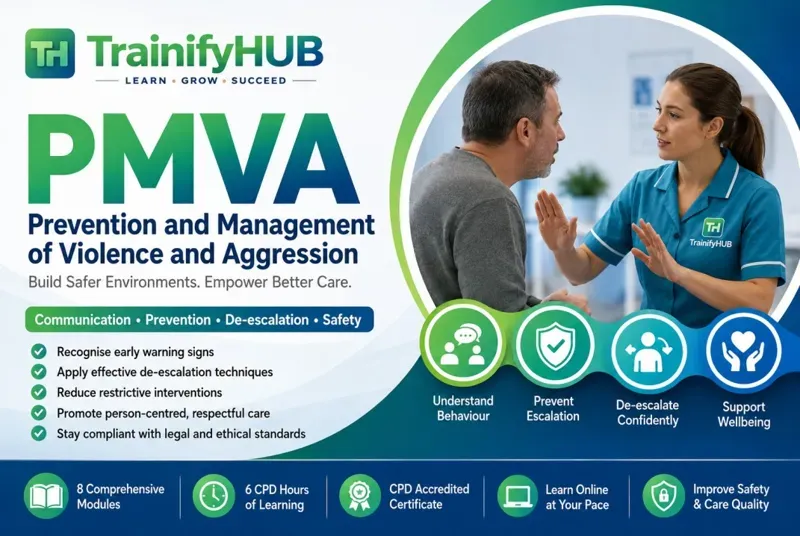
PMVA – Prevention and Management of Violence and Aggression (PMVA) Training Course
4.5(20)
9 modules2h61
£20.00
Learn how person-centred support, everyday risk observations and appropriate escalation contribute to falls prevention for older people.
9
2h 37m
0+
beginner

Course Price
£20.00
One-time payment - 9 months' access
Buying for your team?
Up to 30% off per seat: 10+ seats 10%, 25+ seats 20%, 50+ seats 30%.
CATEGORY
Health & Social CareLAST UPDATED
Nov 2026
Course Price
£20.00
One-time payment - 9 months' access
Buying for your team?
Up to 30% off per seat: 10+ seats 10%, 25+ seats 20%, 50+ seats 30%.
CATEGORY
Health & Social CareLAST UPDATED
Nov 2026
For care-home and home-care staff, this course explores falls risks, changes to report, assessed care plans and safer daily routines. Learners consider consent, independence, mobility-support limits, fear of falling and appropriate help after a fall. Fictional scenarios support decisions within the care-worker role. It does not provide clinical falls assessment, exercise prescription, floor-lifting or practical moving-and-handling training.
Study online at your own pace using eight teaching modules, fictional written practice and a separate final knowledge assessment. Estimated total structured learning: 2 hours 37 minutes. This is a planning estimate; individual study time varies.
This module develops awareness of falls and person-centred risk, using factual information and the person’s current individual arrangements to explain decisions within the care-worker role.
By the end of this Module, learners will be able to:
✓ Explain falls risks in care and the course population.
✓ Recognise individual preferences when considering proportionate support.
Workplace example: Maeve values preparing a snack independently. A recent near miss and her preferences are known, but no professional assessment result is supplied.
Application: Explain proportionate, person-centred support and identify what needs review. Do not impose blanket restrictions or use a prediction score as a guarantee.
This module develops awareness of recognising changes and reporting risks, using factual information and the person’s current individual arrangements to explain decisions within the care-worker role.
By the end of this Module, learners will be able to:
✓ Identify changes and risks to report.
✓ Prepare a factual handover without diagnosing or adding facts.
Workplace example: During a home-care visit a person reports new dizziness compared with their usual presentation. The cause is not known.
Application: Prepare a factual handover and obtain appropriate advice through the care pathway. Do not diagnose the cause, alter medicines or dismiss the change as normal.
This module develops awareness of care plans and professional assessment, using factual information and the person’s current individual arrangements to explain decisions within the care-worker role.
By the end of this Module, learners will be able to:
✓ Distinguish frontline observations from competent professional assessment.
✓ Separate plan implementation from clinical decisions in a fictional brief.
Workplace example: A current care plan is available, but a worker is asked to diagnose repeated falls and design a new exercise programme.
Application: Separate following agreed instructions from professional assessment and treatment decisions. Report changes and refer the proposed clinical decisions to the appropriate professional.
This module develops awareness of safer environments and daily routines, using factual information and the person’s current individual arrangements to explain decisions within the care-worker role.
By the end of this Module, learners will be able to:
✓ Recognise environmental and routine improvements.
✓ Explain how consent and role boundaries affect changes in a home or care setting.
Workplace example: Loose leads and poor lighting are noticed in a person’s own home. The person does not agree to an immediate rearrangement of their kitchen.
Application: Discuss practical concerns and agreed improvements while respecting consent, property and role boundaries. Record and escalate unresolved concerns rather than forcing changes.
This module develops awareness of mobility, equipment and role limits, using factual information and the person’s current individual arrangements to explain decisions within the care-worker role.
By the end of this Module, learners will be able to:
✓ Follow individually assessed mobility-support requirements.
✓ Identify a mismatch in staffing or equipment and seek appropriate help.
Workplace example: An individually assessed mobility arrangement requires equipment and staffing that are not currently available.
Application: Identify the mismatch and seek appropriate assistance. Do not improvise a transfer, substitute equipment or assume one staffing rule applies to every person.
This module develops awareness of supporting participation and confidence, using factual information and the person’s current individual arrangements to explain decisions within the care-worker role.
By the end of this Module, learners will be able to:
✓ Encourage agreed participation within the person's plan.
✓ Respond respectfully to fear of falling without prescribing exercise or forcing activity.
Workplace example: A person is worried about falling and declines a usual social activity. Their current plan supports agreed participation.
Application: Use respectful communication, preferences and the existing plan to discuss participation and appropriate review. Do not prescribe exercise, force activity or promise that no fall can happen.
This module develops awareness of responding to a fall and recording, using factual information and the person’s current individual arrangements to explain decisions within the care-worker role.
By the end of this Module, learners will be able to:
✓ Choose appropriate urgent help after a fall.
✓ Record supplied observations and actions without assuming an unwitnessed fall caused no injury.
Workplace example: A person is found on the floor after an unwitnessed fall and reports hip pain. The worker does not know whether other injuries occurred.
Application: Seek emergency help for possible hip injury, follow emergency advice and do not lift the person or assume there is no injury. Record supplied observations, known timings and actual actions.
This module develops awareness of falls-prevention scenarios, using factual information and the person’s current individual arrangements to explain decisions within the care-worker role.
By the end of this Module, learners will be able to:
✓ Choose a source-led response in care-home and community scenarios.
✓ Explain how consent, proportionate support, escalation and records fit together.
Workplace example: One colleague proposes stopping a person from moving independently after a stumble. The person wants to continue ordinary daily activities.
Application: Explain proportionate support, consent and the need for appropriate assessment and plan review. Combine safe escalation with independence and factual records rather than a blanket restriction.
This course is officially recognised and certified
CPD
Points Awarded
All accreditations are verified and recognised by relevant industry bodies. Upon successful completion, your certificate will display the appropriate accreditation marks.
16 questions answered
Care-home and home-care staff supporting older people, including workers reviewing awareness of everyday falls risks.
The NICE NG249 context covers people aged 65 or over and people aged 50–64 with additional risk factors.
No. Practical handling, lifting and floor recovery require separate employer training, assessed competence and individual plans.
No. Exercise prescription, clinical assessment and medicine changes are outside this awareness course.
No. The course uses individual needs, observations and proportionate support, without falls prediction scores or guarantees.
It considers preferences, respectful communication and agreed support, without blanket restrictions or coercion.
Follow that individual staffing requirement and seek appropriate assistance. It is not a universal rule for every transfer or hoist.
Recognising when to seek urgent or emergency help, keeping the person comfortable and warm, following emergency advice and making factual records within role limits.
No. The activities use fictional care-home and community situations and private reflection.
Complete the learning and score at least 12/15 (80%) in the separate 15-question final knowledge assessment. Each question has four options and one correct answer. The assessment allows up to 10 attempts with a 30-minute limit per attempt.
No. The TrainifyHUB course completion certificate is valid for one year from passing and does not certify clinical or practical handling competence.
Learner access lasts nine months from assignment. An unassigned company entitlement has no expiry.
Allow approximately 2 hours 37 minutes of total structured learning. This includes the teaching, meaningful private written activities and final assessment. Individual study time varies.
Yes. This TrainifyHUB CPD-accredited awareness course carries 3 CPD points. CPD recognition is separate from regulated qualifications, employer authorisation and practical competence.
No. The supplied fictional briefs, written responses and guided reviews support private self-study. They are not individually marked practical or clinical assessments. Keep any notes free of real personal information.
Yes. The self-paced online format is suitable for individual learners and company-assigned learners. Check that the course scope matches your role and service requirements.
✓ You will learn to recognise relevant changes, follow individual assessed plans, respect consent and role boundaries, seek appropriate help and make factual records.
✓ Fictional care-home and home-care examples support reflection on everyday decisions.
✓ Falls risks can change with the person and their environment. This course helps staff make proportionate everyday decisions while respecting independence, following assessed plans and seeking appropriate help.
✓ Practise explaining decisions using fictional adult-care situations rather than assumptions.
✓ Strengthen factual communication, person-centred support and appropriate escalation.
✓ Connect awareness learning with your own employer procedures and separately required role training.
Flexible online learning for individuals and company teams across England, Scotland, Wales and Northern Ireland, including:
✓ London ✓ Birmingham ✓ Leicester
✓ Coventry ✓ Nottingham ✓ Derby
✓ Manchester ✓ Liverpool ✓ Leeds
✓ Sheffield ✓ Bradford ✓ Newcastle
✓ Bristol ✓ Southampton ✓ Portsmouth
✓ Brighton ✓ Oxford ✓ Cambridge
✓ Norwich ✓ Glasgow ✓ Edinburgh
✓ Aberdeen ✓ Dundee ✓ Cardiff
✓ Swansea ✓ Newport ✓ Wrexham
✓ Belfast ✓ Derry/Londonderry
Online availability does not make the England-specific provider or legal context identical across the UK. Check the local requirements and care arrangements that apply to your service.
✓ CPD-accredited TrainifyHUB course: 3 CPD points.
✓ Complete all eight modules and the separate final knowledge assessment. Pass at 12/15 correct answers (80%).
✓ The course completion certificate is valid for one year from passing.
✓ This is non-regulated awareness learning, not an RQF qualification, clinical authorisation or evidence of practical competence.
✓ Learner access lasts nine months from assignment. Unassigned company entitlements do not expire.
0+
Students Enrolled
New
Be the first!
2h 37m
Estimated Duration


 CPD Accredited Provider
 Secure Payments
Our team can advise on the right training package for your organisation.
Keep learning
Picked from what learners take alongside this course.
More in Health & Social CareHealth & Social Care
£20.00
 More in Health & Social Care
 More in Health & Social Care
 More in Health & Social Care
 More in Health & Social Care
 More in Health & Social Care
Health & Social Care
£20.00
 More in Health & Social Care
 More in Health & Social Care
Health & Social Care
£20.00
Based on 0 reviews
You must be logged in to submit a review. Please log in or create an account.