
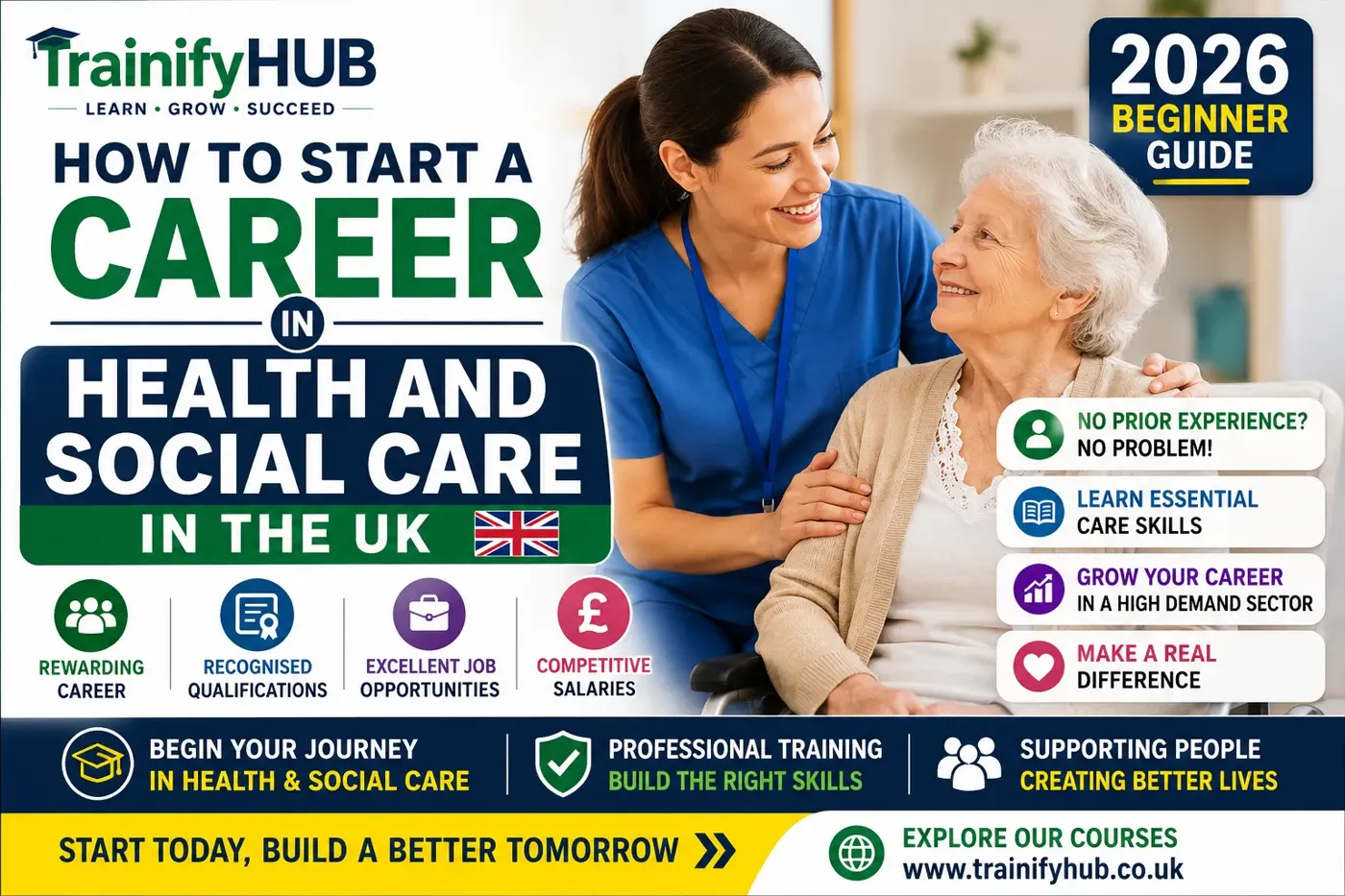
How to Start a Career in Health and Social Care in the UK
hello@trainifyhub.co.uk
Author
What Is the First Step to Starting a Career in Health and Social Care?
The first step is understanding that health and social care in the UK is not one system. It is two separate systems that work side by side: the NHS and social care.
Most guides skip this distinction and jump straight into job titles. That causes confusion later, because the NHS and social care have different employers, different pay structures, and different ways to apply for a job. Knowing which one you are aiming for shapes every decision after this.
What Is the Difference Between the NHS and Social Care?
The NHS provides publicly funded healthcare across England, Scotland, Wales, and Northern Ireland. Social care covers support with daily living, delivered through care homes, home care, and community services.
How the NHS Works
The NHS pays most non-medical staff through the Agenda for Change pay framework. This is a public, banded system, so you can check the exact salary for a role before you apply.
You apply for NHS jobs mainly through NHS Jobs, the national job board. Hiring can take longer than in social care, since NHS trusts often follow a more formal recruitment process.
How Social Care Works
Social care includes residential care homes, home care, supported living, and community mental health support. Most employers here are independent organisations, funded through local councils, private fees, or both.
Pay is not set by a national framework, so it varies between employers. Skills for Care, the workforce body for adult social care in England, publishes regular wage data if you want to compare providers before applying.
Many people move between the two systems during their career. Starting in social care and moving to the NHS later is common, and so is the reverse. Neither is a lesser starting point.
What Entry-Level Roles Can You Start With?
Most people enter the sector through one of three roles: Care Assistant, Support Worker, or Healthcare Assistant. All three are designed for people with no prior experience.
Care Assistant and Support Worker
Care Assistants support people with daily living tasks in care homes or in someone's own home. Support Workers do similar work, often with people who have a disability or a mental health condition, helping them live as independently as possible.
Both roles are widely advertised across the UK, and employers expect to train you from scratch. This makes them the fastest way into the sector if you have no care background.
Healthcare Assistant
Healthcare Assistants work alongside nurses and doctors, usually in hospitals or GP surgeries. The setting is more clinical than a Care Assistant role, but you still do not need prior experience to apply.
This role suits people who want early exposure to a clinical environment, particularly if nursing or another allied health profession is a longer-term goal.
Do You Need Qualifications to Start?
No. You do not need a degree, A-levels, or a formal care qualification to get your first job in health and social care. Employers hire on attitude and reliability, then train you once you start.
What you complete after starting matters more than what you bring in. Almost every employer will expect you to complete the Care Certificate during your induction period.
What Is the Care Certificate?
The Care Certificate is a set of induction standards that new care and health support staff complete on the job. It is not something you need to finish before applying for a role.
The certificate is based on 16 standards, following an update in March 2025 that added a standard on learning disability and autism awareness, per NHS England's workforce guidance (hee.nhs.uk, 2025). These standards cover safeguarding, communication, privacy and dignity, health and safety, and infection prevention among other topics.
The Care Certificate is not a legal requirement in the strict sense, but the Care Quality Commission expects care providers to use it as the baseline for new staff. TrainifyHUB's Care Certificate portfolio course covers all the current standards if you want to prepare before your induction begins.
What Qualifications Help You Progress?
Once you are working, formal qualifications help you move into more senior or specialist roles. The two most common routes are Diplomas and CPD short courses.
Level 2 and Level 3 Diplomas
A Level 2 Diploma in Health and Social Care is a common next step after starting work. A Level 3 Diploma builds on this and supports a move into senior carer or team leader roles.
Diplomas are widely recognised by employers and are often studied while working, rather than before starting a job.
NVQs and Older Qualifications
You may still see NVQs mentioned in job adverts or by colleagues. NVQs in health and social care have been replaced by Diplomas as the current qualification, but many existing staff still hold valid NVQs from earlier in their career, per Skills for Care's careers guidance (skillsforcare.org.uk, accessed 2026).
If you are starting fresh today, aim for a Diploma rather than an NVQ, since it is the qualification employers now expect to see for new applicants.
How Has the Care Worker Visa Closure Changed Career Opportunities?
The UK closed the Health and Care Worker visa route to new overseas care worker applicants on 22 July 2025. This removed occupation codes for care workers and senior care workers from new sponsorship applications, per the Home Office's Statement of Changes confirmed by immigration specialists (DavidsonMorris, 2025).
This does not affect people already working in the UK on this visa, who can extend their stay until 2028. What it does change is the shape of demand for UK-based applicants.
With fewer overseas recruits entering the sector, employers now rely more heavily on training and hiring people already living in the UK. If you are based in the UK and considering care work, this shift works in your favour.
How Do You Find Your First Job in Health and Social Care?
NHS Jobs is the main job board for NHS roles. Social care roles are usually found through individual provider websites, specialist care recruitment agencies, or your local council's job listings.
You can also find local care organisations through the Care Quality Commission's website, since every registered provider is listed there. Some areas run a Jobcentre Plus care sector routeway, a short programme that includes training, work experience, and a guaranteed interview at the end.
Volunteering or short work experience placements can help if you are unsure which part of the sector suits you. This is a low-risk way to test the work before committing to a full-time role.
How Do You Progress Once You Are in the Sector?
Progression usually follows one of three paths: moving into leadership, advancing through clinical grades, or developing a specialism. All three build on the Care Certificate and Diploma foundation you complete early on.
Specialist CPD courses are a common way to build expertise without leaving your current role. TrainifyHUB's mental health awareness course and advanced adult care course are examples of the kind of specialist training that supports a move into senior or specialist positions.
Registered Manager roles, which require an NVQ or Diploma at Level 5 in Leadership for Health and Social Care, sit at the top of the operational progression path. Getting there starts with the same first step as everyone else: a Care Assistant, Support Worker, or Healthcare Assistant role, and a willingness to keep training as you go.