 Similar topic
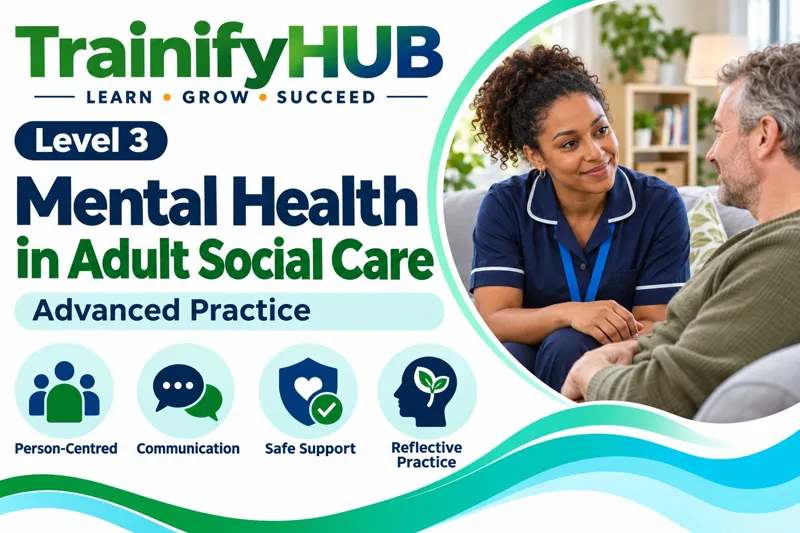
Level 3 Mental Health in Adult Social Care – Advanced Practice
Strengthen person-centred mental health support in adult social care through 15 Modules, applied cases and reflective learning for experienced care staff.
No ratings yet
5.00 CPD Points
MODULES
16
DURATION
4h 53m
STUDENTS
0+
LEVEL
advanced
Course Price
GBP 35.00
One-time payment - 9 months' access
Buying for your team?
Up to 30% off per seat: 10+ seats 10%, 25+ seats 20%, 50+ seats 30%.
This course includes:
16 comprehensive modules
4h 53m of video content
PDF, PPT & Infographics included
Final assessment included
9 months' access on mobile & desktop
Certificate of completion
5.00 CPD Points
CATEGORY
Health & Social CareLAST UPDATED
Nov 2026
About this course
Build on care experience to recognise changes in wellbeing, support individual goals, communicate respectfully and coordinate timely help. The course covers depression and distress awareness, complex needs, physical wellbeing, daily living, consent, safeguarding, families, records and supervision. Examples focus on England adult social care. Level 3 describes advanced non-regulated learning; it is not an RQF qualification, clinical training or a licence to practise.
👥 What you need
Experience in adult social care is recommended. No regulated qualification prerequisite is specified. Use an accessible internet-enabled device and a way to read/hear teaching and make private learning notes. Activities use fictional facts; no workplace access or identifiable care data is required.
⏱ Learning time
Allow approximately 4 hours 53 minutes for the course, including teaching videos, guided self-study activities and the final assessment.
Learning Outcomes
📘 Module 1 — Mental Health, Wellbeing and Adult Social Care
Mental health affects mood, thinking, relationships and daily functioning; experiences vary and can coexist with physical illness or disability. Social care staff contribute through respectful support, observation and timely referral.
By the end of this module, learners will be able to:
✓ Distinguish mental wellbeing from a clinical diagnosis
✓ Identify the contribution and limits of adult social care support.
Workplace application: Arthur stops attending meals and appears withdrawn. Speak with him, record the change and explore whether pain, loss, medication or other needs may be relevant. Arrange appropriate review rather than writing “his depression again”.
📘 Module 2 — Person-Centred and Recovery-Focused Support
Recovery-focused support starts from the person’s own definition of a meaningful life. Goals may concern relationships, housing, work, daily routines or confidence, and improvement need not be linear.
By the end of this module, learners will be able to:
✓ Identify the person's goals and strengths
✓ Apply recovery-focused support without promising a particular clinical outcome.
Workplace application: Beatrice wants to return to a local art group but staff focus only on room tidiness. Agree a supported first visit and a review of how it felt, while continuing essential care. Do not make attendance a condition of receiving support.
📘 Module 3 — Communication, Trust and Stigma
Build trust through predictable contact, respectful language and clear explanations of your role. Ask what helps communication, allow processing time and use appropriate interpretation or accessible material.
By the end of this module, learners will be able to:
✓ Use respectful, non-stigmatising communication
✓ Identify adjustments that support trust and participation.
Workplace application: Charlie says staff are deliberately making him ill. Acknowledge that he feels frightened, ask about immediate needs and record his account. Seek appropriate clinical advice without arguing aggressively or agreeing that the allegation is established fact.
📘 Module 4 — Recognising Depression and Changes in Wellbeing
Persistent low mood, loss of interest, withdrawal, altered sleep or appetite, reduced energy and difficulty concentrating may warrant assessment. These observations do not establish a diagnosis of depression, and physical illness, bereavement, medicines or other causes may contribute.
By the end of this module, learners will be able to:
✓ Recognise changes that may warrant assessment for depression
✓ Record observations without diagnosing the person.
Workplace application: Doris has stopped eating with others and says nothing matters. Record her words and changes, check immediate safety and arrange timely professional assessment. Do not reassure yourself that withdrawal is a normal part of ageing.
📘 Module 5 — Anxiety and Distress in Daily Care
Anxiety may affect breathing, concentration, sleep and willingness to engage, but new physical symptoms must not automatically be labelled anxiety. Ask what the person experiences and what has helped before.
By the end of this module, learners will be able to:
✓ Identify anxiety or distress in daily routines
✓ Choose supportive responses and an appropriate escalation point.
Workplace application: Edward becomes distressed in a crowded dining room. Offer a quieter choice and allow time, while checking for new physical symptoms. Discuss a plan for future meals rather than insisting he stay to “get used to it”.
📘 Module 6 — Recognising Complex Needs and Seeking Specialist Help
Complex needs may include mental ill health alongside substance use, cognitive changes, trauma, disability or physical illness. Describe what has changed and how it affects daily life rather than assigning a new diagnosis.
By the end of this module, learners will be able to:
✓ Identify signs that support needs exceed the current plan
✓ Describe how to seek specialist advice.
Workplace application: A supported-living resident has slept very little, stopped taking prescribed medicines and become increasingly suspicious. Record specific observations and contact the agreed mental health team promptly; use emergency routes if safety cannot be maintained.
📘 Module 7 — Physical Health, Medicines and Mental Health
Physical and mental health influence each other. Support access to appropriate health checks and report changes such as pain, falls, appetite changes, marked restlessness or new tremor.
By the end of this module, learners will be able to:
✓ Recognise interactions between physical wellbeing, medicines and mental health
✓ Report concerns without changing treatment.
Workplace application: Florence develops tremor and dizziness after a medicines change. Record what is observed, help prevent falls and contact the prescriber or urgent service according to severity. Do not alter the dose or assume the symptoms are harmless.
📘 Module 8 — Supporting Daily Living and Social Connection
Support daily living in ways that preserve control: offer manageable choices about meals, sleep routines, hygiene, activity and relationships. Explore what makes participation difficult and agree practical support, such as accompaniment or reminders.
By the end of this module, learners will be able to:
✓ Plan support for daily routines and social connection
✓ Preserve choice and avoid unnecessary dependence.
Workplace application: George enjoys gardening but has become isolated. Offer a supported visit to an accessible group if he wants it, then review his experience. Keep alternatives available and avoid claiming one activity will cure depression.
📘 Module 9 — Consent, Capacity and Rights
Mental illness does not automatically remove capacity. Apply the MCA principles to the particular decision and time, provide practicable support and distinguish an unwise choice from inability to decide because of an impairment or disturbance.
By the end of this module, learners will be able to:
✓ Apply decision-specific consent and capacity principles
✓ Distinguish a diagnosis from inability to make a decision.
Workplace application: Hannah refuses a change to her morning routine. Explain the options and respect her capacitous choice. If a later complex decision raises capacity concerns, arrange supported assessment rather than recording a blanket “lacks capacity” label.
📘 Module 10 — Self-Harm and Immediate Safety
After self-harm, prioritise immediate physical and psychological safety and seek appropriate clinical assessment. Provide first aid within training and call 999 when life is at risk or safety cannot be maintained.
By the end of this module, learners will be able to:
✓ Identify immediate safety actions after self-harm
✓ Distinguish supportive responses from specialist psychosocial assessment.
Workplace application: A resident has cut her arm and is distressed. Offer immediate support, obtain medical advice appropriate to the injury and safety situation, and arrange mental health assessment through the agreed route. “Superficial” appearance is not reassurance about future safety.
📘 Module 11 — Crisis Recognition and Escalation
A crisis needs prompt expert advice. Use the person’s crisis plan and named team where available.
By the end of this module, learners will be able to:
✓ Recognise a mental health crisis
✓ Select the relevant urgent-help route using the current NHS guidance and local plan.
Workplace application: Sarah is severely distressed and says she intends to end her life now while holding broken glass. Keep a safe distance, obtain emergency help and follow instructions. Do not attempt an untrained physical intervention or make a second routine triage call that delays the emergency response.
📘 Module 12 — Safeguarding, Abuse and Exploitation
Mental ill health can coexist with abuse or exploitation and does not make an allegation unreliable. Look for changes in access to money, food, relationships, privacy or safety and listen to the adult’s account.
By the end of this module, learners will be able to:
✓ Identify abuse, neglect or exploitation concerns
✓ Describe person-centred safeguarding reporting.
Workplace application: Ian cannot afford food because an acquaintance is demanding daily cash. Ask what he wants to happen, record the account and raise the concern promptly. A stated willingness to hand over money does not remove the need to consider coercion.
📘 Module 13 — Working with Families, Carers and Professionals
Families and carers may provide valuable history and support, but involvement should reflect the adult’s wishes and lawful information-sharing arrangements. A relative is not automatically entitled to confidential records or decision-making authority.
By the end of this module, learners will be able to:
✓ Identify appropriate family and professional involvement
✓ Respect the person's wishes and information-sharing boundaries.
Workplace application: Julia asks that her care details are not shared with her mother. Respect the decision unless a justified lawful exception applies, while still listening to the mother’s concerns and offering general carer-support information.
📘 Module 14 — Support Planning, Risk and Accurate Records
A useful support plan identifies the person’s goals, strengths, agreed actions, early warning signs, contacts and review triggers. Record risks in context and choose proportionate support rather than blanket restrictions.
By the end of this module, learners will be able to:
✓ Produce a factual support and risk record
✓ Identify a review trigger without using risk scores to predict suicide.
Workplace application: Kevin wants to travel independently despite anxiety. Agree graduated support, a contact plan and review points with him. Record how the arrangement works in practice and revise it if circumstances change, rather than treating a signed form as permanent approval.
📘 Module 15 — Supervision, Reflective Practice and Quality Improvement
Supervision should examine decisions, communication, boundaries, workload and emotional impact. Use factual examples and the person’s experience to identify what worked and what needs to change.
By the end of this module, learners will be able to:
✓ Use reflective supervision to review a support decision
✓ Propose an improvement grounded in the person's experience.
Workplace application: A worker feels overwhelmed after a crisis. Review the response sensitively, confirm support needs and identify whether the crisis contacts were usable. Test any revised process with staff and follow up the agreed actions.
Accreditation & Recognition
This course is officially recognised and certified
5.00
CPD
Points Awarded
All accreditations are verified and recognised by relevant industry bodies. Upon successful completion, your certificate will display the appropriate accreditation marks.
Frequently Asked Questions
9 questions answered
Experienced care workers, senior carers, team leaders and supervisors.
No; the course is advanced non-regulated learning.
No; staff support, observe and escalate within their competence.
12 correct answers out of 15 (80%).
Nine months from assignment; unassigned company entitlements do not expire.
A guided workbook, two applied cases and an application exercise.
Allow approximately 4 hours 53 minutes, including teaching videos, guided self-study and the final assessment.
The final assessment has 15 single-answer multiple-choice questions. Choose one answer for each question. The pass mark is 80% (12 of 15), with up to 10 attempts and 30 minutes per attempt.
The course completion certificate is valid for one year from passing. This is separate from the nine-month assigned learner access period.
What You'll Learn
✓ Distinguish changes in mental wellbeing from a clinical diagnosis and recognise care-worker role boundaries.
✓ Support goals, strengths and choices through person-centred, recovery-focused practice.
✓ Build trust with respectful communication and practical adjustments.
✓ Recognise changes in mood, distress, physical health and medicines that need appropriate review.
✓ Support daily routines, independence and meaningful social connection.
✓ Respect decision-specific consent, capacity, confidentiality and safeguarding responsibilities.
✓ Recognise urgent safety concerns and use the agreed escalation route without relying on predictive risk scores.
✓ Use factual records, partnership working and reflective supervision to improve support.
Why Take This Course
Experienced staff make decisions about autonomy, distress, changing needs and coordination every day. This course develops reasoned support decisions and clear escalation within professional boundaries.
Certificate of Completion
TrainifyHUB Certificate of Completion after completing the learning and passing the final assessment. Certificate validity: one year from passing. This is not an RQF Level 3 Diploma, Award or Certificate, a full Care Certificate, or proof of clinical or workplace competence.
Course Highlights
0+
Students Enrolled
New
Be the first!
4h 53m
Total Duration


Why book with TrainifyHUB
- CPD accredited training content
- Delivered UK-wide at your workplace
- Certificate of completion included
- Secure, encrypted online payments
Accredited & Trusted
 CPD Accredited Provider
 Secure Payments
Need help choosing a course?
+44 7405 005823 support@trainifyhub.co.uk
Our team can advise on the right training package for your organisation.
Keep learning
Related courses
Picked from what learners take alongside this course.
Similar topic Similar topic
 More in Health & Social Care
 More in Health & Social Care
 More in Health & Social Care
Health & Social Care
Level 2 Food Safety and Hygiene for Health and Social Care
4.7(20)
6 modules2h67
GBP30.00
 More in Health & Social Care
Health & Social Care
Advanced Adult Care Principles and Professional Practice
4.9(20)
13 modules4h66
GBP40.00
 More in Health & Social Care
Health & Social Care
Level 3 Medication Management in Adult Social Care – Advanced Practice
New course
16 modules4h 56m
GBP35.00
 More in Health & Social Care
Student Reviews
0.0
0 stars
Based on 0 reviews
5
0
4
0
3
0
2
0
1
0
🔒 Log In to Review
You must be logged in to submit a review. Please log in or create an account.