Mental Health First Aid: A Complete Guide for Workplaces and Care Teams
Peter Traynor Sime
Author
Mental health first aid is the initial support given to someone who may be experiencing a mental health problem or crisis. In UK workplaces, it helps trained staff recognise signs of distress, start a supportive conversation, encourage professional help where needed and follow the organisation's safeguarding or escalation process. This guide is prepared for learners and employers comparing training options on TrainifyHUB. This guide is prepared for learners and employers comparing training options on TrainifyHUB.
For health and social care teams, the topic matters because staff may support people under pressure while also managing their own wellbeing. This guide explains what mental health first aid training can cover, how it fits with employer duties and how to choose a course without overclaiming what a certificate proves.
Key Takeaways
Mental health first aid is early support, not diagnosis, therapy or clinical treatment.
UK employers should consider mental health as part of their approach to health, safety and wellbeing, but a named mental health first aider is only one possible control.
Training works best when it sits inside a wider policy, referral and supervision route.
A mental health first aid course can build confidence and records of learning, but it does not remove the employer's duty to manage workplace risks.
Care teams should connect mental health awareness with safeguarding, communication, confidentiality and person-centred support.
What is mental health first aid?
Mental health first aid is a structured way to offer initial help. The first aider notices possible signs, listens without judgement, checks immediate risk, gives reassurance and encourages suitable support. The approach is similar in spirit to physical first aid: it is early help until the right ongoing support is available. For related TrainifyHUB guidance, see health and social care training. For official context, see HSE stress and mental health at work. For source context, see HSE stress and mental health at work. For related reading, see the domiciliary care guide.
The role has clear limits. A workplace mental health first aider should not diagnose a condition, promise confidentiality where someone is at risk, act as a counsellor or become the only support route for colleagues. HSE's workplace mental health guidance explains that employers should manage work-related stress and support good mental health through practical action, not only by training one person: HSE stress and mental health at work.
Is mental health first aid a legal requirement in the UK?
UK law does not create a simple rule that every employer must appoint a mental health first aider. Employers do, however, have duties to protect health, safety and welfare at work. HSE guidance says employers should include mental health in risk assessments and act where work-related stress risks are identified: HSE work-related stress and mental health. For structured learning on this topic, review the Mental Health Awareness for Health and Social Care course.
That is why the right question is not only, "Do we need a mental health first aid qualification?" It is, "What does our risk assessment show, and what support arrangements do staff need?" For some organisations, trained mental health first aiders are a useful part of that answer. For others, the immediate need may be manager training, clearer referral routes, workload changes or better supervision.
What does a mental health first aid course usually cover?
A mental health first aid course usually helps learners understand common mental health problems, recognise signs of distress, respond to immediate concerns and encourage appropriate support. It may also cover communication, stigma, boundaries, crisis response and self-care for the person giving support. A useful source for checking this point is NHS mental health information. A relevant TrainifyHUB course option is the Adult Safeguarding Awareness and Protection course.
For care teams, training should connect with everyday practice. A support worker may need to notice a change in mood, respond calmly, record concerns correctly and tell the right person. A team leader may need to support staff after a difficult incident, identify signs of burnout and make sure concerns are escalated through the provider's procedures.
Topic | Why it matters at work |
Recognising warning signs | Helps staff notice when someone may need support. |
Supportive conversation skills | Helps reduce panic, judgement and avoidant responses. |
Crisis awareness | Helps staff know when urgent help or safeguarding action may be needed. |
Boundaries | Protects both the person being supported and the first aider. |
Signposting | Moves the person towards appropriate professional or organisational support. |
Record keeping | Helps employers monitor concerns while respecting confidentiality. |
What should employers put around the training?
Training is stronger when the workplace knows what happens after a conversation. A useful mental health first aid plan should answer five practical questions. A related TrainifyHUB option is the Adult Safeguarding Awareness and Protection course.
Who can staff speak to? Name first aiders, managers, HR contacts, occupational health or external assistance routes where relevant.
What is confidential? Explain when information may need to be shared because of immediate risk, safeguarding or workplace safety.
How are urgent concerns handled? Set out what to do if someone may harm themselves or another person, or is unable to stay safe.
How are first aiders supported? Give first aiders supervision, debriefing and a way to step back when the role becomes heavy.
How is the risk assessment updated? Use themes from conversations carefully to improve workload, management practice and working conditions.
The Health and Safety Executive's first aid needs assessment guidance allows employers to consider mental ill health when deciding first aid arrangements: HSE first aid needs assessment. That does not mean mental health first aid replaces action on work design or stress risks.
Mental health first aid in health and social care
Health and social care workers often operate in emotionally demanding settings. Mental health awareness can support better conversations with colleagues and people receiving care, but it must work alongside safeguarding, professional boundaries and local care plans. For further reading, see the domiciliary care guide.
For regulated care settings, employers also need to make sure staff receive appropriate training, supervision and support for their role. CQC's Regulation 18 guidance explains expectations around suitably qualified, competent, skilled and experienced staff: CQC Regulation 18 staffing guidance. Mental health first aid training can support this wider picture, but it is not a complete competence assessment for every role.
Where teams are planning wider staff learning as well as mental health awareness, the TrainifyHUB course catalogue can help connect mental health, safeguarding, communication and duty-of-care topics.
How should learners choose mental health first aid training?
Start with the role and the setting. An individual learner may want a clear introduction so they can support colleagues with more confidence. A manager may need a course that helps them plan support routes, document training and reinforce boundaries. A care employer may need mental health awareness alongside safeguarding, communication and duty-of-care training. You can compare this with CQC staffing guidance.
Check these points before choosing a course:
Does the course match UK workplace language and responsibilities?
Does it explain the limits of the first aider role?
Does it include practical conversation and signposting guidance?
Does it help learners understand crisis escalation and safeguarding boundaries?
Does the certificate provide useful evidence for training records?
Does your employer accept the course for the role or policy purpose you have in mind?
How can TrainifyHUB support mental health awareness?
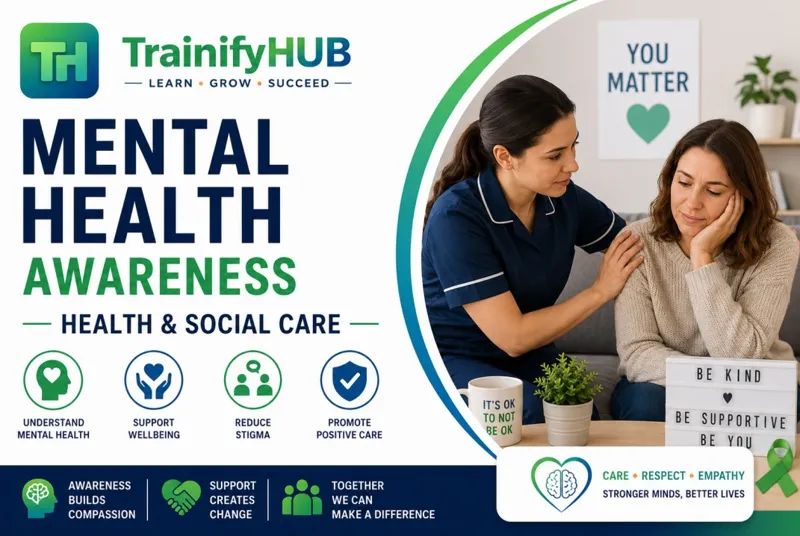
TrainifyHUB's Mental Health Awareness - Health and Social Care course is designed for learners in health and social care settings who need flexible online study and certificate evidence. Use it as part of a wider workplace approach that includes policies, supervision, referral routes and risk assessment. Teams may also find the Autism Awareness for Health and Social Care course relevant. A relevant TrainifyHUB course option is the Mental Health Awareness for Health and Social Care course.
Learners and employers can also review related health and social care training where mental health awareness connects with communication, safeguarding, dignity and person-centred support.
Conclusion
Mental health first aid gives people a safer way to notice distress, listen well and guide someone towards help. It works best when employers connect training with clear boundaries, risk assessment and support routes. For another source on this area, see Mind mental health at work information.
To build awareness for care settings, view TrainifyHUB's Mental Health Awareness - Health and Social Care course and agree how it fits your workplace wellbeing plan.
A team that handles care, safeguarding and wellbeing together may also need the Autism Awareness for Health and Social Care course as a related learning option.
Frequently Asked Questions
No. Mental health first aid is initial support and signposting. Counselling or therapy should be provided by appropriately qualified professionals.
There is no single rule that every workplace must appoint one. Employers should assess health, safety and wellbeing risks, then decide what arrangements are suitable.
Online training can build knowledge and awareness. Employers should still decide whether further role-specific practice, supervision or policy training is needed.
Yes, when it is used with clear boundaries. It can improve awareness and conversations, but it should sit alongside safeguarding, care planning and staff support procedures.
They should follow the organisation's emergency or safeguarding process, seek immediate help where there is serious risk and avoid trying to manage the crisis alone.
No single certificate proves compliance. It can support training records, but employers remain responsible for suitable risk assessment, supervision and workplace controls.