IELTS Writing Task 1: Complete Guide to Format, Examples and Band Criteria
Peter Traynor Sime
Author
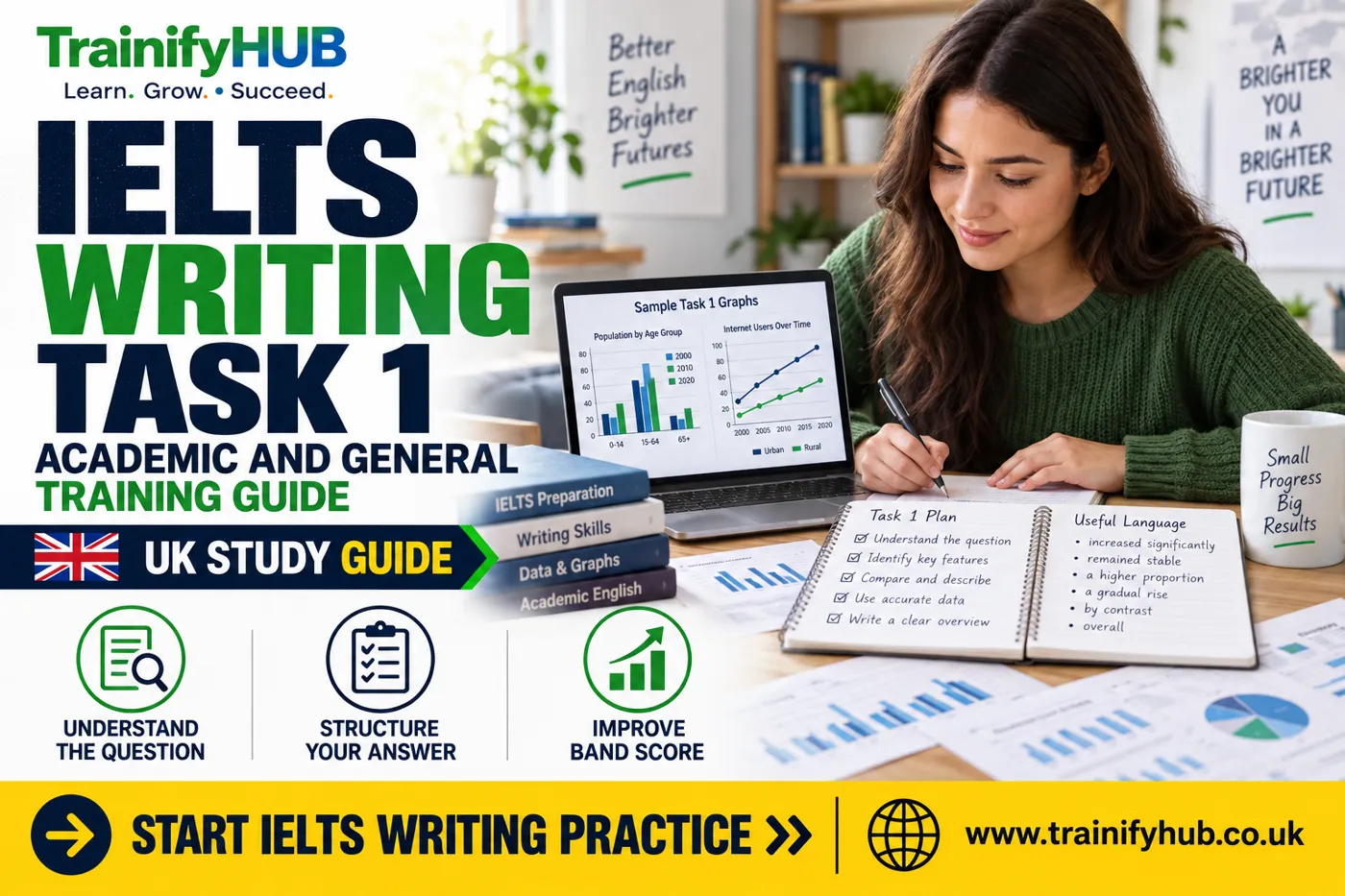
IELTS Writing Task 1 is the first writing task in the IELTS test. In Academic IELTS, you usually describe visual information such as a chart, graph, table, map or process. In General Training IELTS, you write a letter for a given situation. This guide is prepared for learners and employers comparing training options on TrainifyHUB.
This guide explains the format, timing, assessment criteria and practical structure for Task 1 so you can practise with a clearer plan.
Key Takeaways
IELTS Writing Task 1 is different in Academic and General Training.
Academic Task 1 needs a clear overview of the main trends, stages or comparisons.
General Training Task 1 needs a letter that fits the purpose, tone and bullet points.
IELTS Writing is marked using four criteria: task achievement or response, coherence and cohesion, lexical resource, and grammatical range and accuracy.
Practice should focus on planning, structure and accuracy, not memorising a fixed sample answer.
What is IELTS Writing Task 1?
IELTS Writing Task 1 tests whether you can respond clearly to a short writing prompt. The official IELTS scoring guide explains how band scores and writing assessment criteria work: IELTS scoring in detail.
The task depends on which IELTS route you take.
Test type | Task 1 format | What you need to do |
Academic IELTS | Chart, graph, table, map, diagram or process | Summarise and compare the main information in a formal report style. |
General Training IELTS | Letter | Write for a practical situation using a suitable tone and covering the bullet points. |
Both versions reward clear organisation, relevant content, accurate language and control of tone.
How long should IELTS Writing Task 1 take?
The IELTS Writing test lasts 60 minutes in total. Test takers are commonly advised to spend about 20 minutes on Task 1 and about 40 minutes on Task 2. Task 2 carries more weight, so spending too long on Task 1 can hurt your overall Writing performance. For source context, see IELTS scoring in detail.
A simple time plan is:
Analyse the task for 2-3 minutes. Identify the chart type, letter purpose or key instructions.
Plan for 2 minutes. Choose the main features or letter points.
Write for 12-14 minutes. Keep the structure controlled.
Check for 2-3 minutes. Fix grammar, spelling, missing data and tone problems.
Do not start writing before you understand the task. A rushed answer often misses the overview, bullet point or tone requirement.
How is IELTS Academic Writing Task 1 structured?
IELTS Academic Writing Task 1 should usually have four clear parts.
Part | Purpose |
Introduction | Paraphrase what the visual information shows. |
Overview | Summarise the biggest trend, contrast, stage or overall pattern. |
Body paragraph 1 | Group the first main set of details. |
Body paragraph 2 | Group the second main set of details. |
The overview is very important. For a line graph, it might describe which figure rose most or whether all categories changed in the same direction. For a process, it might describe the number of stages and the start/end point. For a map, it might describe the biggest changes to layout or land use.
Avoid listing every number. Select the main features and support them with data. A relevant TrainifyHUB course option is the IELTS Writing Practice Tests course.
How is General Training Writing Task 1 structured?
General Training Task 1 is a letter. The prompt usually gives a situation and bullet points. Your answer should cover all bullet points and use a tone that fits the reader. A related TrainifyHUB option is the Digital Skills and Computer Fundamentals course.
Letter type | Tone |
Formal | To an organisation, employer, official or unknown person. |
Semi-formal | To someone you know in a professional or polite context. |
Informal | To a friend or family member. |
A good structure is:
opening purpose
response to bullet point 1
response to bullet point 2
response to bullet point 3
closing line matched to the tone
Tone mistakes can lower the quality of the answer. For example, writing to a council office as if texting a friend will not fit the task.
What band criteria matter most?
The official IELTS scoring guide explains that Writing is marked against four criteria: task achievement or task response, coherence and cohesion, lexical resource, and grammatical range and accuracy: IELTS scoring in detail. For further reading, see the Microsoft 365 Fundamentals guide.
For Task 1, think of the criteria like this:
Task achievement. Did you answer the prompt fully and include the key information?
Coherence and cohesion. Is the answer organised and easy to follow?
Lexical resource. Do you use a suitable range of vocabulary accurately?
Grammatical range and accuracy. Are your sentences varied and mostly correct?
You do not need rare words to score well. Clear, accurate language is usually better than forced advanced vocabulary.
What does a strong IELTS Writing Task 1 sample answer do?
A strong sample answer is useful because it shows decisions, not because it gives sentences to memorise. A relevant TrainifyHUB course option is the Digital Skills and Computer Fundamentals course.
For Academic IELTS, a good sample answer:
introduces the visual information accurately
gives a clear overview
groups details logically
compares figures where useful
avoids personal opinions
uses data accurately
For General Training, a good sample answer:
opens with the purpose of the letter
covers all bullet points
uses the right tone
gives enough detail for the situation
closes naturally
When reviewing any IELTS writing task 1 sample answer, ask why each paragraph is there. That will help you transfer the method to a new question.
How should you practise IELTS Task 1 writing?
Practice works best when it is deliberate. Do not only write full answers. Mix full answers with smaller drills.
Write only overviews for five different Academic charts.
Practise grouping data without writing the full report.
Rewrite informal letters in a formal tone.
Check one answer for grammar only.
Build a list of accurate comparison verbs and linking phrases.
Time yourself after the method feels familiar.
Keep your practice answers. Looking back at old work helps you see whether your errors are repeated or improving.
If you want to strengthen wider study habits alongside IELTS preparation, the TrainifyHUB online course catalogue includes flexible online learning options for workplace and professional development.
How can TrainifyHUB support IELTS Writing practice?
TrainifyHUB's IELTS Writing Practice Tests: Academic and General Training Mastery course supports learners who want structured online practice for IELTS Writing. For another source on this area, see IELTS writing band descriptors. A relevant TrainifyHUB course option is the Microsoft Excel for Workplace Data Management, Reporting and Business Productivity course.
Use it to build familiarity with Task 1 formats, practise under clearer conditions and improve your approach to planning and reviewing answers. IELTS scores are awarded only through official IELTS testing, so course practice should be treated as preparation rather than a score guarantee.
Learners who also need basic computer confidence for online study can review TrainifyHUB's Digital Skills and Computer Fundamentals course.
Conclusion
IELTS Writing Task 1 becomes easier when you understand the task type, plan the answer and write for the band criteria. Focus on clear structure, accurate content and controlled language.
To practise with a structured course, view TrainifyHUB's IELTS Writing Practice Tests course and use it alongside official IELTS band descriptors.
Frequently Asked Questions
It is the first IELTS Writing task. Academic candidates describe visual information, while General Training candidates write a letter. For related reading, see the Microsoft 365 Fundamentals guide.
IELTS Task 1 has a minimum word requirement set by the test format. Check the current official IELTS instructions before your test and practise writing enough without adding filler.
Yes. Academic Task 1 answers should include a clear overview of the main trends, stages, comparisons or changes.
You can learn from sample answers, but memorising fixed answers is risky because the question changes. Learn the structure and decision-making instead.
It is different rather than simply easier. General Training tests letter purpose, tone and bullet coverage, while Academic tests summary and comparison of visual information.
No. A course can support preparation and practice, but official IELTS scoring is handled through the test and examiner assessment.