
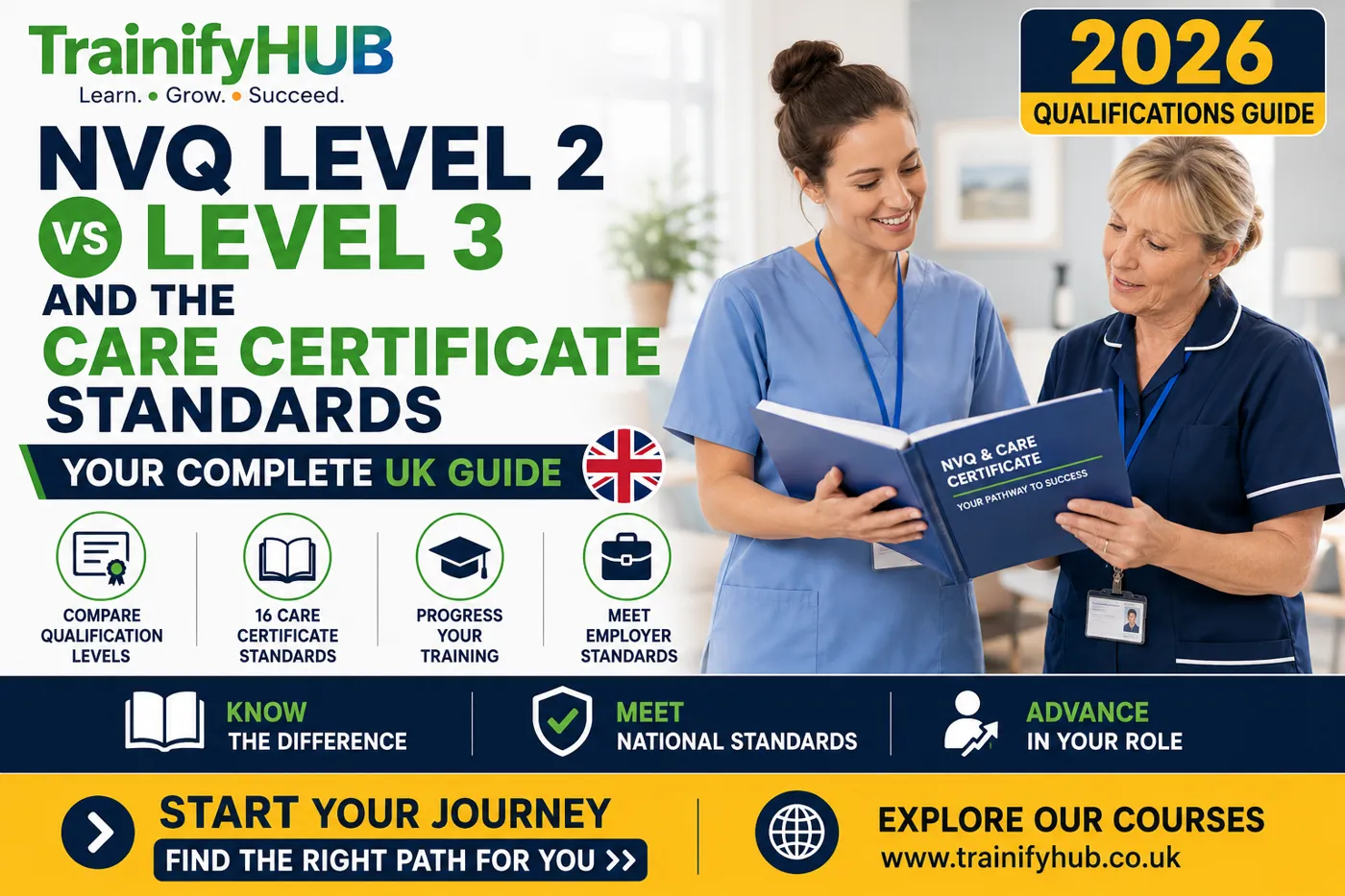
NVQ Level 2 vs Level 3: What's the Difference
hello@trainifyhub.co.uk
Author
What Is the Difference Between NVQ Level 2 and Level 3?
NVQ Level 2 covers routine, intermediate tasks that you can carry out with some independence. NVQ Level 3 covers advanced, often supervisory work, where you are expected to work independently and take responsibility for outcomes.
The practical difference comes down to complexity and responsibility. Level 2 proves you can competently do a job. Level 3 proves you can do that job to a higher standard, often while supervising others or contributing to more complex decisions.
Are NVQs Still Being Awarded?
This is worth addressing directly, since the answer affects how you should read the rest of this guide. In most sectors, including health and social care, NVQs in their original form are no longer awarded to new learners.
They have largely been replaced by Level 2 and Level 3 Certificates and Diplomas under the Regulated Qualifications Framework, known as the RQF. Sources vary on exactly when this shift happened, with some pointing to changes in 2015 and 2018, and others noting that many awarding bodies only stopped issuing new NVQ certificates as recently as 2023 and 2024.
What matters in practice is this: people, employers, and job listings still commonly say "NVQ Level 2" or "NVQ Level 3" even when they mean the current RQF equivalent. The terminology has simply not caught up with the regulatory change, so you will keep seeing both terms used interchangeably.
What Does NVQ Level 2 Involve?
NVQ Level 2, or its current RQF equivalent, is aimed at people building solid, day to day competence in a role. It suits both beginners entering a field and those already working who want a recognised qualification.
What Is NVQ Level 2 Equivalent To?
Level 2 is broadly equivalent to 4 to 5 GCSEs at grades 9 to 4, or A* to C under the older grading system. It is also comparable to a BTEC First Certificate or an intermediate apprenticeship.
How Long Does NVQ Level 2 Take?
Level 2 typically takes 12 to 18 months through an apprenticeship, or 6 to 12 months if studied full time through a college route.
What Does NVQ Level 3 Involve?
NVQ Level 3, or its current RQF equivalent, is aimed at people ready to take on more responsibility. This often means supervising others, working more independently, and applying judgement rather than just following set procedures.
What Is NVQ Level 3 Equivalent To?
Level 3 is broadly equivalent to two A-Levels, or a Level 3 vocational qualification such as a BTEC National. It represents a genuine step up in both academic and practical demand compared to Level 2.
How Long Does NVQ Level 3 Take?
Level 3 usually takes an additional 12 to 24 months on top of Level 2. In total, most people take 2 to 4 years to go from starting out to being fully qualified at Level 3, depending on the trade or sector.
Should You Start at Level 2 or Go Straight to Level 3?
If you are completely new to a sector, Level 2 is the sensible starting point. It builds the foundational competence that Level 3 then builds on, and most Level 3 routes assume you already have that base.
If you already have relevant experience or an equivalent qualification, some routes allow you to move straight to Level 3. This is worth checking directly with your chosen training provider, since eligibility depends on your specific background and the sector you are working in.
Does It Matter Which Awarding Body Issues Your Qualification?
No, as long as the awarding body is recognised. Whether your qualification comes from City & Guilds, NCFE, TQUK, or another accredited body, they all sit on the same national framework and carry equal weight for employment purposes.
This matters if you are choosing between providers, since it means you can pick based on delivery style, cost, or convenience rather than worrying that one awarding body's certificate is worth less than another's.
What Should You Know Before Enrolling in Health and Social Care Specifically?
If you are looking at Level 3 in health and social care, be aware that the qualification landscape changed again recently. The Level 3 Diploma in Adult Care was updated from 1 April 2026, when the previous version lost its funding and Skills for Care endorsement and was replaced by a newly endorsed version.
The older version is being formally withdrawn on 31 July 2026, so if you are partway through it, it is worth confirming with your training provider that you are on the current, endorsed route. A separate Adult Care Worker Apprenticeship Standard also became available for new starts from 27 May 2026, which is worth considering if your employer already sponsors apprenticeships.
Which Level Is Right for Your Career Goals?
Level 2 makes sense if you are entering a field for the first time or want a recognised qualification to support an entry-level role. It gives you a solid, employer-recognised foundation without a long commitment.
Level 3 makes sense once you are ready to move into more senior or supervisory work, or if you want to open the door to further study or higher-level qualifications later. Many people complete Level 2 while working, then progress to Level 3 once they have built enough confidence and experience in the role.