
SSSTS vs SMSTS: Which Construction Safety Course Do You Need in the UK?
hello@trainifyhub.co.uk
Author
What Is the Real Difference Between SSSTS and SMSTS?
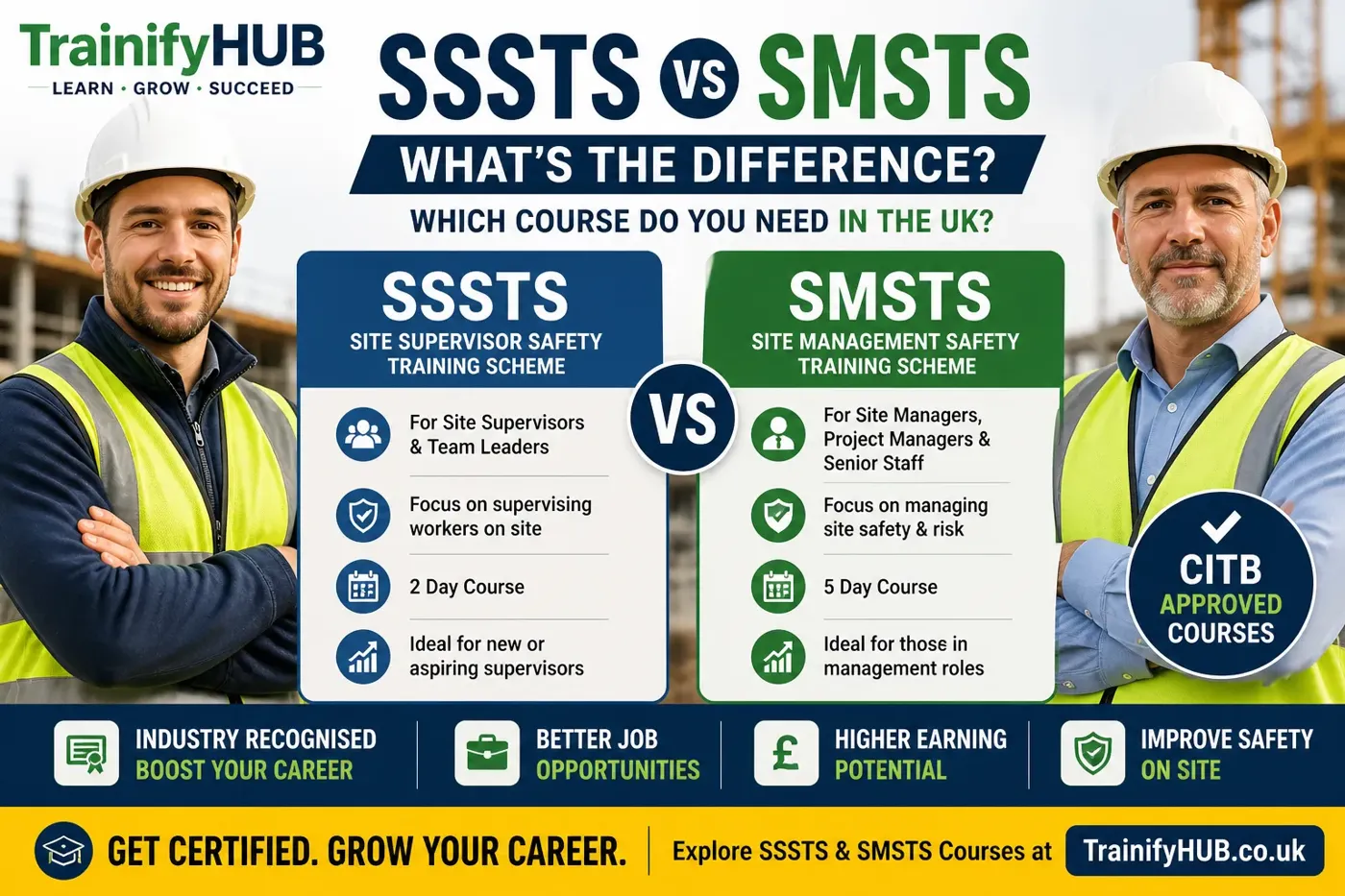
SSSTS and SMSTS are both CITB safety courses, but they train for different jobs. SSSTS is a two-day course built for supervisors. SMSTS is a five-day course built for managers.
The confusion often starts with the name itself. Some training providers, including CITB's own refresher course page, call it the "Site Supervision Safety Training Scheme." Others call it the "Site Supervisors' Safety Training Scheme." Both refer to the same course and the same certificate, so the wording difference is not something you need to worry about when booking.
The real distinction is about responsibility, not paperwork. SSSTS prepares you to supervise a task or a small team on the ground. SMSTS prepares you to manage an entire site, including legal duties under UK construction law.
What Does the SSSTS Course Cover?
The SSSTS course teaches supervisors how to apply health and safety law at the task level. It covers risk assessments, method statements, toolbox talks, and how to report issues up to a site manager.
By the end of the course, a supervisor should be able to run daily site inspections, brief a team on the day's risks, and spot unsafe behaviour before it causes harm. The course sits inside CITB's Site Safety Plus programme, and Build UK requires it for supervisors working on their member sites.
Who Should Take SSSTS?
SSSTS suits anyone who already holds, or is about to hold, a supervisory role. This includes foremen, gangers, working supervisors, and team leaders responsible for a small work package.
You do not need prior health and safety qualifications to book the course. You do need a good working level of spoken and written English, since the course includes group discussion and a written assessment.
How Long Is the SSSTS Course?
SSSTS runs for two days, or around 15 hours of instruction. The certificate is valid for five years, after which you renew it with a one-day SSSTS refresher course.
What Does the SMSTS Course Cover?
The SMSTS course trains site managers to plan and control safety across an entire construction site, not just a single task. It covers the Construction (Design and Management) Regulations 2015, contractor control, plant and lifting operations, temporary works management, and incident investigation.
The course goes deeper into legal accountability than SSSTS does. A site manager who completes SMSTS is expected to sign off the construction phase plan, coordinate subcontractors, and act as the main point of contact for the principal contractor or the HSE.
Who Should Take SMSTS?
SMSTS is aimed at site managers, project managers, contracts managers, and agents. Most Tier 1 main contractors will not put someone in charge of a site without a valid SMSTS certificate on file.
There are no formal entry requirements for SMSTS. CITB does recommend that anyone without prior health and safety management experience take the shorter SSSTS course first, but this is guidance rather than a rule.
How Long Is the SMSTS Course?
SMSTS runs for five days. Like SSSTS, the certificate stays valid for five years, and you renew it with a two-day SMSTS refresher rather than sitting the full course again.
Do You Need SSSTS Before You Can Take SMSTS?
No. You can book SMSTS directly, even if you have never done SSSTS. Many people follow a natural path from supervisor to manager and take SSSTS first, but CITB does not enforce this as a prerequisite.
The only thing that matters is matching the course to the role you actually hold or are about to hold. A supervisor who books SMSTS but never manages a full site gains little from the extra three days of content. A manager who only holds SSSTS may be under-qualified for the legal duties their role carries.
How Has CITB Funding Changed for SSSTS and SMSTS in 2026?
CITB moved short course funding away from its direct Grants Scheme from 8 January 2026. SSSTS, SMSTS, and most other Site Safety Plus short courses now run through local CITB Employer Networks instead, per CITB's funding update covering the change (citb.co.uk, 2026).
This changes both how you claim funding and how much you get. Health and safety short courses are now funded at around 30% of CITB's calculated average market rate, down from the 70% match funding available under the old Employer Network model. Employers need to check registration status with their local CITB adviser before assuming funding is available, since access depends on regional network budgets that run out once spent.
How Much Do SSSTS and SMSTS Cost in 2026?
Course prices vary by training provider, location, and delivery format, so there is no fixed national price for either course. What has changed is the funding contribution available toward that price.
Under the new Employer Network model, SMSTS funding sits at £115 per delegate, down from up to £240 under the old grant scheme. SSSTS funding also sits at £115, compared with up to £120 under the previous grants scheme or £189 under the older Employer Network rate. If you booked training before 8 December 2025 for delivery before 31 March 2026, you may still be able to claim at the older, higher rate, so it is worth keeping proof of your original booking date.
What Happens When Your SSSTS or SMSTS Certificate Expires?
Both certificates last five years from the date you pass. Once that window closes, you cannot simply keep working under an expired certificate, and most sites will not let you.
SSSTS renews through a one-day refresher course. SMSTS renews through a two-day refresher. Both refreshers cover legislative changes and updated practice since your original course, and CITB recommends booking your refresher at least six months before your certificate expires to avoid a gap.
Which Course Do You Need for Your Role?
If your day-to-day work involves supervising a team, running toolbox talks, and reporting to a site manager, SSSTS is the right course. This is the case even if you carry the title "supervisor" only informally, or expect to move into that role soon.
If you are accountable for the site as a whole, sign off safety documentation, manage other supervisors, or deal directly with the principal contractor or HSE, you need SMSTS. A common problem at tender pre-qualification and HSE inspections is finding someone doing a site manager's job while holding only an SSSTS certificate. The qualification does not stretch to cover duties it was not built for.
Anyone planning to prepare for the exam side of either course can review TrainifyHUB's SMSTS course for the full five-day management syllabus, and the SMSTS mock test is a useful way to check readiness before sitting the real exam.
Why Do These Courses Matter for Site Safety?
Construction remains one of the most dangerous sectors to work in. HSE's 2024/25 figures show 35 construction worker deaths, down from 51 the year before, but construction still accounted for the largest share of any industry sector, per HSE's published fatality statistics (hse.gov.uk, published 2 July 2025).
Falls from height stayed the single biggest cause of fatal injury across all industries that year. Good supervision and good site management are two of the few controls that directly reduce that risk, which is exactly what SSSTS and SMSTS are designed to build.
For anyone new to construction site safety more broadly, TrainifyHUB's construction site safety awareness course covers the foundational knowledge that sits underneath both SSSTS and SMSTS, and is a sensible starting point before committing to either qualification.