 More in Health & Social Care
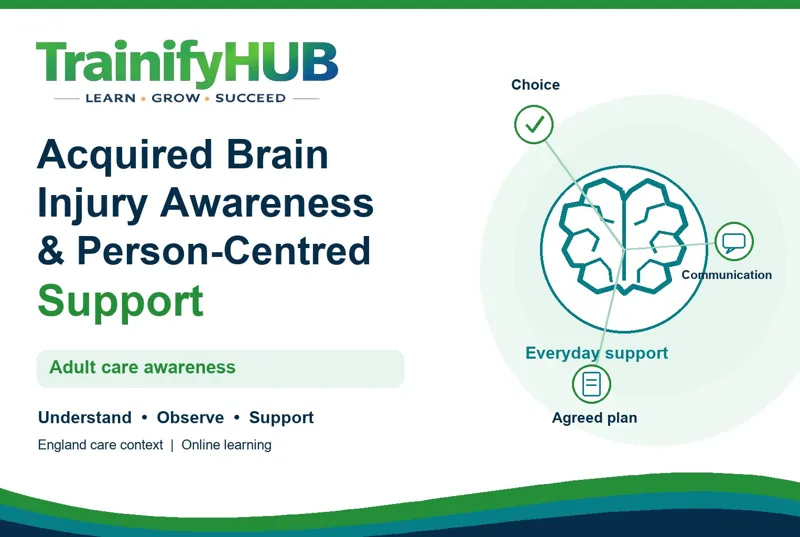
Acquired Brain Injury Awareness & Person-Centred Support
Understand acquired brain injury and support the person’s goals, communication and everyday routines within an adult care role. Practise factual observation and appropriate escalation through eight Modules and independent scenarios.
No ratings yet
3.00 CPD Points
MODULES
9
ESTIMATED DURATION
2h 48m
STUDENTS
0+
LEVEL
beginner
Course Price
£20.00
One-time payment - 9 months' access
Buying for your team?
Up to 30% off per seat: 10+ seats 10%, 25+ seats 20%, 50+ seats 30%.
This course includes:
9 comprehensive modules
8 video lessons
1 downloadable resource (PDF)
Final assessment included
9 months’ access on mobile & desktop
Certificate of completion
3.00 CPD Points
CATEGORY
Health & Social CareLAST UPDATED
Nov 2026
About this course
This course helps adult care workers understand how acquired brain injury can affect everyday life and provide person-centred support within their role. Explore the person’s priorities, agreed communication and memory aids, fatigue, emotional changes and coordinated rehabilitation instructions.
Use factual observations and appropriate help rather than diagnosing, predicting recovery or changing treatment. The course uses an England care-provider context and official NICE, NHS and CQC sources. It is a non-regulated awareness course.
Estimated total learning time is approximately 2 hours 48 minutes, including video learning, self-study and the final assessment.
Learning Outcomes
Module 1 - Understanding Acquired Brain Injury
An acquired brain injury is an injury acquired after birth and can follow external trauma or other acquired causes. This is background awareness, not a method for deciding the cause of someone’s current difficulty. Historical labels do not establish what the person can do today. Changes can be less visible than a movement difficulty: someone may speak fluently or walk independently while finding appointments, busy conversations or organising a routine difficult. Start from the person’s own account and current support information, rather than assuming either dependence or complete independence. The CUH information describes possible experiences, including memory gaps, but it cannot explain an individual’s symptoms without that person’s clinical information.
By the end of this Module, learners will be able to:
Describe ABI as an acquired injury with varied possible effects.
Distinguish traumatic injury from other acquired causes.
Recognise that effects and recovery differ between people.
Explain the limits of an adult care-awareness role.
Workplace application
Arthur is 52 and lives in supported living after a recorded traumatic brain injury in a fall six months ago. His agreed support plan concerns daily routines and community participation. While looking at photographs, he says he cannot remember his hospital stay and asks whether he will ever get better. The brief supplies no neurological test result, diagnosis explaining his memory gap or recovery forecast. There is no reported recent head injury or immediate emergency in this brief.
Listen and acknowledge Arthur’s concern. Do not explain his personal memory gap as PTA or promise recovery. Check what individual information and support have been agreed and seek appropriate advice through the recorded contact. Document his own words and the support actually offered, not a new diagnosis or a successful reassurance outcome.
Module 2 - Knowing the Person and Their Goals
Collaborative rehabilitation goals describe what matters to the person and the support needed to work towards it. A daily timetable is not the same as a personal goal. A worker may notice that a routine no longer reflects a preference, or that practical arrangements make participation difficult. Share that observation so the relevant people can review it with the person. Do not equate an invitation to try something with permission to compel participation. Ask what the person wants, explain available choices accessibly and clarify unresolved conflict through the authorised process. This course does not determine a person’s legal capacity or another person’s legal authority.
By the end of this Module, learners will be able to:
Identify the person’s strengths, preferences and meaningful activities.
Support involvement in everyday care decisions.
Distinguish a personal goal from a staff-preferred routine.
Identify information requiring clarification in the current plan.
Workplace application
Elena is 38 and receives home care after ABI. Her plan includes a chosen goal of potting plants on her patio. Today she says she feels anxious about going outside and would prefer to stay inside. A relative previously asked staff to make sure she goes out every day. No authority to override her choice or revised support instruction is supplied.
Elena has expressed a preference that matters. Ask what support she would find helpful and clarify how her goal can be approached within the current arrangements. Do not invent an alternative activity, fixed rest period or consent. Record the preference and seek review of the family instruction if it conflicts with person-centred support.
Module 3 - Supporting Communication, Memory and Thinking
Keep everyday observations distinct from specialist cognitive assessment without assuming that general guidance gives a worker assessment authority. An observation such as “asked for the instruction to be repeated” records an event; “has lost capacity” is a different, unsupported conclusion. A diary, visual prompt, quieter setting or one-step explanation may be helpful where agreed with the person and consistent with current instructions. Do not introduce a new device, test or therapeutic programme merely because a general information page mentions one. Report when support is missing, confusing or no longer helpful.
By the end of this Module, learners will be able to:
Recognise everyday communication or memory support needs.
Use agreed accessible information and prompts within role.
Allow time without assuming inability to decide.
Recognise when specialist advice is needed.
Workplace application
David is 64 and lives in a care home after a recorded ABI. During dressing he stops partway through, drops an item of clothing and says he is frustrated. An agency worker starts asking questions to test his memory. The brief supplies no diagnostic result or agreed visual chart. The current communication instructions have not yet been checked. There is no reported recent head injury or acute emergency in this brief.
Stop treating a few questions as authority to diagnose or label David. Respectfully reduce pressure, ask what help he wants and check the current communication support instructions. An agreed aid may then be used within role; the brief does not authorise inventing one. Record the dressing difficulty and frustration factually and obtain appropriate clarification.
Module 4 - Fatigue and Everyday Activities
Fatigue may affect both thinking and physical activity and may vary from day to day. A demanding conversation, appointment or journey can affect participation, but an observer cannot establish the medical cause of tiredness, distress or confusion. Read the individual instructions for activity, rest and support, ask about the person’s priorities and record how the routine is affecting them. New or worsening problems need suitable advice rather than a fixed recovery timetable or an assumption that everything is due to ABI. A family request to increase exercise does not replace authorised rehabilitation instructions.
By the end of this Module, learners will be able to:
Recognise how cognitive and physical effort may affect daily life.
Support agreed routines, rest and priorities.
Follow authorised approaches to daily activities and equipment.
Report new or worsening difficulties without prescribing treatment.
Workplace application
Sarah is 29 and receives home care after ABI. Her plan includes support for a chosen shopping visit. On returning she reports exhaustion and has difficulty concentrating on preparing lunch. A relative asks the worker to double her exercise routine. The brief supplies no medical explanation, revised therapy instruction, safe swallowing instruction or agreed exercise change.
Sarah reports exhaustion; its cause is unknown. Support a safe pause or other response consistent with her wishes and current instructions and seek advice about changed needs. Do not double exercise, prescribe fluids or defer essential care indefinitely. Record her report and what actually occurs. Urgent new symptoms require the appropriate urgent help route.
Module 5 - Responding to Emotional and Behavioural Changes
Respond calmly and respectfully without assigning every emotional or behavioural change to brain damage. People can experience distress for many reasons. Listen to what the person says and consider relevant facts such as noise, interrupted routines, discomfort or a missing support aid, without asserting a cause. Privacy and dignity matter when recording and discussing difficult events. Offer understandable choices within the plan. An offered quiet space is not evidence that the person accepts it or that their distress resolves. Seek help promptly for safety concerns and use emergency help when needed.
By the end of this Module, learners will be able to:
Recognise possible emotional or behavioural changes without diagnosing.
Use calm respectful communication and maintain dignity.
Consider context and unmet support needs.
Seek appropriate help when wellbeing or safety concerns arise.
Workplace application
Marcus is 45 and lives in a care home after ABI. During a noisy celebration he shouts, puts his cup down forcefully and says he is not the person he used to be. A staff member suggests physically taking him to another room as a punishment. The brief establishes neither the cause of his distress nor that he accepts help. There is no reported recent head injury in this everyday-support example; any actual immediate danger still requires prompt appropriate help.
Do not use punishment or treat this awareness exercise as training or authority for physical intervention. Respond calmly, protect dignity, offer space or a quieter option where safe and appropriate, and obtain trained help if needed. Noise and Marcus’s words are facts; a neurological or psychological explanation and acceptance of an offer are not. Record the actual response without promising resolution.
Module 6 - Working with Rehabilitation Plans and Teams
Rehabilitation may involve different professionals, and the relevant combination depends on the individual. The care worker needs clear instructions for their own contribution and a usable route for questions, not a self-assigned clinical case-management category. Check which plan is current, what support is agreed, and who should be contacted if information conflicts. A written reference to a therapy activity is not itself practical training or authority to deliver it. Share factual observations through authorised channels and protect confidentiality. A coordinator or specialist decides any change to a rehabilitation programme through the appropriate process.
By the end of this Module, learners will be able to:
Identify the purpose of an individual rehabilitation plan.
Distinguish worker support from specialist assessment or treatment.
Use the recorded contact and clarification routes.
Share factual observations while respecting confidentiality.
Workplace application
Rachel is 41 and receives home care with a rehabilitation plan involving different professionals. Her current written instructions include support with a daily planner after breakfast. At handover a colleague says she made no effort and that the plan is wrong, but gives no factual account of what happened. The brief supplies no actual session duration, reason for difficulty, current professional role allocation or authority to amend the plan.
The handover contains an opinion and missing facts. Check the current written instruction and ask what Rachel said, what support was offered and what was observed. Use the recorded contact for unresolved instructions. Do not abandon or redesign therapy, infer a complex-case-manager allocation or invent a 5-minute success. Record only actual information and the clarification sought.
Module 7 - Recognising Changes and Seeking Help
Keep emergency recognition separate from the person’s usual recorded ABI support needs. A recent injury and a new change must not be labelled ordinary ABI without appropriate advice. Record what is actually observed and reported, when it began and where help is needed. A worker does not need to diagnose an injury before seeking urgent help. Do not postpone emergency action for an internal permission, routine paperwork or a complete checklist. Use the current source page for its full advice and the emergency call-handler’s instructions; the selected examples here are not a diagnostic test or an exhaustive triage tool.
By the end of this Module, learners will be able to:
Distinguish usual recorded needs from new changes.
Recognise adult 999 signs after a recent head injury.
Distinguish separate NHS 111 advice in that context.
Communicate observations promptly without delaying urgent help.
Workplace application
Brian is 58 and lives in supported living with recorded ABI. A worker hears a thud. Brian says he slipped and hit his head. The worker sees clear fluid from his nose and observes that he struggles to stay awake. A colleague suggests leaving a routine note for tomorrow. No diagnosis or subsequent outcome is supplied.
Brian’s supplied recent-head-injury features require 999. Call without waiting for routine records or manager permission, give factual observations and follow emergency advice and trained local procedures. Do not diagnose skull fracture or fluid type, perform an untrained technique or invent the outcome. Arrange any internal notification so it does not delay emergency help.
Module 8 - Person-Centred Support Scenarios
Complex scenarios combine the person’s expressed choice, current instructions, actual observations and missing information. Keep these categories distinct. A family member’s request can be important information without proving authority to change care. A worker can explain their role calmly, support the person to be heard and seek appropriate clarification. Record the request and the response actually given, not an assumed outcome. If a safety concern is urgent, the help route takes priority over routine administration. If the information is incomplete, state the uncertainty and seek advice rather than filling the gap with an invented fact.
By the end of this Module, learners will be able to:
Combine the person’s choices, current plan and role limits.
Identify facts, uncertainties and safe next steps.
Record support, changes, contacts and advice accurately.
Identify when support arrangements need review.
Workplace application
Hannah is 34 and receives home care after ABI. Her current plan records a fictional individual instruction for 15minutes of supported gentle walking. Today she says she feels exhausted and wants to stay indoors. A visiting brother insists on a 2-hour hike. The brief does not establish his legal authority, a new therapy instruction or that a different indoor activity has been agreed. These fictional durations are not universal activity limits.
Respect Hannah’s expressed wish and clarify the conflict with the current plan. Explain that the worker cannot adopt a new exercise request on the strength of family pressure. Seek authorised advice through the agreed route and document the facts and request without asserting the brother’s legal status, inventing therapist approval or recording that an alternative activity succeeded.
Accreditation & Recognition
This course is officially recognised and certified
3.00
CPD
Points Awarded
All accreditations are verified and recognised by relevant industry bodies. Upon successful completion, your certificate will display the appropriate accreditation marks.
Frequently Asked Questions
16 questions answered
Adult care workers, agency staff and support staff working in care homes, home care and supported living in England.
The course explores possible everyday effects of acquired brain injury, the person’s goals, agreed communication and memory support, fatigue, respectful responses, rehabilitation plans and appropriate help.
No. It supports awareness, factual observation and following current individual instructions. Diagnosis and recovery advice require appropriate professional input.
No. This is a non-regulated awareness course and does not award an RQF level, clinical registration or practical competence.
No formal employment or qualification prerequisite is imposed. You need a suitable way to access the learning material and complete the independent written activities.
Adult stroke rehabilitation is outside the NICE NG252 framework used here. The course does not teach a stroke-specific rehabilitation pathway.
No. The course distinguishes everyday observation and agreed support from formal assessment. It does not authorise cognitive testing or legal capacity assessment.
Use the authorised contact route to clarify the current plan and your role. Do not invent a therapy programme or change medicines, diet, fluids or activity instructions independently. Emergency help must not wait for routine clarification.
Adult recent-head-injury examples use the current NHS emergency and urgent-advice guidance. The course does not diagnose an injury or replace emergency call-handler instructions.
Eight teaching Modules are accompanied by a learner workbook with complete fictional examples, independent written tasks and review guidance. No real care records, practical test or employer visit is required.
Allow approximately 2 hours 48 minutes in total, including the teaching videos, independent reading and activities, review and the final assessment. You can take additional time to review and complete your own work.
The final assessment has 15 single-answer multiple-choice questions with four options each. Pass with at least 12 correct answers (80 percent). The settings allow up to 10 attempts, 30 minutes per attempt and randomised questions, subject to the actual on-screen instructions.
Yes. Complete your own answers after the learning. Use a quiet place, check your device and connection, read all options and follow the instructions about permitted resources. Do not let another person answer for you.
Learner access is nine months from assignment. Company entitlements that have not yet been assigned do not expire.
A TrainifyHUB certificate of completion follows a passing knowledge assessment. Its platform validity is one year from passing. This does not establish practical or clinical competence.
Ask for accessible learning support or an alternative format where needed before starting. Allow time to pause, review and complete your own responses. Actual platform features and support arrangements should be checked when arranging access.
What You'll Learn
✓ Recognise ABI effects and individual differences without diagnosing.
✓ Support the person’s goals and accessible communication within the current plan.
✓ Use agreed routines and factual observations when fatigue or distress affects daily life.
✓ Clarify rehabilitation instructions and seek appropriate help without delaying an emergency.
Why Take This Course
✓ Practise distinguishing supplied facts from assumptions using complete fictional care scenarios.
✓ Strengthen respectful communication and person-centred support within your role.
✓ Recognise when current instructions or professional/emergency advice are required.
✓ Connect awareness learning with separately required local induction and practical role training.
🌍 Available Online Across the UK
Flexible online learning for individuals and company teams across England, Scotland, Wales and Northern Ireland, including:
✓ London ✓ Birmingham ✓ Leicester
✓ Coventry ✓ Nottingham ✓ Derby
✓ Manchester ✓ Liverpool ✓ Leeds
✓ Sheffield ✓ Bradford ✓ Newcastle
✓ Bristol ✓ Southampton ✓ Portsmouth
✓ Brighton ✓ Oxford ✓ Cambridge
✓ Norwich ✓ Glasgow ✓ Edinburgh
✓ Aberdeen ✓ Dundee ✓ Cardiff
✓ Swansea ✓ Newport ✓ Wrexham
✓ Belfast ✓ Derry/Londonderry
Online availability does not make the England-specific provider or legal context identical across the UK. Check the local requirements and care arrangements that apply to your service.
Certificate of Completion
✓ TrainifyHUB course: 3 CPD points.
✓ Complete all eight teaching Modules and the separate final knowledge assessment. Pass with 12 of 15 correct answers (80 percent).
✓ Completion certificate validity is one year from passing.
✓ This is non-regulated awareness learning, not an RQF qualification, clinical authorisation or practical competence award.
✓ Learner access is nine months from assignment. Unassigned company entitlements do not expire.
Course Highlights
0+
Students Enrolled
New
Be the first!
2h 48m
Estimated Duration


Why book with TrainifyHUB
- CPD accredited training content
- Delivered UK-wide at your workplace
- Certificate of completion included
- Secure, encrypted online payments
Accredited & Trusted
 CPD Accredited Provider
 Secure Payments
Need help choosing a course?
+44 7405 005823 support@trainifyhub.co.uk
Our team can advise on the right training package for your organisation.
Keep learning
Related courses
Picked from what learners take alongside this course.
More in Health & Social Care More in Health & Social Care
 More in Health & Social Care
Health & Social Care
Diabetes Awareness: Essential Knowledge for Care Professionals
4.8(20)
11 modules3h97
£20.00
 More in Health & Social Care
 More in Health & Social Care
Health & Social Care
Care Certificate Standard 16: Awareness of Learning Disability and Autism
4.7(20)
11 modules4h93
£20.00
 More in Health & Social Care
 More in Health & Social Care
Health & Social Care
Dementia Care Awareness Training – CPD Certified (Updated 2026)
4.6(20)
11 modules3h83
£20.00
 More in Health & Social Care
Student Reviews
0.0
0 stars
Based on 0 reviews
5
0
4
0
3
0
2
0
1
0
🔒 Log In to Review
You must be logged in to submit a review. Please log in or create an account.