 More in Health & Social Care
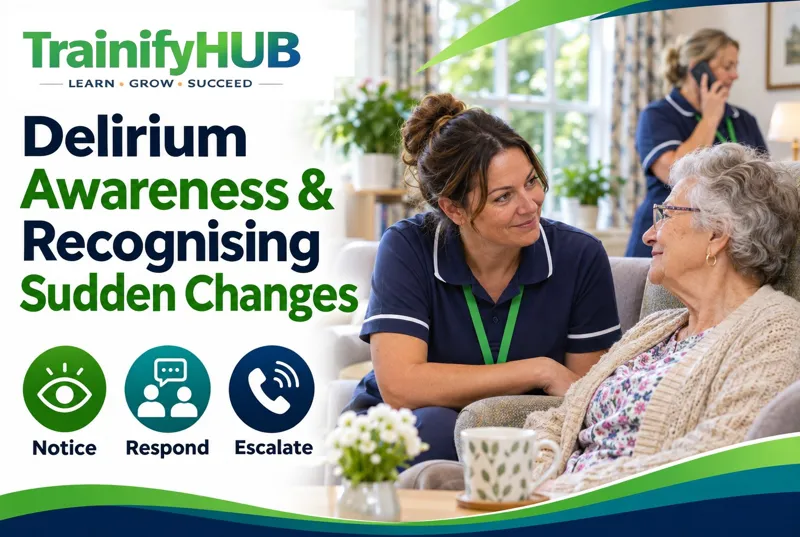
Delirium Awareness & Recognising Sudden Changes
Develop adult-care awareness to recognise sudden confusion and communicate changes without diagnosing. Explore eight Modules with source-grounded examples, written activities and a final knowledge assessment.
No ratings yet
2.00 CPD Points
MODULES
9
ESTIMATED DURATION
2h 30m
STUDENTS
1+
LEVEL
beginner
Course Price
£20.00
One-time payment - 9 months' access
Buying for your team?
Up to 30% off per seat: 10+ seats 10%, 25+ seats 20%, 50+ seats 30%.
This course includes:
9 comprehensive modules
8 video lessons
1 downloadable resource (PDF)
Final assessment included
9 months’ access on mobile & desktop
Certificate of completion
2.00 CPD Points
CATEGORY
Health & Social CareLAST UPDATED
Nov 2026
About this course
Delirium can change attention, thinking and everyday communication rapidly. This course develops awareness of usual presentation, quieter changes, urgent help, reassurance, agreed everyday support and accurate handover.
Learn through adult-care examples in an England core context, using verified official sources. This non-regulated awareness course supports person-centred observation and communication; it does not award professional, clinical or practical competence.
Learning Outcomes
Module 1 - Understanding Delirium and Sudden Change
Explain delirium awareness without diagnosing.
Distinguish a sudden change from a known usual pattern.
Recognise that delirium can occur alongside dementia.
State the course’s role and setting limits.
Apply your learning: Fictional brief: Morgan usually chats during the morning visit. Today Morgan repeatedly loses the thread and cannot explain where they are. A colleague says this is probably just ageing. The onset is new; no clinical explanation is supplied. In this exercise, identify what is known, distinguish the person’s account from observations and mark missing information explicitly. Read a fictional shift brief; separate observations, assumptions and questions for a factual handover. Explain the reason for your response and identify where advice, escalation or an authorised review is needed. Sudden confusion requires immediate NHS emergency help. Do not wait for a manager, a routine GP appointment, readings or a completed checklist; follow emergency instructions and your trained procedures. Use the supplied facts only: do not add a diagnosis, measured result, contact, permission or agency outcome to make the answer appear complete. Compare your reasoning with the teaching and record an unresolved question for reflection.
Module 2 - Knowing the Person’s Usual Presentation
Identify useful information about usual communication and routine.
Listen to the person and those who know them.
Distinguish direct observation from a reported account.
Seek accessible information without delaying urgent action.
Apply your learning: Fictional brief: Jo uses hearing aids, enjoys familiar radio programmes and usually answers directly. A relative reports a change since yesterday. The handover says only that Jo is difficult today. The current emergency response has not yet been documented. In this exercise, identify what is known, distinguish the person’s account from observations and mark missing information explicitly. Compare two written accounts of the same fictional person; draft a baseline-versus-change table and identify unsupported assumptions. Explain the reason for your response and identify where advice, escalation or an authorised review is needed. Sudden confusion requires immediate NHS emergency help. Do not wait for a manager, a routine GP appointment, readings or a completed checklist; follow emergency instructions and your trained procedures. Use the supplied facts only: do not add a diagnosis, measured result, contact, permission or agency outcome to make the answer appear complete. Compare your reasoning with the teaching and record an unresolved question for reflection.
Module 3 - Recognising Changes Including Quiet Delirium
Recognise changes in attention, communication or alertness.
Notice withdrawal or slower responses as well as agitation.
Describe fluctuation factually.
Avoid labelling change as merely ageing or dementia.
Apply your learning: Fictional brief: Lee is usually alert and joins lunch. Today Lee is unusually quiet, slow to respond and withdrawn. A colleague says there is no concern because Lee is not agitated. No diagnosis or measured observations are provided. In this exercise, identify what is known, distinguish the person’s account from observations and mark missing information explicitly. Sort fictional observations into known baseline, new change and information missing; explain which changes require immediate escalation. Explain the reason for your response and identify where advice, escalation or an authorised review is needed. Sudden confusion requires immediate NHS emergency help. Do not wait for a manager, a routine GP appointment, readings or a completed checklist; follow emergency instructions and your trained procedures. Use the supplied facts only: do not add a diagnosis, measured result, contact, permission or agency outcome to make the answer appear complete. Compare your reasoning with the teaching and record an unresolved question for reflection.
Module 4 - Responding to Sudden Confusion and Getting Urgent Help
Identify the NHS emergency route for sudden confusion.
Give clear location, onset and change information.
Recognise unsafe delays while seeking managerial approval.
Follow emergency instructions within role.
Apply your learning: Fictional brief: During a home-care visit Sam suddenly seems confused and cannot follow familiar conversation. The supervisor is not answering. A colleague suggests completing the full routine checklist and waiting for tomorrow’s GP review. The address is in the care record. In this exercise, identify what is known, distinguish the person’s account from observations and mark missing information explicitly. Write the first three actions and a concise emergency handover for a supplied sudden-change scenario; explain why a routine review would delay help. Explain the reason for your response and identify where advice, escalation or an authorised review is needed. Sudden confusion requires immediate NHS emergency help. Do not wait for a manager, a routine GP appointment, readings or a completed checklist; follow emergency instructions and your trained procedures. Use the supplied facts only: do not add a diagnosis, measured result, contact, permission or agency outcome to make the answer appear complete. Compare your reasoning with the teaching and record an unresolved question for reflection.
Module 5 - Communication, Reassurance and Immediate Support
Introduce yourself and explain actions simply.
Use calm, brief communication and reassurance.
Respect communication aids and preferences.
Avoid excessive questioning or unauthorised restriction.
Apply your learning: Fictional brief: Emergency help has been requested for a sudden change. Pat looks distressed and several people are asking questions at once. Pat uses glasses and prefers short sentences. No authority for restraint or clinical treatment has been given. In this exercise, identify what is known, distinguish the person’s account from observations and mark missing information explicitly. Rewrite an unhelpful fictional conversation into six respectful exchanges, then identify practical support that remains within the worker’s role. Explain the reason for your response and identify where advice, escalation or an authorised review is needed. Sudden confusion requires immediate NHS emergency help. Do not wait for a manager, a routine GP appointment, readings or a completed checklist; follow emergency instructions and your trained procedures. Use the supplied facts only: do not add a diagnosis, measured result, contact, permission or agency outcome to make the answer appear complete. Compare your reasoning with the teaching and record an unresolved question for reflection.
Module 6 - Everyday Support Within Agreed Care Plans
Describe the purpose of personalised support.
Check existing plans for eating, drinking and mobility needs.
Report concerns about comfort, sensory aids or sleep.
Distinguish care-worker support from clinical treatment decisions.
Apply your learning: Fictional brief: Following professional review, Alex has an authorised support plan describing preferred drinks, existing mobility assistance and use of hearing aids. Today a worker notices discomfort and less participation. The plan contains no authority to change medicines or prescribe treatment. In this exercise, identify what is known, distinguish the person’s account from observations and mark missing information explicitly. Review a supplied care-plan excerpt; identify four safe support actions and four points requiring advice, with reasons. Explain the reason for your response and identify where advice, escalation or an authorised review is needed. Sudden confusion requires immediate NHS emergency help. Do not wait for a manager, a routine GP appointment, readings or a completed checklist; follow emergency instructions and your trained procedures. Use the supplied facts only: do not add a diagnosis, measured result, contact, permission or agency outcome to make the answer appear complete. Compare your reasoning with the teaching and record an unresolved question for reflection.
Module 7 - Recording, Handover and Follow-Up
Record observed change, timing, contacts and advice.
Separate facts from inference in records.
Support accurate authorised handover.
Escalate continuing or recurrent concerns through agreed routes.
Apply your learning: Fictional brief: A draft note says Taylor was confused because of a urine infection and the family was told. The worker actually observed a sudden change, contacted emergency services and followed advice. No clinician has supplied a diagnosis; the note omits timings and advice. In this exercise, identify what is known, distinguish the person’s account from observations and mark missing information explicitly. Correct a flawed incident note and produce a short handover plus two follow-up questions; do not invent a diagnosis or contact. Explain the reason for your response and identify where advice, escalation or an authorised review is needed. Sudden confusion requires immediate NHS emergency help. Do not wait for a manager, a routine GP appointment, readings or a completed checklist; follow emergency instructions and your trained procedures. Use the supplied facts only: do not add a diagnosis, measured result, contact, permission or agency outcome to make the answer appear complete. Compare your reasoning with the teaching and record an unresolved question for reflection.
Module 8 - Applying Learning Through Care Scenarios
Apply immediate escalation to a home-care scenario.
Recognise a quiet change in a care-home scenario.
Identify unsafe assumptions in team discussion.
Explain learning to carry into local supervision.
Apply your learning: Fictional briefs: In a care home, Ren becomes unusually withdrawn compared with yesterday. In home care, Ash suddenly cannot make sense of a familiar conversation. Neither brief supplies a diagnosis. Local contact details and measured readings have not been provided. In this exercise, identify what is known, distinguish the person’s account from observations and mark missing information explicitly. Complete two fictional scenario responses and a written action reflection, stating what is known, what is missing and what must happen next. Explain the reason for your response and identify where advice, escalation or an authorised review is needed. Sudden confusion requires immediate NHS emergency help. Do not wait for a manager, a routine GP appointment, readings or a completed checklist; follow emergency instructions and your trained procedures. Use the supplied facts only: do not add a diagnosis, measured result, contact, permission or agency outcome to make the answer appear complete. Compare your reasoning with the teaching and record an unresolved question for reflection.
Accreditation & Recognition
This course is officially recognised and certified
2.00
CPD
Points Awarded
All accreditations are verified and recognised by relevant industry bodies. Upon successful completion, your certificate will display the appropriate accreditation marks.
Frequently Asked Questions
16 questions answered
It means noticing and communicating new changes in attention, thinking, communication or alertness without making a diagnosis or choosing a clinical cause.
No. Delirium can occur alongside dementia. A known diagnosis must not be used to dismiss a sudden new change.
Yes. New withdrawal, slower responses and reduced participation can be concerning. Absence of agitation is not reassurance by itself.
Use the current NHS emergency advice immediately: go to A&E or call 999. In the care-setting scenarios, call 999 and follow instructions without waiting for managerial permission or routine checks.
No. The course does not confer screening, scoring or diagnostic competence. It distinguishes appropriate practitioner assessment and expert diagnosis from worker awareness.
Follow the current authorised plan, role training and professional advice. The course does not prescribe fluids, exercises, medicines, oxygen or other clinical treatment.
NICE CG103 is scoped to hospitals and long-term care. Setting-specific recommendations must not be treated as universal home-care instructions.
Adult care workers, agency staff and support workers in care homes, home care and supported living. The main provider and legal context is England; online access elsewhere does not make England law universal.
No formal qualification is required for this awareness learning. You need to access the teaching and written activities and follow your employer’s current care, reporting and emergency arrangements in real work.
Eight teaching Modules are paired with a learner workbook containing complete fictional briefs, independent written responses and reflection. No real care records, employer visit or practical test is required.
The estimated total course learning time is approximately 2 hours 30 minutes including video learning, self-study and the final assessment. Allow time to pause, review and complete your own responses; this is an estimate, not a guarantee of an individual learner’s speed.
Answer 15 single-answer multiple-choice questions with four options each. Pass with at least 12 correct answers (80 percent). Required settings are 30 minutes, up to 10 attempts and randomised questions; follow the actual on-screen instructions.
Yes. Complete your own answers after learning, use a quiet place and a working device and connection, read every option and use only permitted resources. Another person must not answer for you.
Learner access is nine months from assignment. Company entitlements that have not been assigned do not expire.
A TrainifyHUB certificate of completion follows a passing knowledge assessment, with platform validity of one year from passing. This non-regulated course awards no RQF level, accreditation, registration or clinical or practical competence.
Ask for accessible support or an alternative format if needed, and take time to pause and review. Actual caption, playback and support arrangements require checking when access is arranged.
What You'll Learn
Explain the awareness purpose and why new confusion matters.
Use the person’s baseline and trusted observations.
Notice concerning changes that may be less obvious.
Act promptly under the current emergency advice.
Support the person safely while help is arranged.
Recognise supportive care without independently treating.
Keep a useful factual trail and share continuing concerns.
Choose timely, respectful action across care settings.
Why Take This Course
Everyday care requires respectful communication, attention to changes and clear role boundaries. Complete self-contained fictional activities to practise separating facts from assumptions, explain a safe response and identify when appropriate help or review is needed.
Sudden confusion requires immediate NHS emergency help. Do not wait for a manager, a routine GP appointment, readings or a completed checklist; follow emergency instructions and your trained procedures.
🌍 Available Online Across the UK
This course is available online from England, Scotland, Wales and Northern Ireland using a suitable device and internet connection. Locations include:
✓ London ✓ Birmingham ✓ Leicester
✓ Coventry ✓ Nottingham ✓ Derby
✓ Manchester ✓ Liverpool ✓ Leeds
✓ Sheffield ✓ Bradford ✓ Newcastle
✓ Bristol ✓ Southampton ✓ Portsmouth
✓ Brighton ✓ Oxford ✓ Cambridge
✓ Norwich ✓ Glasgow ✓ Edinburgh
✓ Aberdeen ✓ Dundee ✓ Cardiff
✓ Swansea ✓ Newport ✓ Wrexham
✓ Belfast ✓ Derry/Londonderry
Online access does not extend the course’s stated legal or care-setting scope. Follow applicable local requirements, employer policies and role boundaries; practical training, assessment and authorisation remain separate.
Certificate of Completion
A TrainifyHUB certificate of completion follows a passing knowledge assessment: at least 12 correct answers out of 15 (80 percent). Certificate validity is one year from passing. This is a non-regulated awareness certificate, with no RQF level, accreditation, clinical registration or practical competence award.
Learner access is nine months from assignment. Unassigned company entitlements do not expire.
Course Highlights
1+
Students Enrolled
New
Be the first!
2h 30m
Estimated Duration


Why book with TrainifyHUB
- CPD accredited training content
- Delivered UK-wide at your workplace
- Certificate of completion included
- Secure, encrypted online payments
Accredited & Trusted
 CPD Accredited Provider
 Secure Payments
Need help choosing a course?
+44 7405 005823 support@trainifyhub.co.uk
Our team can advise on the right training package for your organisation.
Keep learning
Related courses
Picked from what learners take alongside this course.
More in Health & Social Care More in Health & Social Care
Health & Social Care
Diabetes Awareness: Essential Knowledge for Care Professionals
4.8(20)
11 modules3h97
£20.00
 More in Health & Social Care
 More in Health & Social Care
Health & Social Care
Care Certificate Standard 16: Awareness of Learning Disability and Autism
4.7(20)
11 modules4h93
£20.00
 More in Health & Social Care
 More in Health & Social Care
Health & Social Care
Dementia Care Awareness Training – CPD Certified (Updated 2026)
4.6(20)
11 modules3h83
£20.00
 More in Health & Social Care
 More in Health & Social Care
Student Reviews
0.0
0 stars
Based on 0 reviews
5
0
4
0
3
0
2
0
1
0
🔒 Log In to Review
You must be logged in to submit a review. Please log in or create an account.