 More in Health & Social Care
Duty of Candour & Incident Reporting
Develop awareness of openness, incident reporting and the distinct duties of workers and registered providers in England adult care.
No ratings yet
3.00 CPD Points
MODULES
9
ESTIMATED DURATION
2h 57m
STUDENTS
0+
LEVEL
beginner

Course Price
£20.00
One-time payment - 9 months' access
Buying for your team?
Up to 30% off per seat: 10+ seats 10%, 25+ seats 20%, 50+ seats 30%.
This course includes:
9 comprehensive modules
8 video lessons
1 downloadable resource (PDF)
Final assessment included
9 months’ access on mobile & desktop
Certificate of completion
3.00 CPD Points
CATEGORY
Health & Social CareLAST UPDATED
Nov 2026
About this course
This self-paced awareness course uses eight Modules and original fictional activities. Explore everyday openness, recognising events, immediate safe support, provider-specific candour decisions, accessible communication, records, notifications and learning. It supports knowledge development and preparation for care roles; it does not award a regulated qualification or clinical/practical competence.
What you need
✓ No formal qualification prerequisite is specified.
✓ Use an accessible internet-enabled device and a way to read or hear the teaching.
✓ Fictional activities do not require employment or access to real care records. Employer procedures, training, authorisation and competence checks remain separate.
Learning time
Approximately 2 hours 57 minutes including video learning, self-study and the final assessment. Individual pace varies.
Learning Outcomes
Module 1 — Openness and the Duty of Candour
Openness includes acknowledging concerns, giving an accurate account within your role and seeking help when information is incomplete. It continues even when the additional notifiable-safety-incident procedure does not apply. Do not conceal an incident while deciding how serious it is.
By the end of this Module, learners will be able to:
✓ Distinguish everyday openness, worker reporting and the registered person’s statutory candour process.
At a fictional home, Nadia learns that an agreed visit was late. Alex says the delay was worrying. Nadia knows when she arrived but does not know why the earlier worker was delayed.
Module 2 — Recognising Incidents and Near Misses
A hazard is a source of possible harm. An incident or error is an event; local reporting definitions explain how to record it. A near miss can reveal a system weakness despite no resulting harm. Reporting and learning are needed without automatically calling every event a statutory notifiable safety incident.
By the end of this Module, learners will be able to:
✓ Identify events needing reporting without treating every hazard or near miss as statutory candour.
A worker finds a wet walkway before anyone uses it. In a separate event a person is found after an unwitnessed fall and sent for assessment; the clinical outcome is not yet known.
Module 3 — Immediate Safety and Internal Reporting
Address immediate danger and obtain appropriate help. Continue safe support within your competence and follow the person’s current plan and emergency arrangements. This course supplies no first-aid, medication, transfer, restraint or equipment-repair technique.
By the end of this Module, learners will be able to:
✓ Explain safe support, prompt reporting and urgent escalation within competence.
At 14:10, Ben finds a person beside a damaged chair. Ben did not see what happened. A trained colleague is obtaining the required urgent support; the normal supervisor is unavailable.
Module 4 — Provider Duties and Thresholds
Regulation 20 distinguishes a health service body in paragraph 8 from other registered persons in paragraph 9. The appropriate definition follows the provider and regulated activity; the building name or a worker’s job title is not enough. Frontline workers report; authorised people establish the legal application with healthcare-professional judgement.
By the end of this Module, learners will be able to:
✓ Explain why authorised provider assessment must use the correct Regulation 20 definition.
A non-health-service-body provider receives a report that a person attended hospital after a care incident. The record contains no confirmed harm findings or professional opinion.
Module 5 — Communication, Apology and Support
Speak respectfully and make communication accessible to the person. Explain known facts without guessing causes or promising an outcome. Offer reasonable support and arrange competent help with communication needs. Record preferences and any agreed next contact.
By the end of this Module, learners will be able to:
✓ Describe honest, accessible communication and formal candour support within the assigned role.
Morgan asks for an explanation after a reported incident and requests an interpreter. A relative also asks to receive all information. No permission or lawful authority for that disclosure has been established.
Module 6 — Accurate Records and Notifications
Records must identify observations, the person’s own account, actions, timing and who was informed. Distinguish a witnessed fact from a report or hypothesis. Correct errors transparently through the approved process; do not erase the original, backdate an entry or invent care.
By the end of this Module, learners will be able to:
✓ Separate internal records, candour correspondence and CQC statutory notifications.
At 09:05, Erin hears a person say “the chair moved”. Erin did not see the event. The shift lead was told at 09:08. No injury assessment or contact with family is recorded.
Module 7 — Learning and Improvement Actions
An incident review should examine evidence, system conditions and the person’s experience. Competent staff establish causes; a worker should not investigate beyond their role or assume misconduct. A report or training attendance alone does not show that the underlying risk has been removed.
By the end of this Module, learners will be able to:
✓ Explain a proportionate learning action with ownership and a check of effectiveness.
A fictional review finds that staff were using two conflicting handover forms. The cause has been confirmed by the authorised reviewer. The proposed response is to introduce one controlled form.
Module 8 — Role-Based Incident Scenarios
Combine immediate support, factual reporting, openness and appropriate provider review. Treat each issue separately: a safety concern, a request for information and a notification decision do not have identical owners or urgency.
By the end of this Module, learners will be able to:
✓ Apply worker and authorised-provider responsibilities without inventing missing facts.
At a fictional home, an unwitnessed event is reported. A person is receiving urgent assessment; their relative requests a full explanation. The usual manager cannot be reached, and a previously reported walkway concern remains unresolved. No clinical findings or representative authority are yet available.
Final Assessment
Choose one correct answer for each of 15 multiple-choice questions. Read every option and complete your own assessment. The pass mark is 80%, requiring 12 correct answers. Check your device and internet connection, work in a quiet place and follow platform instructions about permitted resources.
Accreditation & Recognition
This course is officially recognised and certified
3.00
CPD
Points Awarded
All accreditations are verified and recognised by relevant industry bodies. Upon successful completion, your certificate will display the appropriate accreditation marks.
Frequently Asked Questions
16 questions answered
Adult care workers and people preparing for those roles in England.
CQC provider context is England; do not present it as UK-wide law.
No. It is online awareness; workplace training and competence assessment remain separate.
There are 15 single-answer multiple-choice questions. Pass with at least 12 correct answers out of 15 (80%).
Nine months from assignment; unassigned company entitlements do not expire.
One year from passing; no statutory annual refresher is implied.
Approximately 2 hours 57 minutes of structured learning. Individual pace varies.
This CPD-accredited course carries 3 CPD points. It does not replace employer induction, role authorisation or workplace competence assessment.
No. Report under applicable local arrangements while authorised people consider the provider-specific statutory definition.
No. Further facts and appropriate professional judgement may be needed.
No. It is part of certain defined outcomes, not a general waiting period before action or reporting.
CQC explains that an apology is not by itself an admission of liability. Do not make promises about legal or insurance outcomes.
No. Internal reporting, candour and event-specific statutory notifications are distinct obligations.
The registered provider uses appropriately authorised people and the relevant professional judgement; a frontline worker should report facts within role.
No. Appropriate relevant-person status, authority, consent and confidentiality arrangements need to be considered.
No. Use the fictional briefs in the supplied learner workbook. Do not disclose real personal information or incident records.
What You'll Learn
✓ Distinguish everyday openness, worker reporting and the registered person’s statutory candour process.
✓ Identify events needing reporting without treating every hazard or near miss as statutory candour.
✓ Explain safe support, prompt reporting and urgent escalation within competence.
✓ Explain why authorised provider assessment must use the correct Regulation 20 definition.
✓ Describe honest, accessible communication and formal candour support within the assigned role.
✓ Separate internal records, candour correspondence and CQC statutory notifications.
✓ Explain a proportionate learning action with ownership and a check of effectiveness.
✓ Apply worker and authorised-provider responsibilities without inventing missing facts.
Why Take This Course
✓ Distinguish everyday openness from provider statutory candour processes.
✓ Practise factual acknowledgements, prompt reporting and accessible communication.
✓ Recognise why threshold decisions and notifications need authorised provider assessment.
✓ Connect learning actions with responsibilities and review rather than assuming a report removes risk.
🌍 Available Online Across the UK
✓ London ✓ Birmingham ✓ Leicester
✓ Coventry ✓ Nottingham ✓ Derby
✓ Manchester ✓ Liverpool ✓ Leeds
✓ Sheffield ✓ Bradford ✓ Newcastle
✓ Bristol ✓ Southampton ✓ Portsmouth
✓ Brighton ✓ Oxford ✓ Cambridge
✓ Norwich ✓ Glasgow ✓ Edinburgh
✓ Aberdeen ✓ Dundee ✓ Cardiff
✓ Swansea ✓ Newport ✓ Wrexham
✓ Belfast ✓ Derry/Londonderry
Online availability does not change the course’s jurisdiction-specific teaching. Apply relevant local law, safeguards and employer procedures elsewhere in the UK.
Certificate of Completion
✓ Complete the learning and pass the 15-question final assessment at 80 percent (12 out of 15).
✓ CPD-accredited training with 3 CPD points based on estimated structured learning.
✓ Certificate validity is one year from passing.
✓ Learner access is nine months from assignment; company unassigned entitlements do not expire.
✓ This course does not award a regulated qualification, the full Care Certificate or workplace clinical or practical competence.
Course Highlights
0+
Students Enrolled
New
Be the first!
2h 57m
Estimated Duration


Why book with TrainifyHUB
- CPD accredited training content
- Delivered UK-wide at your workplace
- Certificate of completion included
- Secure, encrypted online payments
Accredited & Trusted
 CPD Accredited Provider
 Secure Payments
Need help choosing a course?
+44 7405 005823 support@trainifyhub.co.uk
Our team can advise on the right training package for your organisation.
Keep learning
Related courses
Picked from what learners take alongside this course.
More in Health & Social Care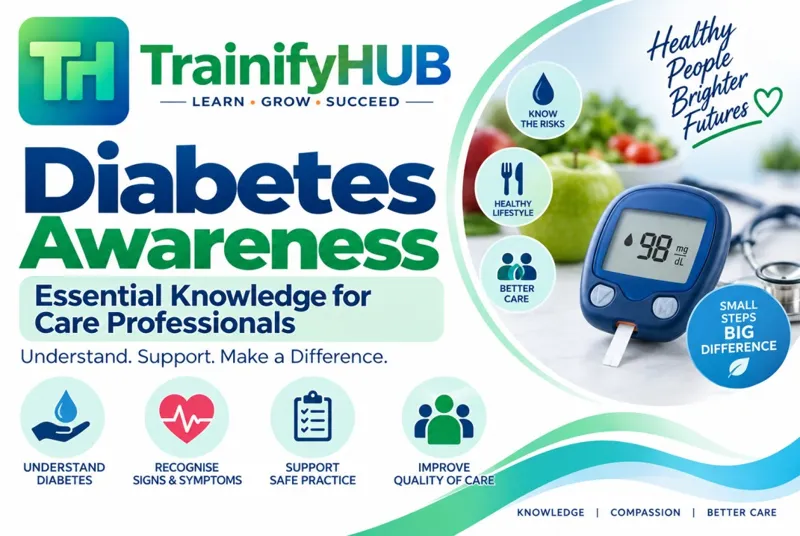 More in Health & Social Care
Health & Social Care
Diabetes Awareness: Essential Knowledge for Care Professionals
4.8(20)
11 modules3h97
£20.00
 More in Health & Social Care
 More in Health & Social Care
Health & Social Care
Care Certificate Standard 16: Awareness of Learning Disability and Autism
4.7(20)
11 modules4h93
£20.00
 More in Health & Social Care
 More in Health & Social Care
Health & Social Care
Dementia Care Awareness Training – CPD Certified (Updated 2026)
4.6(20)
11 modules3h83
£20.00
 More in Health & Social Care
 More in Health & Social Care
Student Reviews
0.0
0 stars
Based on 0 reviews
5
0
4
0
3
0
2
0
1
0
🔒 Log In to Review
You must be logged in to submit a review. Please log in or create an account.