 More in Health & Social Care
Level 3 Medication Management in Adult Social Care – Advanced Practice
Strengthen medicines support in adult social care. Explore consent, reconciliation, stock and storage, safe administration, PRN review, covert-medicine controls and learning from errors.
No ratings yet
5.00 CPD Points
MODULES
16
DURATION
4h 56m
STUDENTS
0+
LEVEL
advanced

Course Price
GBP 35.00
One-time payment - 9 months' access
Buying for your team?
Up to 30% off per seat: 10+ seats 10%, 25+ seats 20%, 50+ seats 30%.
This course includes:
16 comprehensive modules
4h 56m of video content
PDF, PPT & Infographics included
Final assessment included
9 months' access on mobile & desktop
Certificate of completion
5.00 CPD Points
CATEGORY
Health & Social CareLAST UPDATED
Nov 2026
About this course
Medicines support should match the person and setting while preserving independence. This course develops practical judgement about unclear instructions, refusal, discrepancies and clinical escalation without granting prescribing or administration competence. Fifteen teaching Modules, guided reading, two applied case studies and a supervision exercise support deeper learning. Main context: England adult social care. Distinguish applicable England duties from England-and-Wales law and local practice. This is advanced non-regulated Level 3 training, not an RQF qualification or clinical competence sign-off.
👥 What you need
Experience of adult care practice, access to an internet-enabled device and time for the teaching, guided reading and applied tasks. Use current local procedures alongside the course and anonymise discussion examples.
⏱ Learning time
Allow approximately 4 hours 56 minutes for the course, including teaching videos, guided self-study activities and the final assessment.
Learning Outcomes
📘 Module 1 — Medicines Support in Adult Social Care
Medicines support ranges from practical assistance and reminders to administration, depending on assessed need, consent and the agreed plan. NICE SC1 addresses care homes; NG67 addresses adults receiving community social care.
By the end of this module, learners will be able to:
✓ Distinguish care-home from community medicines guidance
✓ Identify the level of support required by an individual.
Workplace application: Arthur manages tablets but cannot open a new package. Assess the assistance he wants and obtain suitable pharmacy advice rather than taking over all administration automatically.
📘 Module 2 — Roles, Competence and Delegation
Staff must be trained and assessed as competent for their assigned medicines tasks and know when to seek help. Routine management allocation is different from delegation of a healthcare task.
By the end of this module, learners will be able to:
✓ Identify authorised medicines responsibilities
✓ Distinguish delegation from permission to act beyond assessed competence.
Workplace application: Beatrice is asked to administer an unfamiliar injection because she passed an online course. She raises the competence gap and the manager arranges an authorised practitioner and appropriate training before future allocation.
📘 Module 3 — Consent, Capacity and Refusal
Seek consent and offer information in a form the person can understand. Explore a refusal respectfully, including pain, swallowing problems, side effects or misunderstanding, without coercion.
By the end of this module, learners will be able to:
✓ Recognise consent, refusal and capacity concerns
✓ Explain the need to record and escalate a refusal appropriately.
Workplace application: Charlie refuses a tablet because it sticks in his throat. Record the refusal, seek appropriate advice and arrange review of swallowing and formulation. Do not crush the tablet or hide it in food on staff initiative.
📘 Module 4 — Assessing Support Needs and Care Planning
Assess the person’s ability and wishes in relation to each practical task, including obtaining, storing, identifying and taking medicines. Consider vision, dexterity, understanding, routines and communication without assuming incapacity.
By the end of this module, learners will be able to:
✓ Assess practical support needs within the worker's role
✓ Identify responsibilities and review triggers in a medicines plan.
Workplace application: Doris can choose and take medicines but struggles with small print. Explore accessible labels and agreed assistance with the pharmacy. Document what she continues to do herself and review whether the arrangement works.
📘 Module 5 — Medicines Information, Reconciliation and Transfers
Transfers create risks when prescriptions, labels, discharge information and existing records differ. Obtain current, accurate information and clarify changes with the responsible prescriber or pharmacy through the agreed reconciliation process.
By the end of this module, learners will be able to:
✓ Identify essential information at a transfer of care
✓ Recognise discrepancies requiring reconciliation by the responsible professional.
Workplace application: Edward returns from hospital with two conflicting doses. Contact the responsible professional before administering the disputed dose, explain when it is due and obtain clear instructions. Preserve the reconciliation record and brief the next shift.
📘 Module 6 — Ordering, Receiving and Stock Control
Ordering and receipt systems should prevent shortages, duplication and unnecessary stock. Agree responsibilities and lead times with the person, prescriber and pharmacy.
By the end of this module, learners will be able to:
✓ Describe checks when ordering and receiving medicines
✓ Identify stock discrepancies that require action.
Workplace application: Florence’s repeat delivery contains a discontinued medicine and omits a current item. Segregate the discrepancy safely, contact the pharmacy/prescriber and arrange continuity of the current treatment. Do not assume a delivered medicine must still be required.
📘 Module 7 — Storage, Security and Disposal
Store medicines according to the exact product instructions and the assessed security needs of the setting and person. Temperature limits and in-use expiry vary; do not impose a single room-temperature limit on every product.
By the end of this module, learners will be able to:
✓ Identify storage, security and disposal requirements
✓ Recognise when arrangements do not meet the person's instructions.
Workplace application: A fridge reading is outside its permitted range. Record the duration and affected stock, secure it appropriately and obtain pharmacy advice while arranging any urgent supply. Do not discard or continue using everything without assessment.
📘 Module 8 — Safe Administration and Individual Instructions
Before administration, check the person, current medicine and instructions, consent, allergies and relevant timing, route and dose. A mnemonic is a prompt, not a complete safety system.
By the end of this module, learners will be able to:
✓ Apply individual administration instructions within competence
✓ Recognise when uncertainty requires stopping and seeking advice.
Workplace application: George struggles to swallow a modified-release tablet. Stop and seek advice on a safe alternative rather than crushing it. Record the missed or delayed dose and obtain timely instructions about clinical risk.
📘 Module 9 — Medicines Administration Records and Handover
The medicines record should accurately show the support provided and what was taken, refused, omitted or otherwise not administered. Record promptly after the action, using the service’s documented codes and explanatory notes where needed; codes are not universal.
By the end of this module, learners will be able to:
✓ Produce an accurate administration record
✓ Distinguish an omission, refusal and administration and communicate discrepancies.
Workplace application: Hannah finds an unsigned box for a time-critical medicine. Check the available evidence and contact the relevant worker or clinician promptly. Do not assume either that the medicine was given or that a replacement dose is safe.
📘 Module 10 — As-Required Medicines and Effectiveness Review
An as-required medicine needs clear, person-specific directions: indication, dose, route, minimum interval, maximum amount and how effectiveness and adverse effects will be reviewed. Staff should know relevant non-medicine support and when to seek advice.
By the end of this module, learners will be able to:
✓ Identify the instructions needed for as-required medicines
✓ Record the reason, administration and observed effect for review.
Workplace application: Ian receives PRN pain relief but remains distressed. Follow the specified review and escalation instructions, recording his response. Do not give an additional dose before the permitted interval or assume distress always means more analgesia is needed.
📘 Module 11 — High-Risk Medicines and Specialist Support
Some medicines require additional precautions because errors can cause serious harm. Follow the exact plan for insulin, anticoagulants, opioids, patches and other specialist treatments.
By the end of this module, learners will be able to:
✓ Recognise medicines requiring particular safeguards
✓ Identify when specialist advice or additional competence is needed.
Workplace application: Julia has a prescribed patch and staff cannot confirm whether the previous one was removed. Follow the product and care-plan checks and obtain advice before applying another. Record location, timing and the resolved action through the approved system.
📘 Module 12 — Covert Administration and Best-Interests Processes
Covert administration means giving medicine without the person knowing. It requires a lawful, decision-specific process where the person lacks relevant capacity, consideration of less restrictive alternatives and a recorded best-interests decision with appropriate involvement.
By the end of this module, learners will be able to:
✓ Explain the decision-specific process for covert administration
✓ Identify the need for best-interests and pharmaceutical advice.
Workplace application: Kevin’s relative asks staff to mix tablets into soup. Pause the proposal, arrange the relevant capacity/best-interests process and obtain clinical/pharmacy advice. If a lawful plan is agreed, ensure each medicine and review trigger is explicit.
📘 Module 13 — Errors, Adverse Effects and Escalation
When an error or suspected adverse effect occurs, prioritise the person’s safety and obtain timely clinical advice, using emergency services where indicated. Give accurate details of the medicine, dose, timing, symptoms and other relevant information.
By the end of this module, learners will be able to:
✓ Recognise a medicines error or possible adverse effect
✓ Take protective action and report without concealing the event.
Workplace application: Laura may have received a duplicate dose. Seek urgent advice with the medicine details, follow monitoring instructions within competence and report honestly. Investigate the handover failure after immediate safety is addressed.
📘 Module 14 — Supporting Independence and Working with Professionals
Support self-administration where appropriate through an individual assessment and agreed plan. Consider accessible packaging, reminders or equipment with pharmacy/professional advice and the person’s consent.
By the end of this module, learners will be able to:
✓ Identify support that preserves medicines independence
✓ Agree appropriate communication with the person and professionals.
Workplace application: Mark wants to resume managing his tablets after illness. Agree a supported review and practical trial with the relevant team, clear recording and review points. Do not withdraw all assistance immediately or permanently take over without reassessment.
📘 Module 15 — Audit, Supervision and Service Improvement
Audit medicines systems and actual practice together: current instructions, support plans, records, storage, stock, competence and incident follow-up. Choose frequency and sampling according to risk and local policy rather than claiming a national monthly requirement.
By the end of this module, learners will be able to:
✓ Review a sample medicines record and support plan
✓ Propose a specific audit, supervision or improvement action.
Workplace application: Nora finds repeated missing PRN outcome records. Check whether reviews happened, address any current concerns and improve the recording and handover process. Re-audit a defined sample and report actual results.
Accreditation & Recognition
This course is officially recognised and certified
5.00
CPD
Points Awarded
All accreditations are verified and recognised by relevant industry bodies. Upon successful completion, your certificate will display the appropriate accreditation marks.
Frequently Asked Questions
12 questions answered
Assess what the person manages and the assistance they want. A packaging or information difficulty does not automatically justify taking over administration.
No. Tasks require assessed competence, authorisation and appropriate individual arrangements. Escalate gaps while maintaining care through a competent practitioner.
Record the refusal and obtain appropriate swallowing and formulation advice. Do not crush a tablet or conceal it on staff initiative.
Seek clear authorised advice before the affected disputed dose, communicate urgency and preserve a reconciliation and handover record.
Record the excursion and affected stock, secure it appropriately and obtain pharmacy advice while addressing urgent supply needs. Do not use or discard everything without assessment.
It creates uncertainty to resolve promptly. It is not proof of omission and not permission to administer a replacement dose or retrospectively invent a signature.
A lawful decision-specific capacity and best-interests process, each medicine's necessity and appropriate clinical and pharmaceutical advice. Informal family agreement is insufficient.
Check whether care and outcome reviews actually occurred, address current concerns, improve systems and re-audit. Missing documentation alone does not establish every underlying event.
Answer at least 12 of the 15 single-answer assessment questions correctly: 80%.
Nine months from the date the course is assigned to that learner.
No. An unassigned company-purchased entitlement has no expiry or time limit.
One year from the date the learner passes; this is separate from access validity.
What You'll Learn
✓ Distinguish medicines-support responsibilities in care homes and community services.
✓ Recognise competence, delegation and professional boundaries.
✓ Support consent, refusal and person-centred medicines planning.
✓ Understand reconciliation, ordering, storage, security and disposal arrangements.
✓ Follow individual administration instructions and maintain accurate records.
✓ Recognise the need for clear PRN plans and specialist input for higher-risk support.
✓ Explain the safeguards and professional advice needed for covert administration.
✓ Report errors and concerns, support independence and use audit to improve practice.
Why Take This Course
Reliable medicines support depends on clear responsibilities, current instructions and accurate communication across services. This course helps senior care staff examine the systems behind day-to-day support, identify gaps in records or authority and follow appropriate review routes. Care-home and community contexts remain distinct, and prescribing or specialist decisions stay with the responsible professionals.
Certificate of Completion
A TrainifyHUB course completion certificate follows successful assessment at 80%. Certificate validity is one year from the pass date. This does not establish regulated qualification status, professional registration or specialist workplace competence.
Course Highlights
0+
Students Enrolled
New
Be the first!
4h 56m
Total Duration


Why book with TrainifyHUB
- CPD accredited training content
- Delivered UK-wide at your workplace
- Certificate of completion included
- Secure, encrypted online payments
Accredited & Trusted
 CPD Accredited Provider
 Secure Payments
Need help choosing a course?
+44 7405 005823 support@trainifyhub.co.uk
Our team can advise on the right training package for your organisation.
Keep learning
Related courses
Picked from what learners take alongside this course.
More in Health & Social Care More in Health & Social Care
Health & Social Care
Advanced Adult Care Principles and Professional Practice
4.9(20)
13 modules4h66
GBP40.00
 More in Health & Social Care
 More in Health & Social Care
Health & Social Care
Level 3 Mental Health in Adult Social Care – Advanced Practice
New course
16 modules4h 53m
GBP35.00
 More in Health & Social Care
 More in Health & Social Care
Health & Social Care
Level 2 Food Safety and Hygiene for Health and Social Care
4.7(20)
6 modules2h67
GBP30.00
 More in Health & Social Care
 More in Health & Social Care
Health & Social Care
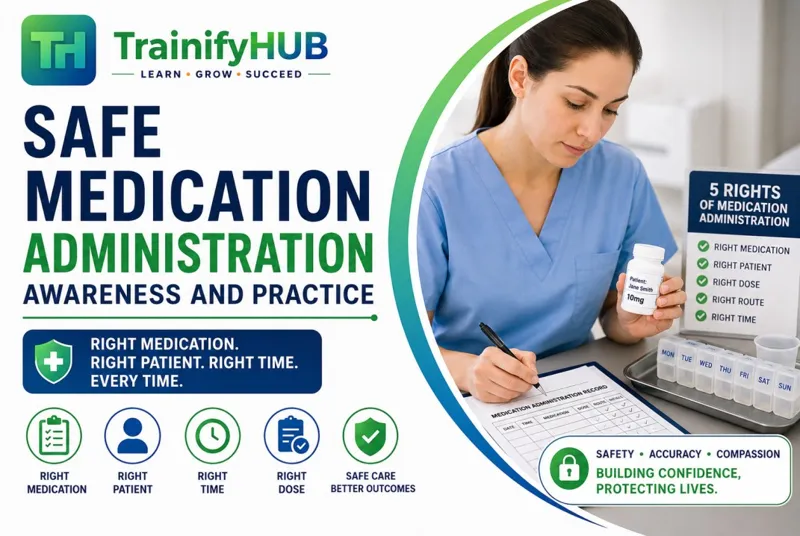
Safe Medication Administration Awareness and Practice
4.8(20)
6 modules2h72
GBP30.00
Student Reviews
0.0
0 stars
Based on 0 reviews
5
0
4
0
3
0
2
0
1
0
🔒 Log In to Review
You must be logged in to submit a review. Please log in or create an account.