 Similar topic
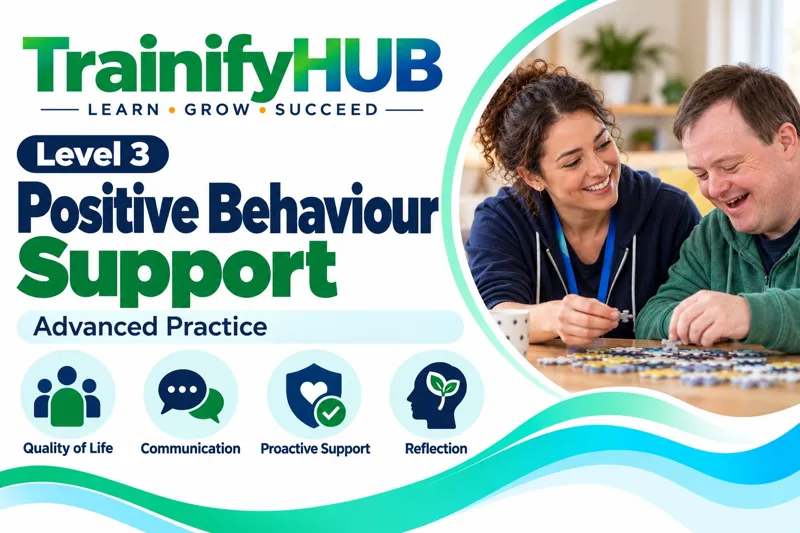
Level 3 Positive Behaviour Support – Advanced Practice
Develop rights-based positive behaviour support. Explore communication, health needs, proactive plans, meaningful activity, specialist assessment and least restrictive practice.
No ratings yet
5.00 CPD Points
MODULES
16
DURATION
4h 52m
STUDENTS
0+
LEVEL
advanced
Course Price
GBP 35.00
One-time payment - 9 months' access
Buying for your team?
Up to 30% off per seat: 10+ seats 10%, 25+ seats 20%, 50+ seats 30%.
This course includes:
16 comprehensive modules
4h 52m of video content
PDF, PPT & Infographics included
Final assessment included
9 months' access on mobile & desktop
Certificate of completion
5.00 CPD Points
CATEGORY
Health & Social CareLAST UPDATED
Nov 2026
About this course
A lower incident count is insufficient if a person loses choice and participation. This course helps experienced staff connect careful observations with proactive support and assess whether quality of life improves. NICE learning-disability recommendations are used within their stated scope. Fifteen teaching Modules, guided reading, two applied case studies and a supervision exercise support deeper learning. Main context: England adult social care. Distinguish applicable England duties from England-and-Wales law and local practice. This is advanced non-regulated Level 3 training, not an RQF qualification or clinical competence sign-off.
👥 What you need
Experience of adult care practice, access to an internet-enabled device and time for the teaching, guided reading and applied tasks. Use current local procedures alongside the course and anonymise discussion examples.
⏱ Learning time
Allow approximately 4 hours 52 minutes for the course, including teaching videos, guided self-study activities and the final assessment.
Learning Outcomes
📘 Module 1 — Positive Behaviour Support, Rights and Quality of Life
Positive Behaviour Support aims to improve quality of life and reduce distress through understanding the person, their environment and the possible functions of behaviour. It is not a compliance programme.
By the end of this module, learners will be able to:
✓ Explain PBS in terms of rights and quality of life
✓ Distinguish supportive practice from behaviour control for staff convenience.
Workplace application: Arthur is quiet only because staff exclude him from activities. Review what he enjoys, how he communicates and what support would enable participation. Reduced incident counts must not conceal a poorer quality of life.
📘 Module 2 — Understanding Behaviour as Communication
Behaviour can communicate needs or be influenced by pain, communication barriers, demands, sensory experiences and responses from other people. Do not assume a particular function from one event or describe every action as deliberate manipulation.
By the end of this module, learners will be able to:
✓ Describe possible communicative functions of behaviour
✓ Separate observation from assumptions about intent.
Workplace application: Beatrice pushes away a washcloth during care. Pause, check comfort and communication and record the context. Explore possible pain or an unwanted approach rather than concluding that she is trying to control staff.
📘 Module 3 — Person-Centred Values and Co-Production
Co-production means the person influences goals and support, with communication adjustments and chosen supporters where appropriate. Ask what a good day looks like and how they express choice or disagreement.
By the end of this module, learners will be able to:
✓ Identify the person's preferences and strengths
✓ Include the person in designing support they can understand.
Workplace application: Charlie prefers evening bathing but the plan assumes morning care. Explore how to support his choice and agree any practical changes with the team. Record his preference and review whether staff follow it.
📘 Module 4 — Health, Pain and Unmet Needs
A sudden or persistent change in behaviour can signal pain, illness, sensory difficulty, medicine effects, sleep disruption or unmet needs. Record specific changes and seek timely clinical assessment rather than treating them solely as a behavioural problem.
By the end of this module, learners will be able to:
✓ Recognise possible pain, illness or unmet needs
✓ Identify when a healthcare review is required.
Workplace application: Doris begins hitting her face and avoids meals. Arrange prompt health review and communicate observations about pain and eating. Do not simply introduce a reward chart for eating or wait several weeks for ABC data.
📘 Module 5 — Communication and Environmental Adjustments
Adjust communication to the person: suitable words, pictures, objects, signs or devices, enough processing time and a consistent approach. Consider noise, light, crowding, predictability and accessibility.
By the end of this module, learners will be able to:
✓ Choose communication and environmental adjustments
✓ Explain how their effect will be observed and reviewed.
Workplace application: Edward becomes distressed when several staff speak at once. Agree one lead communicator, a short visual sequence and more time. Check his response rather than assuming every person needs the same low-stimulation routine.
📘 Module 6 — Observing Behaviour and Gathering Information
Describe behaviour observably, including timing, duration, context and impact. Antecedent–behaviour–consequence records can support understanding, but patterns do not prove causation.
By the end of this module, learners will be able to:
✓ Record antecedents, observable behaviour and consequences
✓ Distinguish a factual record from a causal conclusion.
Workplace application: Logs call Florence “unpredictable”. More precise records show distress often follows rushed personal care. This suggests a hypothesis to explore, not proof of motive. Review pace, consent, communication and health factors with the team.
📘 Module 7 — Functional Assessment and Specialist Roles
Functional assessment considers what predicts and maintains behaviour, its history and impact, and the person’s abilities, needs and environment. The complexity and risk determine the expertise required.
By the end of this module, learners will be able to:
✓ Describe the purpose of functional assessment
✓ Identify contributions requiring appropriately qualified specialists.
Workplace application: George’s self-injury increases despite the current plan. Arrange appropriate specialist assessment and health review, providing factual records and the person’s communication needs. Agree interim safety support while awaiting input.
📘 Module 8 — Developing a Positive Behaviour Support Plan
A behaviour support plan should connect an evidence-based understanding with practical proactive support, communication and skill development, early-response strategies and safe reactive arrangements where needed. Specify who does what, how staff are trained, what will be recorded and when the plan is reviewed.
By the end of this module, learners will be able to:
✓ Identify the components of an individual PBS plan
✓ Link practical strategies to assessed needs and review arrangements.
Workplace application: Hannah’s plan contains only crisis instructions. Add agreed meaningful activity, environmental adjustments, communication support and early signs, with clear responsibilities. Monitor both quality of life and incidents rather than promising a fixed percentage reduction.
📘 Module 9 — Proactive Support and Meaningful Activity
Proactive support makes valued activities and relationships accessible before distress escalates. Offer real choices and the assistance needed for participation, including breaking activities into manageable steps.
By the end of this module, learners will be able to:
✓ Plan meaningful activity and proactive support
✓ Explain how these support choice and quality of life.
Workplace application: Ian spends afternoons alone and likes gardening. Offer supported gardening if he wants it, with alternatives and communication support. Review enjoyment and distress over time without treating attendance as a mandatory behaviour intervention.
📘 Module 10 — Teaching Skills and Supporting Choice
Skill development should be accessible, relevant and based on the person’s needs and assessment. A communication alternative, such as asking for a break, must be understood and reliably respected by staff.
By the end of this module, learners will be able to:
✓ Identify an achievable skill or choice goal
✓ Describe supportive teaching that avoids coercion.
Workplace application: Julia throws a plate when overwhelmed. An agreed plan introduces a break card and staff respond consistently when she uses it. Review whether she understands and can access the card; do not withdraw breaks when she is too distressed to use it.
📘 Module 11 — Early Signs, De-Escalation and Safer Responses
Recognise the person’s individual early signs and use agreed calming responses. Reduce unnecessary demands, use respectful simple communication, allow space and offer choices where safe.
By the end of this module, learners will be able to:
✓ Recognise early signs of distress
✓ Select a safer response consistent with the person's plan and worker competence.
Workplace application: Kevin begins pacing and covering his ears in a noisy lounge. Offer a quieter option and space using his plan. If distress escalates beyond safe support, obtain assistance rather than trying an untrained physical technique.
📘 Module 12 — Restrictive Interventions and Least Restrictive Practice
Restrictions require a lawful basis, necessity, proportionality, appropriate competence and review; a care plan or family agreement alone does not supply legal authority. Consider physical, chemical, mechanical and environmental restrictions.
By the end of this module, learners will be able to:
✓ Compare less restrictive alternatives
✓ Identify authorisation, current legal review and competence requirements for restrictions.
Workplace application: A supported-living kitchen is locked for everyone because cleaning products are accessible. Review safer storage and individual support promptly. Any remaining restriction needs person-specific justification and legal review; do not assume a care-home DoLS form covers supported living.
📘 Module 13 — Consent, Capacity and Safeguarding
Presume capacity, support decisions and distinguish unwise choices from incapacity. Assessment and best-interests decisions are decision- and time-specific and must involve the person as far as possible.
By the end of this module, learners will be able to:
✓ Apply decision-specific consent and capacity principles
✓ Identify safeguarding concerns in restrictive or coercive practice.
Workplace application: Laura is pressured by acquaintances to give them money. Explore her wishes and the possibility of coercion, record facts and raise safeguarding concerns. Do not dismiss the situation as simply an unwise financial choice.
📘 Module 14 — Working with Families and Multidisciplinary Teams
Agree shared goals and responsibilities with the person, chosen supporters and relevant professionals. Families may know important communication cues and history, but their involvement must respect the adult’s preferences, confidentiality and any lawful authority.
By the end of this module, learners will be able to:
✓ Identify appropriate family and multidisciplinary contributions
✓ Share observations and agree consistent support responsibilities.
Workplace application: Mark’s family and staff disagree about morning routines. Hold a review centred on his preferences and the assessment evidence, agree a practical trial and name the person responsible for checking its effect.
📘 Module 15 — Reviewing Outcomes, Supervision and Quality Improvement
Review quality of life, participation, injuries, distress, restrictions and staff implementation together. A fall in incident reports might reflect under-recording or exclusion, so examine the context.
By the end of this module, learners will be able to:
✓ Review quality-of-life and support outcomes
✓ Propose a plan revision, supervision action or specialist review.
Workplace application: Nora’s incident count drops while her access to communal areas also falls. Review whether apparent improvement has been achieved through exclusion and agree safer, more inclusive support. Track participation as well as incident numbers.
Accreditation & Recognition
This course is officially recognised and certified
5.00
CPD
Points Awarded
All accreditations are verified and recognised by relevant industry bodies. Upon successful completion, your certificate will display the appropriate accreditation marks.
Frequently Asked Questions
12 questions answered
No. Review wellbeing, choice and participation as well as incidents. A fall achieved through exclusion may represent poorer quality of life.
Observe context and communication and consider pain, preferences and unmet needs. Do not assume a motive from one behaviour or label.
New health concerns need timely review. Behaviour data can be gathered alongside this; it should not delay clinical attention.
Factual observations support hypotheses about patterns. They do not prove one cause with certainty or authorise a restriction.
Complex or worsening concerns need expertise appropriate to the person and situation. Provide factual records and maintain interim safety and health support.
Include meaningful activity, accessible communication, environmental adjustments, early signs, practical responsibilities and review measures for quality of life.
No. Restrictive interventions require appropriate competence and lawful person-specific arrangements. This course does not certify physical restraint or authorise confinement.
Check participation, wellbeing and the person's goals alongside distress and incidents. Review whether apparent improvement depends on avoidable restriction.
Answer at least 12 of the 15 single-answer assessment questions correctly: 80%.
Nine months from the date the course is assigned to that learner.
No. An unassigned company-purchased entitlement has no expiry or time limit.
One year from the date the learner passes; this is separate from access validity.
What You'll Learn
✓ Explain Positive Behaviour Support through rights, participation and quality of life.
✓ Recognise behaviour as communication and consider health, pain and unmet needs.
✓ Involve the person in support goals and practical environmental adjustments.
✓ Gather factual observations and contribute appropriately to specialist assessment.
✓ Support a proactive PBS plan, meaningful activity, skills and choice.
✓ Recognise early signs of distress and follow agreed safer responses.
✓ Identify consent, safeguarding and least-restrictive practice responsibilities.
✓ Review outcomes with families, professionals and reflective supervision.
Why Take This Course
A helpful behaviour-support approach starts with the person’s experience, needs and quality of life. This course helps experienced staff move beyond reactive instructions towards consistent observation, proactive support and meaningful review. It also clarifies the limits of staff assessment and intervention roles, so concerns are escalated and restrictions are scrutinised through the appropriate processes.
Certificate of Completion
A TrainifyHUB course completion certificate follows successful assessment at 80%. Certificate validity is one year from the pass date. This does not establish regulated qualification status, professional registration or specialist workplace competence.
Course Highlights
0+
Students Enrolled
New
Be the first!
4h 52m
Total Duration


Why book with TrainifyHUB
- CPD accredited training content
- Delivered UK-wide at your workplace
- Certificate of completion included
- Secure, encrypted online payments
Accredited & Trusted
 CPD Accredited Provider
 Secure Payments
Need help choosing a course?
+44 7405 005823 support@trainifyhub.co.uk
Our team can advise on the right training package for your organisation.
Keep learning
Related courses
Picked from what learners take alongside this course.
Similar topic More in Health & Social Care
 More in Health & Social Care
 More in Health & Social Care
 More in Health & Social Care
Health & Social Care
Level 2 Food Safety and Hygiene for Health and Social Care
4.7(20)
6 modules2h67
GBP30.00
 More in Health & Social Care
 More in Health & Social Care
Health & Social Care
Level 3 Autism & Learning Disability – Advanced Support Practice
New course
16 modules5h 4m
GBP35.00
 More in Health & Social Care
Health & Social Care
Advanced Adult Care Principles and Professional Practice
4.9(20)
13 modules4h66
GBP40.00
Student Reviews
0.0
0 stars
Based on 0 reviews
5
0
4
0
3
0
2
0
1
0
🔒 Log In to Review
You must be logged in to submit a review. Please log in or create an account.