 Similar topic
Health & Social Care
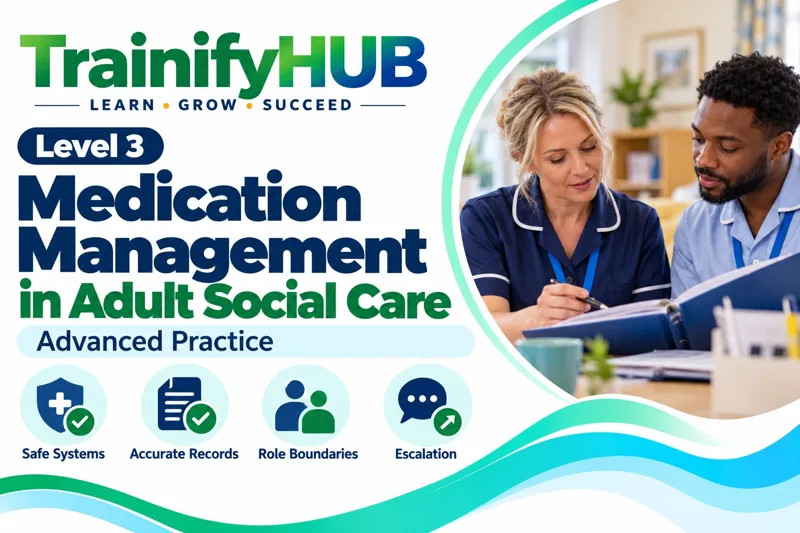
Level 3 Medication Management in Adult Social Care – Advanced Practice
New course
16 modules4h 56m
GBP35.00
Understand medicines support, role limits, consent, accurate records and escalation when instructions, supply or a person’s needs raise concerns.
9
2h 9m
1+
beginner

Course Price
GBP 20.00
One-time payment
Buying for your team?
Up to 30% off per seat: 10+ seats 10%, 25+ seats 20%, 50+ seats 30%.
CATEGORY
Health & Social CareLAST UPDATED
Nov 2026
Course Price
GBP 20.00
One-time payment
Buying for your team?
Up to 30% off per seat: 10+ seats 10%, 25+ seats 20%, 50+ seats 30%.
CATEGORY
Health & Social CareLAST UPDATED
Nov 2026
Medicines support in adult social care requires clear responsibilities, current instructions and communication with the person and relevant professionals. This awareness course explains person-centred plans, consent, safe support principles, records, storage and disposal, refusal and omissions, care transitions and competence checks. Eight Modules use realistic scenarios to help staff recognise uncertainty, record the support provided and obtain the right advice. England is the core context. Use the learning alongside employer policies and the assessed medicines plan. Practical administration training, competence assessment and workplace authorisation remain separate.
Frontline adult social care workers who support people with medicines.
No formal qualification prerequisite is set. You need a device, internet access, sufficient English for the learning and access to local plans, policies and escalation contacts. Practical training and task authorisation are separate requirements for medicines duties.
Allow approximately 2 hours 9 minutes overall, including videos, guided reading, scenario reflection and the final assessment. Study at your own pace; individual completion times vary.
The eight modules follow medicines support from the person’s plan and consent into safety checks, records, storage and communication. Refusal, omissions, discrepancies and changes between care settings are considered through role-boundary and competence scenarios.
✓ Distinguish awareness learning from authorised administration tasks.
✓ Connect current instructions, consent and the assessed support plan.
✓ Explore records, supply and storage within local arrangements.
✓ Review when uncertainty or a medicines concern needs appropriate advice.
Medicines support ranges from a reminder to practical help or administration, depending on the assessed plan and authorised role. Be clear about what the person manages independently and what staff are responsible for.
By the end of this Module, learners will be able to:
✓ Distinguish support tasks and authorised administration.
Workplace application: A colleague asks a worker with awareness training only to administer an unfamiliar medicine. Worked response: Explain the competence limit and obtain an appropriately trained and authorised response.
Medicines support should enable independence and reflect the person’s needs and preferences. The plan records the assessed support, responsibilities and arrangements for review; changes in need may require earlier review rather than a universal fixed interval.
By the end of this Module, learners will be able to:
✓ Recognise care plan and consent requirements.
Workplace application: A person wants medicine taken with a drink that may conflict with the label instructions. Worked response: Check the specific instructions and seek pharmacist or prescriber advice rather than assuming the drink is suitable.
Safe support begins with the correct person, medicine, dose, route, time and documentation, together with the person’s consent and the current plan. These checks do not turn an untrained worker into a competent administrator.
By the end of this Module, learners will be able to:
✓ Identify source-supported safety checks within role.
Workplace application: The medicine label and current administration record show different instructions. Worked response: Do not resolve the discrepancy by guessing; seek clarification through the authorised medicines route.
Record the medicines support actually provided, including an omission or refusal, in the appropriate record promptly. The MAR supports safe communication but does not replace an accurate care plan or current instructions.
By the end of this Module, learners will be able to:
✓ Recognise accurate recording and escalation needs.
Workplace application: A worker is asked to sign the MAR in advance to save time. Worked response: Record only support actually completed and refuse advance signing.
Supply arrangements should prevent avoidable missed doses while preserving the person’s agreed responsibilities. Storage follows the medicine label, assessed risks and setting; refrigeration is not required for every medicine.
By the end of this Module, learners will be able to:
✓ Explain policy-led medicine handling arrangements.
Workplace application: A nursing-home worker assumes all unwanted medicines can be returned through the non-nursing care-home pharmacy process. Worked response: Check the nursing home’s licensed disposal arrangements and use its authorised procedure.
Respect a refusal and establish any concern the person wishes to explain without pressure. Record and escalate according to the medicine, risks and plan; there is no universal waiting period or safe delay for every medicine.
By the end of this Module, learners will be able to:
✓ Escalate concerns without making clinical decisions.
Workplace application: A person refuses a time-critical medicine and the worker is unsure what delay is safe. Worked response: Record the refusal and obtain prompt clinical advice through the plan rather than imposing a standard delay.
Care transitions require clear communication about the current medicines, last recorded support, recent changes and outstanding concerns. Identify who is responsible for each part of the support and obtain clarification when information is incomplete.
By the end of this Module, learners will be able to:
✓ Use relevant setting-specific handovers.
Workplace application: A hospital discharge list conflicts with the home-care medicines record. Worked response: Raise the discrepancy with the authorised clinical and care contacts before relying on conflicting instructions.
Review medicines scenarios by checking role, consent, current instructions, recording and escalation together. Practical competence must be assessed for the actual task and reviewed through the employer’s arrangements.
By the end of this Module, learners will be able to:
✓ Identify practical training and sign-off requirements.
Workplace application: A worker argues that an online certificate alone proves competence to perform a new medicines task. Worked response: Obtain the required task-specific training and employer competence assessment before taking on that task.
Complete 15 single-answer multiple-choice questions after the teaching and associated activities. Select one correct answer from four options for each question. The pass mark is 80% (12 out of 15).
This course is officially recognised and certified
CPD
Points Awarded
All accreditations are verified and recognised by relevant industry bodies. Upon successful completion, your certificate will display the appropriate accreditation marks.
12 questions answered
Frontline adult social care workers supporting people with medicines.
No. Task-specific practical training, demonstrated competence and workplace authorisation remain separate.
No. The course covers frontline awareness, safe decisions and role limits.
England is the core context. Follow the applicable requirements and local arrangements in your service.
This awareness course gives no prescribing or dose-changing authority. Seek clarification through the authorised route.
Obtain authorised clarification rather than choosing an instruction or guessing.
Respect the person’s choice, record the refusal and escalate according to the medicine, plan and clinical risks.
This course does not authorise covert administration decisions. The applicable lawful and medicine-specific process is required.
Yes. Follow the authorised procedure for the care setting and the person’s plan.
Fifteen single-answer questions; 12 correct answers achieve the 80% pass mark.
Nine months from assignment. Company-purchased entitlements do not expire while unassigned.
One year from passing. Certificate validity is separate from employer competence review and clinical authorisation.
✓ Distinguish support tasks and authorised administration.
✓ Recognise care plan and consent requirements.
✓ Identify source-supported safety checks within role.
✓ Recognise accurate recording and escalation needs.
✓ Explain policy-led medicine handling arrangements.
✓ Escalate concerns without making clinical decisions.
✓ Use relevant setting-specific handovers.
✓ Identify practical training and sign-off requirements.
Clear medicines support depends on the information passed between the person, care staff and relevant professionals. The course brings plans, instructions and records together, helping learners recognise an unclear or conflicting arrangement and the limits of their own role.
Unclear instructions, inaccurate records and assumptions about roles can put people at risk. This course helps staff recognise those concerns, support the person’s choices and communicate promptly without making unsupported clinical decisions.
✓ Clarify medicines-support responsibilities and their limits.
✓ Connect consent, current instructions and factual records.
✓ Recognise uncertainty and obtain authorised clarification.
Medicines-awareness learning is available online across England, Scotland, Wales and Northern Ireland, including London, Manchester, Glasgow, Cardiff and Belfast. Study at your own pace and revisit the support scenarios. The course’s stated setting and jurisdiction still apply, and practical medicines training, competence assessment and employer authorisation remain separate from online access.
A TrainifyHUB completion certificate is issued after achieving the 80% assessment pass standard. Certificate validity is one year from passing. This non-regulated awareness course does not authorise prescribing, dose changes or unassessed administration, or certify practical competence.
1+
Students Enrolled
New
Be the first!
2h 9m
Estimated Duration


 CPD Accredited Provider
 Secure Payments
Our team can advise on the right training package for your organisation.
Keep learning
Picked from what learners take alongside this course.
Similar topicHealth & Social Care
GBP35.00
 More in Health & Social Care
 More in Health & Social Care
 More in Health & Social Care
 More in Health & Social Care
 More in Health & Social Care
Health & Social Care
GBP35.00
 More in Health & Social Care
 More in Health & Social Care
Health & Social Care
GBP20.00
Based on 0 reviews
You must be logged in to submit a review. Please log in or create an account.