 Similar topic
Pressure Ulcer Prevention Awareness
Learn how everyday care observations, individual prevention plans and timely reporting support pressure ulcer prevention in adult social care.
No ratings yet
3.00 CPD Points
MODULES
9
ESTIMATED DURATION
2h 38m
STUDENTS
0+
LEVEL
beginner

Course Price
£20.00
One-time payment - 9 months' access
Buying for your team?
Up to 30% off per seat: 10+ seats 10%, 25+ seats 20%, 50+ seats 30%.
This course includes:
9 comprehensive modules
8 video lessons
1 downloadable resource (PDF)
Final assessment included
9 months’ access on mobile & desktop
Certificate of completion
3.00 CPD Points
CATEGORY
Health & Social CareLAST UPDATED
Nov 2026
About this course
This course is for care-home and home-care workers supporting adults who may be at risk of pressure damage. It covers changes in skin and comfort, following assessed prevention and movement plans, equipment concerns, food and fluid support, records and escalation. Fictional situations help learners decide what to observe, report and clarify. It does not teach wound diagnosis, ulcer staging, treatment, skin-testing or practical moving and handling.
Study online at your own pace using eight teaching modules, fictional written practice and a separate final knowledge assessment. Estimated total structured learning: 2 hours 38 minutes. This is a planning estimate; individual study time varies.
Learning Outcomes
Module 1 — Pressure Damage and Risk Awareness
This module develops awareness of pressure damage and risk awareness, using factual information and the person’s current individual arrangements to explain decisions within the care-worker role.
By the end of this Module, learners will be able to:
✓ Explain pressure-damage risks in everyday care.
✓ Identify relevant risks and observations in a fictional care brief without diagnosing.
Workplace example: Arthur has reduced mobility, is spending longer in his chair and reports new discomfort. The brief supplies no diagnosis or ulcer category.
Application: Identify observations and individual risk context to report. Follow the assessed prevention plan and seek appropriate review rather than using a clinical score or assigning an ulcer stage.
Module 2 — Recognising Changes in Skin and Comfort
This module develops awareness of recognising changes in skin and comfort, using factual information and the person’s current individual arrangements to explain decisions within the care-worker role.
By the end of this Module, learners will be able to:
✓ Recognise changes in skin appearance or comfort to report.
✓ Explain consent, privacy and role boundaries during authorised observations.
Workplace example: During authorised routine care, a person reports new heel discomfort and a change from their usual skin appearance is noticed. Consent and privacy remain important.
Application: Describe the change and the person’s words, then report promptly. Absence of obvious redness does not establish safety; do not perform pressure tests or a diagnostic examination.
Module 3 — Individual Risk and Prevention Plans
This module develops awareness of individual risk and prevention plans, using factual information and the person’s current individual arrangements to explain decisions within the care-worker role.
By the end of this Module, learners will be able to:
✓ Follow an individually assessed prevention plan.
✓ Identify missing instructions and request appropriate clarification.
Workplace example: An individual prevention plan is missing the agreed position-change instructions. A colleague proposes applying the same fixed schedule to everyone.
Application: Identify the missing authorised instructions and who should clarify them. Do not invent a universal schedule or remove position-change support without appropriate review.
Module 4 — Position Changes and Mobility Support
This module develops awareness of position changes and mobility support, using factual information and the person’s current individual arrangements to explain decisions within the care-worker role.
By the end of this Module, learners will be able to:
✓ Recognise when planned movement support cannot be delivered safely.
✓ Explain how to seek trained help and report unmet support needs.
Workplace example: A person’s assessed support plan requires two trained workers for a particular movement. Only one worker is available at the planned time.
Application: Seek appropriate trained assistance, report unmet support and maintain safe care within the individual arrangements. Do not improvise the movement or treat the staffing requirement as universal for everyone.
Module 5 — Equipment, Skin Care and Daily Support
This module develops awareness of equipment, skin care and daily support, using factual information and the person’s current individual arrangements to explain decisions within the care-worker role.
By the end of this Module, learners will be able to:
✓ Recognise observable equipment and daily skin-care concerns.
✓ Distinguish plan-led support from unauthorised settings, repairs or treatment.
Workplace example: A pressure-relieving device has an observable fault and the worker is unsure whether its settings are authorised.
Application: Report the actual equipment concern and obtain appropriate assistance. Do not invent repairs, settings or treatment, and do not assume equipment removes other planned support needs.
Module 6 — Nutrition, Hydration and Recording
This module develops awareness of nutrition, hydration and recording, using factual information and the person’s current individual arrangements to explain decisions within the care-worker role.
By the end of this Module, learners will be able to:
✓ Follow plan-led nutrition and hydration support.
✓ Write factual records of support, observations and escalation using supplied facts.
Workplace example: A person’s intake has reduced and their plan includes an individual fluid restriction. The brief supplies no replacement clinical instruction.
Application: Record known intake and changes, follow authorised arrangements and seek appropriate advice. Generic hydration encouragement must not override the individual restriction.
Module 7 — Escalation and Safeguarding Concerns
This module develops awareness of escalation and safeguarding concerns, using factual information and the person’s current individual arrangements to explain decisions within the care-worker role.
By the end of this Module, learners will be able to:
✓ Distinguish clinical advice, incident reporting and safeguarding concerns.
✓ Choose appropriate help and escalation without diagnosing or calculating a clinical safeguarding score.
Workplace example: Planned prevention support has repeatedly not been delivered and there are new skin or comfort concerns. The reasons and any safeguarding conclusion are unknown.
Application: Arrange appropriate clinical advice and report actual omissions through incident and safeguarding pathways as applicable. Do not diagnose neglect, calculate a safeguarding score or wait to prove harm before reporting a concern.
Module 8 — Prevention Scenarios and Reflection
This module develops awareness of prevention scenarios and reflection, using factual information and the person’s current individual arrangements to explain decisions within the care-worker role.
By the end of this Module, learners will be able to:
✓ Choose a personalised prevention response in fictional care-home and home-care scenarios.
✓ Explain consent, plan-led action, recording and follow-up.
Workplace example: Edith declines a planned position change and says it hurts. A colleague suggests recording the task as completed to keep the chart tidy.
Application: Respect the response, communicate accessibly and obtain appropriate review and support. Record refusal, discomfort, actual actions and follow-up; do not use force, assume incapacity or invent delivered care.
Accreditation & Recognition
This course is officially recognised and certified
3.00
CPD
Points Awarded
All accreditations are verified and recognised by relevant industry bodies. Upon successful completion, your certificate will display the appropriate accreditation marks.
Frequently Asked Questions
16 questions answered
Care-home and home-care workers supporting adults with pressure-damage risks, including staff seeking an awareness refresher.
No. It is non-regulated awareness learning. Diagnosis, ulcer staging and clinical treatment are outside its scope.
No. Follow the assessed care and handling plans and your employer's practical training and competence requirements.
No. Follow the individual assessed prevention plan and seek clarification when instructions are missing or cannot be delivered.
No. Individual prevention and position-change support still follow the assessed plan.
No. Changes may look different across skin tones. Report relevant changes from the person's usual skin appearance and comfort.
No. Clinical needs and any safeguarding concerns need appropriate consideration and escalation; concerns should not be dismissed.
A separate 15-question single-answer assessment follows the eight Modules. Each question has four options and one correct answer; pass at 12/15 or 80%.
A CPD-accredited TrainifyHUB course completion certificate with 3 CPD points, valid for one year from passing. This is not an RQF or other regulated qualification and does not prove clinical or practical competence.
Learner access lasts nine months from assignment. A company entitlement not yet assigned has no expiry.
No. Use the fictional briefs and private reflections. Do not submit identifiable care records or intimate photographs.
Allow approximately 2 hours 38 minutes of total structured learning. This includes the teaching, meaningful private written activities and final assessment. Individual study time varies.
Yes. This TrainifyHUB CPD-accredited awareness course carries 3 CPD points. CPD recognition is separate from regulated qualifications, employer authorisation and practical competence.
No. The supplied fictional briefs, written responses and guided reviews support private self-study. They are not individually marked practical or clinical assessments. Keep any notes free of real personal information.
Yes. The self-paced online format is suitable for individual learners and company-assigned learners. Check that the course scope matches your role and service requirements.
No specialist equipment or workplace placement is required for these fictional knowledge activities. Actual care tasks remain subject to individual plans, employer training and appropriate competence requirements.
What You'll Learn
✓ You will learn to recognise relevant changes, follow individual assessed plans, respect consent and role boundaries, seek appropriate help and make factual records.
✓ Fictional care-home and home-care examples support reflection on everyday decisions.
Why Take This Course
✓ Pressure-damage prevention depends on consistent everyday observations, planned support and clear reporting. This course helps care workers recognise their contribution and the limits of an awareness role.
✓ Practise explaining decisions using fictional adult-care situations rather than assumptions.
✓ Strengthen factual communication, person-centred support and appropriate escalation.
✓ Connect awareness learning with your own employer procedures and separately required role training.
🌍 Available Online Across the UK
Flexible online learning for individuals and company teams across England, Scotland, Wales and Northern Ireland, including:
✓ London ✓ Birmingham ✓ Leicester
✓ Coventry ✓ Nottingham ✓ Derby
✓ Manchester ✓ Liverpool ✓ Leeds
✓ Sheffield ✓ Bradford ✓ Newcastle
✓ Bristol ✓ Southampton ✓ Portsmouth
✓ Brighton ✓ Oxford ✓ Cambridge
✓ Norwich ✓ Glasgow ✓ Edinburgh
✓ Aberdeen ✓ Dundee ✓ Cardiff
✓ Swansea ✓ Newport ✓ Wrexham
✓ Belfast ✓ Derry/Londonderry
Online availability does not make the England-specific provider or legal context identical across the UK. Check the local requirements and care arrangements that apply to your service.
Certificate of Completion
✓ CPD-accredited TrainifyHUB course: 3 CPD points.
✓ Complete all eight modules and the separate final knowledge assessment. Pass at 12/15 correct answers (80%).
✓ The course completion certificate is valid for one year from passing.
✓ This is non-regulated awareness learning, not an RQF qualification, clinical authorisation or evidence of practical competence.
✓ Learner access lasts nine months from assignment. Unassigned company entitlements do not expire.
Course Highlights
0+
Students Enrolled
New
Be the first!
2h 38m
Estimated Duration


Why book with TrainifyHUB
- CPD accredited training content
- Delivered UK-wide at your workplace
- Certificate of completion included
- Secure, encrypted online payments
Accredited & Trusted
 CPD Accredited Provider
 Secure Payments
Need help choosing a course?
+44 7405 005823 support@trainifyhub.co.uk
Our team can advise on the right training package for your organisation.
Keep learning
Related courses
Picked from what learners take alongside this course.
Similar topic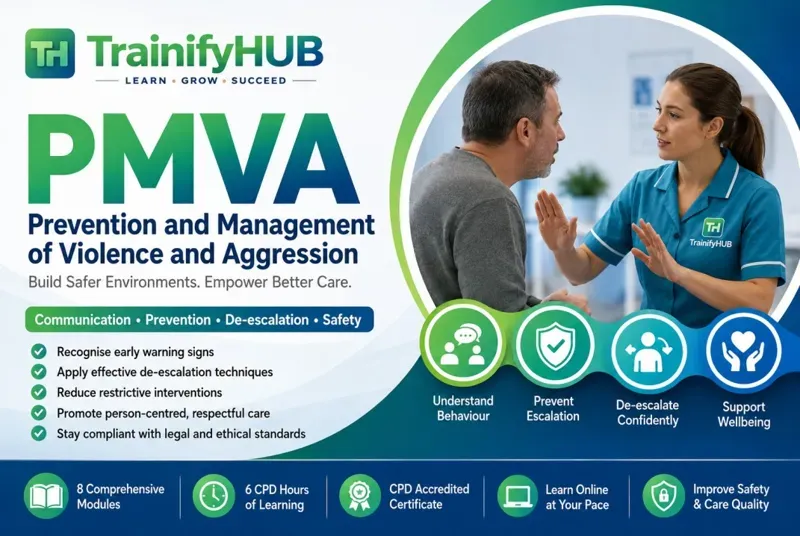 More in Health & Social Care
Health & Social Care
PMVA – Prevention and Management of Violence and Aggression (PMVA) Training Course
4.5(20)
9 modules2h61
£20.00
 More in Health & Social Care
 More in Health & Social Care
Health & Social Care
Diabetes Awareness: Essential Knowledge for Care Professionals
4.8(20)
11 modules3h97
£20.00
 More in Health & Social Care
 More in Health & Social Care
Health & Social Care
Care Certificate Standard 16: Awareness of Learning Disability and Autism
4.7(20)
11 modules4h93
£20.00
 More in Health & Social Care
 More in Health & Social Care
Health & Social Care
Dementia Care Awareness Training – CPD Certified (Updated 2026)
4.6(20)
11 modules3h83
£20.00
Student Reviews
0.0
0 stars
Based on 0 reviews
5
0
4
0
3
0
2
0
1
0
🔒 Log In to Review
You must be logged in to submit a review. Please log in or create an account.