 More in Health & Social Care
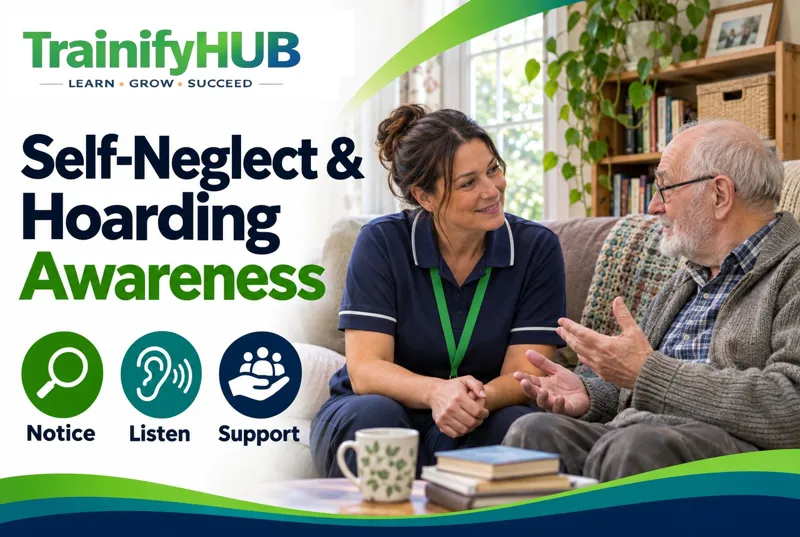
Self-Neglect & Hoarding Awareness
Develop adult-care awareness to recognise self-neglect concerns and respond respectfully without labelling. Explore eight Modules with source-grounded examples, written activities and a final knowledge assessment.
No ratings yet
2.00 CPD Points
MODULES
9
ESTIMATED DURATION
2h 29m
STUDENTS
3+
LEVEL
beginner
Course Price
£20.00
One-time payment - 9 months' access
Buying for your team?
Up to 30% off per seat: 10+ seats 10%, 25+ seats 20%, 50+ seats 30%.
This course includes:
9 comprehensive modules
8 video lessons
1 downloadable resource (PDF)
Final assessment included
9 months’ access on mobile & desktop
Certificate of completion
2.00 CPD Points
CATEGORY
Health & Social CareLAST UPDATED
Nov 2026
About this course
Self-neglect and hoarding can involve distress, unmet needs and changing safety concerns. This course explores factual observation, respectful engagement, supported decisions, proportionate safeguarding reporting and sustained follow-up.
Learn through adult-care examples in an England core context, using verified official sources. This non-regulated awareness course supports person-centred observation and communication; it does not award professional, clinical or practical competence.
Learning Outcomes
Module 1 - Understanding Self-Neglect and Hoarding
Describe self-neglect concerns in everyday language.
Distinguish possible neglect by others from self-neglect.
Recognise that hoarding and self-neglect can overlap but differ.
State the limits of worker diagnosis and authority.
Apply your learning: Fictional briefs: Fin has difficulty managing personal care; Mika is distressed about discarding possessions; Rowan reports that another person withholds agreed support. These are concerns needing exploration. No diagnosis, capacity finding or cause has been established. In this exercise, identify what is known, distinguish the person’s account from observations and mark missing information explicitly. Compare three fictional short profiles; distinguish observed concerns, possible explanations and information that cannot be assumed. Explain the reason for your response and identify where advice, escalation or an authorised review is needed. Clutter, refusal or an unwise choice alone does not prove incapacity. Report factual concerns through appropriate routes; do not force clearance, enter unsafe areas or assume an automatic safeguarding enquiry. Use the supplied facts only: do not add a diagnosis, measured result, contact, permission or agency outcome to make the answer appear complete. Compare your reasoning with the teaching and record an unresolved question for reflection.
Module 2 - Recognising Concerns Without Labelling
Describe concerns about personal care or surroundings factually.
Consider impact on the person’s daily life.
Notice change from usual circumstances.
Avoid equating clutter or disagreement with incapacity.
Apply your learning: Fictional brief: A record describes Terry as dirty, stubborn and lacking capacity because possessions fill part of a room. It gives no precise observations, usual circumstances, impact or account of Terry’s views. No assessment is supplied. In this exercise, identify what is known, distinguish the person’s account from observations and mark missing information explicitly. Rewrite judgemental fictional notes into factual observations; list further respectful questions and explain what must not be inferred. Explain the reason for your response and identify where advice, escalation or an authorised review is needed. Clutter, refusal or an unwise choice alone does not prove incapacity. Report factual concerns through appropriate routes; do not force clearance, enter unsafe areas or assume an automatic safeguarding enquiry. Use the supplied facts only: do not add a diagnosis, measured result, contact, permission or agency outcome to make the answer appear complete. Compare your reasoning with the teaching and record an unresolved question for reflection.
Module 3 - Starting Respectful Conversations
Choose respectful non-stigmatising language.
Ask what matters and what support feels acceptable.
Adapt communication and allow time.
Respond to refusal without threats or coercion.
Apply your learning: Fictional brief: Noor is embarrassed about a concern and says workers will judge them. A colleague proposes saying everything will be thrown away unless Noor cooperates. Noor’s communication preferences and desired outcomes have not yet been explored. In this exercise, identify what is known, distinguish the person’s account from observations and mark missing information explicitly. Rewrite an unhelpful fictional conversation into a six-exchange dialogue; identify two ways to preserve trust and one concern still requiring reporting. Explain the reason for your response and identify where advice, escalation or an authorised review is needed. Clutter, refusal or an unwise choice alone does not prove incapacity. Report factual concerns through appropriate routes; do not force clearance, enter unsafe areas or assume an automatic safeguarding enquiry. Use the supplied facts only: do not add a diagnosis, measured result, contact, permission or agency outcome to make the answer appear complete. Compare your reasoning with the teaching and record an unresolved question for reflection.
Module 4 - Choice, Consent and Decision-Making Support
Explain the presumption of capacity.
Recognise that an unwise choice alone does not prove incapacity.
Offer practical accessible decision support.
Identify concerns needing an appropriately authorised assessment.
Apply your learning: Fictional brief: Blair declines an offer of help with possessions. Blair can explain a concern about losing valued items. A colleague treats this refusal as proof of incapacity. The precise decision, support offered and information understood are not documented. In this exercise, identify what is known, distinguish the person’s account from observations and mark missing information explicitly. Analyse a fictional refusal of support; write the decision involved, support offered, facts missing and who should be consulted without declaring incapacity. Explain the reason for your response and identify where advice, escalation or an authorised review is needed. Clutter, refusal or an unwise choice alone does not prove incapacity. Report factual concerns through appropriate routes; do not force clearance, enter unsafe areas or assume an automatic safeguarding enquiry. Use the supplied facts only: do not add a diagnosis, measured result, contact, permission or agency outcome to make the answer appear complete. Compare your reasoning with the teaching and record an unresolved question for reflection.
Module 5 - Recognising Immediate Safety Risks
Notice concerning access, escape or ignition conditions.
Recognise when emergency action takes priority.
Follow role-specific safety and emergency arrangements.
Avoid unsafe entry, forced clearance or improvised hazard handling.
Apply your learning: Fictional brief: At a planned visit, a worker observes possessions narrowing an exit route and items close to a heat source. No active fire is described. A colleague offers to enter an unsafe area and clear everything without agreement. Emergency plans are held by the employer. In this exercise, identify what is known, distinguish the person’s account from observations and mark missing information explicitly. Read a supplied fictional visit brief; separate immediate danger, reportable concern and missing facts, then explain safe first actions. No practical clearance exercise. Explain the reason for your response and identify where advice, escalation or an authorised review is needed. Clutter, refusal or an unwise choice alone does not prove incapacity. Report factual concerns through appropriate routes; do not force clearance, enter unsafe areas or assume an automatic safeguarding enquiry. Use the supplied facts only: do not add a diagnosis, measured result, contact, permission or agency outcome to make the answer appear complete. Compare your reasoning with the teaching and record an unresolved question for reflection.
Module 6 - Reporting Concerns and Working With Others
Follow employer safeguarding reporting arrangements.
Explain why self-neglect requires case-specific consideration.
Share relevant information through authorised routes.
Recognise the contribution of different agencies.
Apply your learning: Fictional brief: Drew’s daily wellbeing appears affected by increasing difficulty with personal care and surroundings. Drew has views about acceptable support. A worker says every self-neglect concern automatically means a section 42 enquiry. Local safeguarding arrangements exist but are not reproduced here. In this exercise, identify what is known, distinguish the person’s account from observations and mark missing information explicitly. Draft a factual safeguarding concern and a proportionate team-information request from a supplied fictional brief; do not invent local contacts or promise an enquiry. Explain the reason for your response and identify where advice, escalation or an authorised review is needed. Clutter, refusal or an unwise choice alone does not prove incapacity. Report factual concerns through appropriate routes; do not force clearance, enter unsafe areas or assume an automatic safeguarding enquiry. Use the supplied facts only: do not add a diagnosis, measured result, contact, permission or agency outcome to make the answer appear complete. Compare your reasoning with the teaching and record an unresolved question for reflection.
Module 7 - Recording, Reviewing and Sustaining Engagement
Record observations, the person’s views and actions.
Document relevant consent and advice accurately.
Report changing risk or unsuccessful engagement.
Support review without labelling the person non-compliant.
Apply your learning: Fictional brief: A note says Cameron is non-compliant and nothing can be done. Cameron actually declined one offer, accepted a further conversation and described a priority. The worker has observations and advice to record, but no formal enquiry outcome. In this exercise, identify what is known, distinguish the person’s account from observations and mark missing information explicitly. Improve a flawed fictional record and draft a follow-up handover noting the person’s priorities, agreed next steps and unresolved concerns. Explain the reason for your response and identify where advice, escalation or an authorised review is needed. Clutter, refusal or an unwise choice alone does not prove incapacity. Report factual concerns through appropriate routes; do not force clearance, enter unsafe areas or assume an automatic safeguarding enquiry. Use the supplied facts only: do not add a diagnosis, measured result, contact, permission or agency outcome to make the answer appear complete. Compare your reasoning with the teaching and record an unresolved question for reflection.
Module 8 - Applying Learning to Adult-Care Scenarios
Apply role limits to a home-care situation.
Respond to possible neglect by others without assuming cause.
Identify unsafe coercive or diagnostic statements.
Explain how learning applies to local supervision.
Apply your learning: Fictional briefs: At one home visit, new access concerns are noted and the person wants help that respects valued possessions. In another case, a person says someone else is preventing agreed care. Neither case establishes diagnosis, incapacity or the responsible agency’s final decision. In this exercise, identify what is known, distinguish the person’s account from observations and mark missing information explicitly. Complete two fictional scenario responses and a short reflection; identify immediate action, respectful communication, reporting and information still needed. Explain the reason for your response and identify where advice, escalation or an authorised review is needed. Clutter, refusal or an unwise choice alone does not prove incapacity. Report factual concerns through appropriate routes; do not force clearance, enter unsafe areas or assume an automatic safeguarding enquiry. Use the supplied facts only: do not add a diagnosis, measured result, contact, permission or agency outcome to make the answer appear complete. Compare your reasoning with the teaching and record an unresolved question for reflection.
Accreditation & Recognition
This course is officially recognised and certified
2.00
CPD
Points Awarded
All accreditations are verified and recognised by relevant industry bodies. Upon successful completion, your certificate will display the appropriate accreditation marks.
Frequently Asked Questions
16 questions answered
They may overlap but are not interchangeable labels. Describe observed impact and the person’s account without assuming a diagnosis or cause.
Listen and report the factual concern through the appropriate safeguarding arrangements. Do not relabel possible neglect by others as self-neglect or investigate independently.
No. Capacity is presumed and relates to a particular decision at a particular time. Support communication and seek appropriate advice about a specific concern; an unwise choice alone is not proof.
No. Self-neglect does not automatically result in an enquiry. Workers report concerns; the responsible local authority considers the individual case and statutory conditions.
No. It provides no forced-clearance, unsafe-access, legal-authorisation or practical hazard-handling competence. Respect choices, agreements and role-specific safety arrangements.
Report observed access, escape and ignition concerns through appropriate safety routes. Do not enter unsafe areas or improvise specialist action. Immediate danger needs prompt emergency help.
No. London-specific service offers are not national entitlements. Check the person’s actual local arrangements through authorised routes.
Adult care workers, agency staff and support workers in care homes, home care and supported living. The main provider and legal context is England; online access elsewhere does not make England law universal.
No formal qualification is required for this awareness learning. You need to access the teaching and written activities and follow your employer’s current care, reporting and emergency arrangements in real work.
Eight teaching Modules are paired with a learner workbook containing complete fictional briefs, independent written responses and reflection. No real care records, employer visit or practical test is required.
The estimated total course learning time is approximately 2 hours 29 minutes including video learning, self-study and the final assessment. Allow time to pause, review and complete your own responses; this is an estimate, not a guarantee of an individual learner’s speed.
Answer 15 single-answer multiple-choice questions with four options each. Pass with at least 12 correct answers (80 percent). Required settings are 30 minutes, up to 10 attempts and randomised questions; follow the actual on-screen instructions.
Yes. Complete your own answers after learning, use a quiet place and a working device and connection, read every option and use only permitted resources. Another person must not answer for you.
Learner access is nine months from assignment. Company entitlements that have not been assigned do not expire.
A TrainifyHUB certificate of completion follows a passing knowledge assessment, with platform validity of one year from passing. This non-regulated course awards no RQF level, accreditation, registration or clinical or practical competence.
Ask for accessible support or an alternative format if needed, and take time to pause and review. Actual caption, playback and support arrangements require checking when access is arranged.
What You'll Learn
Understand the awareness scope without diagnosing or blaming.
Notice changes and impacts using factual observations.
Build engagement around the person’s priorities and communication needs.
Support decisions and recognise when appropriate advice is needed.
Distinguish immediate danger from concerns requiring planned coordinated action.
Use safeguarding routes without assuming an automatic outcome.
Keep accurate records and support consistent follow-up.
Combine respectful engagement, safe action and appropriate reporting.
Why Take This Course
Everyday care requires respectful communication, attention to changes and clear role boundaries. Complete self-contained fictional activities to practise separating facts from assumptions, explain a safe response and identify when appropriate help or review is needed.
Clutter, refusal or an unwise choice alone does not prove incapacity. Report factual concerns through appropriate routes; do not force clearance, enter unsafe areas or assume an automatic safeguarding enquiry.
🌍 Available Online Across the UK
This course is available online from England, Scotland, Wales and Northern Ireland using a suitable device and internet connection. Locations include:
✓ London ✓ Birmingham ✓ Leicester
✓ Coventry ✓ Nottingham ✓ Derby
✓ Manchester ✓ Liverpool ✓ Leeds
✓ Sheffield ✓ Bradford ✓ Newcastle
✓ Bristol ✓ Southampton ✓ Portsmouth
✓ Brighton ✓ Oxford ✓ Cambridge
✓ Norwich ✓ Glasgow ✓ Edinburgh
✓ Aberdeen ✓ Dundee ✓ Cardiff
✓ Swansea ✓ Newport ✓ Wrexham
✓ Belfast ✓ Derry/Londonderry
Online access does not extend the course’s stated legal or care-setting scope. Follow applicable local requirements, employer policies and role boundaries; practical training, assessment and authorisation remain separate.
Certificate of Completion
A TrainifyHUB certificate of completion follows a passing knowledge assessment: at least 12 correct answers out of 15 (80 percent). Certificate validity is one year from passing. This is a non-regulated awareness certificate, with no RQF level, accreditation, clinical registration or practical competence award.
Learner access is nine months from assignment. Unassigned company entitlements do not expire.
Course Highlights
3+
Students Enrolled
New
Be the first!
2h 29m
Estimated Duration


Why book with TrainifyHUB
- CPD accredited training content
- Delivered UK-wide at your workplace
- Certificate of completion included
- Secure, encrypted online payments
Accredited & Trusted
 CPD Accredited Provider
 Secure Payments
Need help choosing a course?
+44 7405 005823 support@trainifyhub.co.uk
Our team can advise on the right training package for your organisation.
Keep learning
Related courses
Picked from what learners take alongside this course.
More in Health & Social Care More in Health & Social Care
Health & Social Care
Diabetes Awareness: Essential Knowledge for Care Professionals
4.8(20)
11 modules3h97
£20.00
 More in Health & Social Care
 More in Health & Social Care
Health & Social Care
Care Certificate Standard 16: Awareness of Learning Disability and Autism
4.7(20)
11 modules4h93
£20.00
 More in Health & Social Care
 More in Health & Social Care
Health & Social Care
Dementia Care Awareness Training – CPD Certified (Updated 2026)
4.6(20)
11 modules3h83
£20.00
 More in Health & Social Care
 More in Health & Social Care
Student Reviews
0.0
0 stars
Based on 0 reviews
5
0
4
0
3
0
2
0
1
0
🔒 Log In to Review
You must be logged in to submit a review. Please log in or create an account.