 More in Health & Social Care
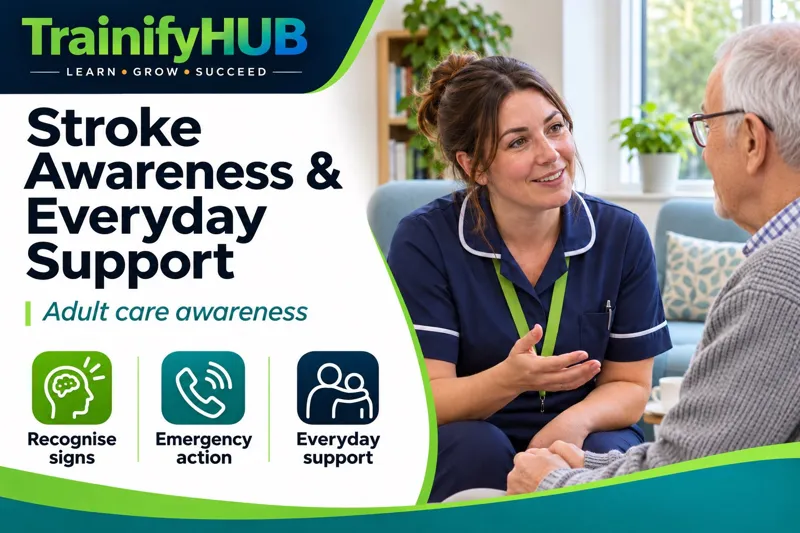
Stroke Awareness & Everyday Support
Recognise possible stroke signs, seek emergency help promptly and support everyday recovery using individual plans and clear communication within an adult care role.
No ratings yet
3.00 CPD Points
MODULES
9
ESTIMATED DURATION
2h 32m
STUDENTS
0+
LEVEL
beginner
Course Price
£20.00
One-time payment - 9 months' access
Buying for your team?
Up to 30% off per seat: 10+ seats 10%, 25+ seats 20%, 50+ seats 30%.
This course includes:
9 comprehensive modules
8 video lessons
1 downloadable resource (PDF)
Final assessment included
9 months’ access on mobile & desktop
Certificate of completion
3.00 CPD Points
CATEGORY
Health & Social CareLAST UPDATED
Nov 2026
About this course
Build confidence in recognising possible stroke signs and supporting everyday life after stroke. This CPD-accredited online course is for adult care workers and agency staff in care homes, home care and supported living. Eight modules cover emergency action, individual care plans, communication, daily activities, mealtimes, fatigue, wellbeing and factual handover.
The teaching uses an England-focused adult care context. Apply the national guidance, employer procedures and individual care plans relevant to your setting.
✓ Study using an internet-enabled device and everyday English comprehension.
✓ No formal qualification is required to start.
✓ Use the workbook’s fictional scenarios and guided activities.
✓ Request an accessible learning format if you need one.
Learning Outcomes
Module 1 — Understanding Stroke and Its Everyday Effects
A stroke can damage the brain and affect everyday life in different ways. A person may have changes in movement, communication, thinking, sensation or the ability to carry out activities. The effects depend on the individual; a stroke label does not tell the worker which abilities, preferences or support arrangements apply. The worker does not diagnose the location, severity or type of stroke.
By the end of this Module, learners will be able to:
✓ Explain stroke awareness without diagnosing or treating stroke.
✓ Describe how stroke effects and recovery needs can differ between people.
✓ Distinguish an established impairment from a new sudden change requiring emergency action without diagnostic certainty.
✓ Identify what must be established from the person and authorised care plan before support.
Workplace example: A care worker reads that a person has had a stroke. No information about the person’s individual effects or preferences is supplied.
Module 2 — Recognising Signs and Calling for Emergency Help
FAST helps people remember common stroke signs. Face: one side may droop or it may be difficult to smile. Arms: one arm may feel weak or numb, and the person may be unable to lift both arms and keep them raised. Speech: words may be slurred, confused or difficult to produce. Time: call 999 if stroke is suspected. Do not wait for all three signs to be present.
By the end of this Module, learners will be able to:
✓ Recognise FAST and other sudden signs listed in the current NHS source.
✓ Call 999 promptly for suspected stroke or signs in the last 24 hours even if stopped.
✓ Communicate known observations, onset and location without inventing or diagnosing.
✓ Follow emergency advice without delaying for routine processes or giving unauthorised treatment.
Workplace example: During a home-care visit an adult suddenly develops a drooping face and changed speech. The signs stop while the worker is preparing to call.
Module 3 — Person-Centred Recovery and Individual Care Plans
Individual recovery and care plans translate specialist assessment and the person’s goals into agreed support. The plan may describe assistance for everyday activity, communication, equipment, mealtimes, fatigue or participation. Workers should know where the current plan is kept, which instructions apply to their role and who can clarify uncertainties.
By the end of this Module, learners will be able to:
✓ Explain the person-led purpose of individual recovery goals.
✓ Identify the current authorised support plan and who can clarify it.
✓ Distinguish a worker’s everyday role from professional rehabilitation decisions.
✓ Report changes and participate in review without prescribing exercises or predicting recovery.
Workplace example: A person’s discharge paperwork mentions recovery goals, but the worker cannot find the current agreed daily-support plan. There is no emergency stated.
Module 4 — Communication and Participation After Stroke
Aphasia can affect speaking, understanding, reading and writing. The person may need more time or a particular communication method. A speech or language difficulty does not itself establish low intelligence or lack of mental capacity. Do not assume that inability to say a word means inability to make a choice.
By the end of this Module, learners will be able to:
✓ Describe how aphasia may affect communication without assuming intelligence or capacity.
✓ Address the person and use established accessible methods and aids.
✓ Give time, reduce distraction and check understanding respectfully.
✓ Seek competent advice when communication support is unclear or ineffective.
Workplace example: A person with established aphasia uses a communication aid named in their care plan. A visitor says staff should ask the family every question instead.
Module 5 — Supporting Everyday Activities and Safe Mobility
Everyday activities should reflect the person’s choices, abilities, current plan and the worker’s training. Assistance with washing, dressing or moving may be part of an assessed plan, but this course does not teach the physical techniques. Do not assume every person after stroke needs the same “affected-side” approach, one-handed method or item of equipment.
By the end of this Module, learners will be able to:
✓ Follow the current assessed plan for everyday activity and mobility support.
✓ Recognise limits of personal training and authorisation with equipment or transfers.
✓ Obtain competent clarification rather than improvising techniques or settings.
✓ Support person-led independence and report changes factually without prescribing rehabilitation.
Workplace example: A worker is asked to support a transfer using equipment and an instruction they have not been trained or authorised to use. No immediate emergency is stated.
Module 6 — Mealtime Support and Swallowing Concerns
Stroke can affect swallowing and mealtime support. This Module provides awareness of the need for an individual authorised plan; it does not teach a swallowing assessment, preparation recipe, therapeutic manoeuvre or first-aid procedure. Workers need access to clear current instructions and must understand the assistance they are trained and authorised to provide.
By the end of this Module, learners will be able to:
✓ Locate and follow the person’s authorised swallowing and mealtime instructions.
✓ Recognise missing, conflicting or changed information requiring competent clarification.
✓ Explain why workers must not assess swallowing or independently alter textures, fluids or medicines.
✓ Seek appropriate help for changed concerns and emergency action for serious choking or breathing difficulty within training.
Workplace example: A person after stroke has a swallowing plan, but a new instruction conflicts with it. No emergency or particular food/fluid recommendation is supplied.
Module 7 — Fatigue Emotional Wellbeing and Social Inclusion
Fatigue and emotional experiences after stroke vary between people and over time. A person may find ordinary activity tiring or experience frustration about changes in everyday life. This awareness course does not enable a worker to diagnose fatigue, depression, anxiety or emotionalism from a single observation.
By the end of this Module, learners will be able to:
✓ Recognise that fatigue and emotional experiences after stroke can vary.
✓ Support the person’s choices and paced participation within the agreed plan.
✓ Record and report new or worsening concerns factually without diagnosing.
✓ Distinguish routine plan-led support from a new sudden change requiring urgent action.
Workplace example: A person wants to join a social activity but says they are very tired. Their plan supports individual pacing; no new sudden neurological symptoms are stated.
Module 8 — Handover Review and Everyday Support Scenarios
Good handover supports continuity, but emergency action comes first. Emergency priority: if there are new sudden neurological changes or stroke is suspected, call 999 without waiting for a manager, routine review or a complete record. Current NHS advice also requires 999 where stroke signs occurred within the last 24 hours even if stopped. Do not dismiss a change as an old stroke effect without appropriate help. A sudden functional drop may represent a stroke sign; it must not automatically be placed in a manager-only category. Give known facts and uncertainty to the emergency adviser, then record contacts, advice and actions without delaying help.
By the end of this Module, learners will be able to:
✓ Prioritise emergency help for new sudden stroke signs without waiting for a complete handover.
✓ Communicate changes from baseline and uncertainty factually.
✓ Share necessary goals, support instructions and follow-up through approved processes.
✓ Seek review or competent clarification without inventing facts, treatment or recovery guarantees.
Workplace example: At handover a worker learns of a new sudden speech change compared with the person’s established communication pattern. The onset time is not known.
Final Assessment
Complete the 15-question single-answer knowledge assessment. Pass mark 80%; up to 10 attempts; maximum 30 minutes per attempt. Complete your own work and follow the on-screen instructions.
Accreditation & Recognition
This course is officially recognised and certified
3.00
CPD
Points Awarded
All accreditations are verified and recognised by relevant industry bodies. Upon successful completion, your certificate will display the appropriate accreditation marks.
Frequently Asked Questions
16 questions answered
Adult care workers and agency staff in England.
No. Recognise other source-listed sudden signs and do not require all FAST signs.
Call 999 if you think the person is having or has had a stroke, or for stroke signs within the last 24 hours even if they stopped; do not wait for a routine review.
Do not drive to A&E; call 999 and follow emergency advice.
No. This awareness course does not authorise medicine prescribing or treatment changes.
No. Provide established communication support and follow appropriate decision-making processes.
No. Effects and recovery vary; use the specialist team’s individual plan.
No. Practical moving and handling needs separate training, assessed competence and authorised instructions.
No. Follow authorised instructions and seek competent clarification; no test sips, manoeuvres or independent food/fluid/medicine changes.
Seek emergency help promptly and follow trained procedures; this is not practical first-aid training.
A separate 15-question knowledge assessment; pass 80 percent. No practical competence assessment.
No. Use the supplied fictional facts.
The course access period is nine months. Company assignment arrangements are managed separately; check the access dates shown in your learner account.
One year from passing; practical competence and employer review needs are separate.
Eight branded teaching videos, a learner workbook with guided reading and fictional written activities, and a separate 15-question final knowledge assessment.
Allow approximately 2 hours 32 minutes for video learning, guided self-study, written activities and the final knowledge assessment. Individual study time varies.
What You'll Learn
✓ Recognise FAST and other sudden concerning changes.
✓ Call 999 promptly when stroke is suspected, including signs within the last 24 hours even if they stopped.
✓ Follow current authorised care plans and individual recovery goals.
✓ Support communication, choice and participation after stroke.
✓ Recognise the limits of your training and seek competent help.
✓ Record and report changed concerns accurately.
Why Take This Course
✓ Recognise changes that need prompt emergency action.
✓ Develop clearer, person-centred communication after stroke.
✓ Support everyday choices using individual care plans.
✓ Practise safe judgement through fictional care scenarios.
✓ Build useful knowledge for accurate reporting and handover.
🌍 Available Online Across the UK
Study at your own pace from England, Scotland, Wales or Northern Ireland.
✓ London ✓ Birmingham ✓ Leicester
✓ Coventry ✓ Nottingham ✓ Derby
✓ Manchester ✓ Liverpool ✓ Leeds
✓ Sheffield ✓ Bradford ✓ Newcastle
✓ Bristol ✓ Southampton ✓ Portsmouth
✓ Brighton ✓ Oxford ✓ Cambridge
✓ Norwich ✓ Glasgow ✓ Edinburgh
✓ Aberdeen ✓ Dundee ✓ Cardiff
✓ Swansea ✓ Newport ✓ Wrexham
✓ Belfast ✓ Derry/Londonderry
The same eight videos, workbook and final assessment are available throughout the UK. Follow the national guidance and employer procedures relevant to your setting.
Certificate of Completion
✓ CPD-accredited training carrying 3 CPD points.
✓ Receive a TrainifyHUB Certificate of Completion after completing the required learning and passing the final assessment.
✓ Assessment: 15 single-answer questions; pass mark 80% (12 out of 15).
✓ Certificate validity: one year from passing.
✓ This is a knowledge-based CPD course; it does not award an RQF qualification or clinical, rehabilitation, first-aid or practical moving-and-handling competence.
Course Highlights
0+
Students Enrolled
New
Be the first!
2h 32m
Estimated Duration

Why book with TrainifyHUB
- CPD accredited training content
- Delivered UK-wide at your workplace
- Certificate of completion included
- Secure, encrypted online payments
Accredited & Trusted
 CPD Accredited Provider
 Secure Payments
Need help choosing a course?
+44 7405 005823 support@trainifyhub.co.uk
Our team can advise on the right training package for your organisation.
Keep learning
Related courses
Picked from what learners take alongside this course.
More in Health & Social Care More in Health & Social Care
 More in Health & Social Care
 More in Health & Social Care
Health & Social Care
Diabetes Awareness: Essential Knowledge for Care Professionals
4.8(20)
11 modules3h97
£20.00
 More in Health & Social Care
 More in Health & Social Care
Health & Social Care
Care Certificate Standard 16: Awareness of Learning Disability and Autism
4.7(20)
11 modules4h93
£20.00
 More in Health & Social Care
 More in Health & Social Care
Health & Social Care
Dementia Care Awareness Training – CPD Certified (Updated 2026)
4.6(20)
11 modules3h83
£20.00
Student Reviews
0.0
0 stars
Based on 0 reviews
5
0
4
0
3
0
2
0
1
0
🔒 Log In to Review
You must be logged in to submit a review. Please log in or create an account.