 More in Health & Social Care
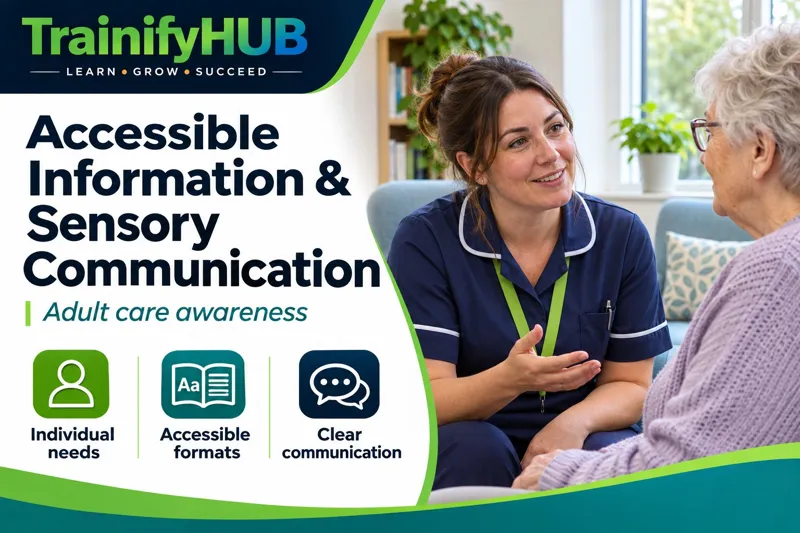
Accessible Information & Sensory Communication
Support accessible information and individual communication needs in adult care, using the current six-step Accessible Information Standard and person-led everyday adjustments.
No ratings yet
2.00 CPD Points
MODULES
9
ESTIMATED DURATION
2h 20m
STUDENTS
0+
LEVEL
beginner
Course Price
£20.00
One-time payment - 9 months' access
Buying for your team?
Up to 30% off per seat: 10+ seats 10%, 25+ seats 20%, 50+ seats 30%.
This course includes:
9 comprehensive modules
8 video lessons
1 downloadable resource (PDF)
Final assessment included
9 months’ access on mobile & desktop
Certificate of completion
2.00 CPD Points
CATEGORY
Health & Social CareLAST UPDATED
Nov 2026
About this course
This self-paced online awareness course is for adult care workers and agency staff working in England, including care homes, home care and supported living. Eight Modules explore identifying needs, recording actionable adjustments, appropriate sharing, accessible formats, hearing and sight loss, deafblindness and accessible care coordination. Fictional examples and written activities develop role-appropriate judgement. The course does not award clinical, interpreting, BSL or practical guiding competence.
Who this course is for
Adult care workers and agency staff in England, including care homes, home care and supported living.
What you need
An internet-enabled device and everyday English comprehension. No formal qualification is required. Use fictional examples in activities and keep real personal information secure.
Learning approach
Eight teaching videos are supported by a learner workbook, guided reading, practical scenarios and a final knowledge assessment. The course supports awareness and role-appropriate decisions; it does not qualify learners in clinical assessment, BSL, interpreting or practical guiding.
Learning time
Allow approximately 2 hours 20 minutes for the full learning package, including video learning, guided study, activities and the final assessment.
🌍 CPD learning across the UK
Access this CPD-accredited online course from England, Scotland, Wales or Northern Ireland, including London, Birmingham, Manchester, Glasgow, Cardiff and Belfast. Study the same eight teaching videos, learner workbook and final assessment at your own pace.
The Accessible Information Standard covered in this course applies in England. Learners in Scotland, Wales and Northern Ireland should use the communication principles alongside the national requirements and employer procedures relevant to their setting. UK-wide online access does not mean the England standard applies unchanged across the UK or that a local classroom is provided.
Learning Outcomes
Module 1 — Accessible Information and Rights in Adult Care
Understand accessible information, communication support and the six-step Accessible Information Standard in England’s adult care context.
By the end of this Module, learners will be able to:
✓ Explain what accessible information and communication support mean in everyday adult care.
✓ Distinguish the England AIS provider context from a worker’s role and from translation alone.
✓ Name the six current AIS steps including review.
✓ Choose a person-led next action without claiming course completion proves compliance.
Workplace application: Compare a large-print appointment request with a request for language translation, and identify the appropriate next question.
Module 2 — Identifying Individual Information and Communication Needs
Explore respectful ways to identify the person’s preferred formats, communication support and environmental adjustments.
By the end of this Module, learners will be able to:
✓ Ask respectful questions about the person’s information and communication needs.
✓ Identify useful formats, support and environmental adjustments without diagnosing.
✓ Distinguish actionable needs from a diagnosis-only record.
✓ Check whether an agreed adjustment works and arrange further support where needed.
Workplace application: Replace a vague handover stating only ‘hearing loss’ with questions that establish what actually helps the person.
Module 3 — Recording Flagging Sharing and Reviewing Needs
Turn agreed communication needs into actionable records, appropriate flags, authorised sharing and responsive reviews.
By the end of this Module, learners will be able to:
✓ Describe identify, record, flag, share, meet and review as a connected cycle.
✓ Write a specific actionable needs record in an authorised system.
✓ Explain appropriate flagging and sharing during care coordination.
✓ Respond to changed or unmet needs through review and escalation without an invented fixed interval.
Workplace application: Record an agreed format and who will arrange it, then check whether the arrangement is still effective.
Module 4 — Clear Spoken Written and Digital Information
Choose clear spoken, written and digital information with the person and check that the chosen format works.
By the end of this Module, learners will be able to:
✓ Select spoken, written and digital formats with the person.
✓ Distinguish plain English from Easy Read.
✓ Improve the clarity and usability of an everyday care message.
✓ Check understanding respectfully and arrange another format or qualified support where needed.
Workplace application: Improve a confusing care-review message and check whether plain English or another accessible format is needed.
Module 5 — Supporting People with Hearing Loss
Support everyday conversations with people with hearing loss and recognise when qualified communication support is needed.
By the end of this Module, learners will be able to:
✓ Describe how hearing loss may affect an everyday care conversation without diagnosing.
✓ Apply person-led attention, positioning, clear speech and noise adjustments.
✓ Explain why hearing aids, lip-reading, written notes, captions and relatives are not universal solutions.
✓ Arrange appropriate communication support and recognise when current NHS urgent advice is needed.
Workplace application: Arrange a quiet face-to-face conversation and ask what communication support works for the individual.
Module 6 — Supporting People with Sight Loss and Deafblindness
Respond to individual preferences for sight loss and deafblindness while recognising the limits of practical assistance.
By the end of this Module, learners will be able to:
✓ Ask people with sight loss or deafblindness about established preferences and communication methods.
✓ Introduce yourself, describe relevant information and seek permission before assistance.
✓ Arrange individual accessible formats and authorised specialist support without assuming Braille or writing will help.
✓ Recognise role limits and current NHS urgent vision-loss advice without teaching guiding or tactile techniques.
Workplace application: Introduce yourself, explain relevant information and ask permission before offering assistance.
Module 7 — Consent Confidentiality and Accessible Care Coordination
Support accessible care choices, appropriate information sharing and escalation without making assumptions about capacity.
By the end of this Module, learners will be able to:
✓ Support a person to understand and express care choices using suitable communication support.
✓ Avoid inferring lack of capacity from sensory or communication difficulty.
✓ Share necessary actionable needs through authorised care-information processes.
✓ Escalate unmet communication needs or confidentiality concerns and support accessible review or complaints.
Workplace application: Arrange communication support for a care choice and share only the necessary needs through authorised processes.
Module 8 — Accessible Communication Scenarios and Improvement
Apply the six AIS steps to fictional care situations, correct immediate access barriers and review whether improvements work.
By the end of this Module, learners will be able to:
✓ Apply all six AIS steps to a fictional care-access failure.
✓ Prioritise correcting the person’s immediate information and communication access.
✓ Propose a factual authorised handover, escalation and process improvement.
✓ Check whether the correction works without claiming a single change proves organisational compliance.
Workplace application: Respond to an inaccessible care-review invitation, meet the immediate need and propose a factual improvement.
Accreditation & Recognition
This course is officially recognised and certified
2.00
CPD
Points Awarded
All accreditations are verified and recognised by relevant industry bodies. Upon successful completion, your certificate will display the appropriate accreditation marks.
Frequently Asked Questions
15 questions answered
Adult care workers and agency staff can study online across England, Scotland, Wales and Northern Ireland. The Accessible Information Standard content uses England requirements; apply the national requirements and employer procedures relevant to your setting.
An England standard for NHS and publicly funded adult social care information and communication needs related to disability, impairment or sensory loss.
Identify needs, record them, flag them, share appropriately, meet them and review them.
No. It covers a range of disability-related information and communication needs. Ask the person what support works.
Translation alone is distinct from the standard’s disability-related scope. Other language-support responsibilities can still apply.
No. Check the person’s needs and arrange a suitable accessible version; shorter wording is not automatically Easy Read.
No. Confirm the person’s needs and arrange appropriately qualified communication support when required, following authorised procedures.
No. Provide suitable support and follow the relevant decision-making procedures; communication ability alone does not establish lack of capacity.
No. It teaches awareness and appropriate arrangements, not practical guiding, tactile communication, BSL or interpreting competence.
No. Organisations must implement and check their actual systems and arrangements. This awareness certificate is not regulator approval or compliance certification.
No. Use the supplied fictional facts and keep personal information secure.
A separate 15-question single-answer knowledge assessment, with an 80% pass mark. It does not assess practical competence.
Nine months from assignment. Unassigned company entitlements do not expire.
One year from passing. Employer review needs and competence requirements remain separate.
No. Workers learn everyday communication support and role boundaries, with source-based advice to seek appropriate help for concerning changes.
What You'll Learn
Explain the England AIS scope; apply identify, record, flag, share, meet and review; ask what helps rather than assume; choose appropriate formats; recognise when qualified support is needed; support accessible care choices; report unmet needs and check improvements.
Why Take This Course
A care letter, conversation or handover can exclude someone when their information or communication needs are missed. Understanding specific needs and agreed adjustments helps workers support participation, dignity and informed choices while recognising when further support is required.
🌍 Available Online Across the UK
This course is available online from England, Scotland, Wales and Northern Ireland using a suitable device and internet connection. Locations include:
✓ London ✓ Birmingham ✓ Leicester
✓ Coventry ✓ Nottingham ✓ Derby
✓ Manchester ✓ Liverpool ✓ Leeds
✓ Sheffield ✓ Bradford ✓ Newcastle
✓ Bristol ✓ Southampton ✓ Portsmouth
✓ Brighton ✓ Oxford ✓ Cambridge
✓ Norwich ✓ Glasgow ✓ Edinburgh
✓ Aberdeen ✓ Dundee ✓ Cardiff
✓ Swansea ✓ Newport ✓ Wrexham
✓ Belfast ✓ Derry/Londonderry
Online access does not extend the course’s stated legal or care-setting scope. Follow applicable local requirements, employer policies and role boundaries; practical training, assessment and authorisation remain separate.
Certificate of Completion
📜 CPD-accredited completion certificate
This CPD-accredited course carries 2 CPD points. Complete the required learning and pass the final knowledge assessment to receive your TrainifyHUB Certificate of Completion with CPD accreditation. Certificate validity is one year from passing. This continuing professional development course does not award an RQF qualification or practical interpreting, BSL, clinical or guiding competence.
Course Highlights
0+
Students Enrolled
New
Be the first!
2h 20m
Estimated Duration


Why book with TrainifyHUB
- CPD accredited training content
- Delivered UK-wide at your workplace
- Certificate of completion included
- Secure, encrypted online payments
Accredited & Trusted
 CPD Accredited Provider
 Secure Payments
Need help choosing a course?
+44 7405 005823 support@trainifyhub.co.uk
Our team can advise on the right training package for your organisation.
Keep learning
Related courses
Picked from what learners take alongside this course.
More in Health & Social Care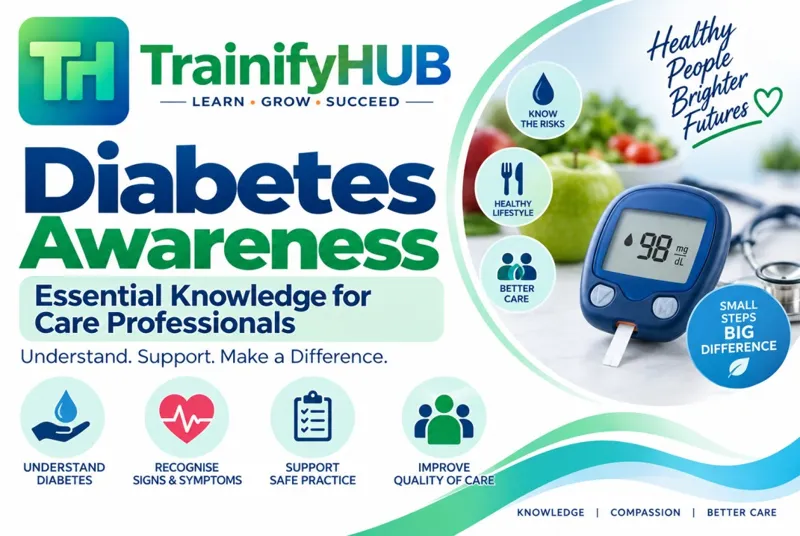 More in Health & Social Care
Health & Social Care
Diabetes Awareness: Essential Knowledge for Care Professionals
4.8(20)
11 modules3h97
£20.00
 More in Health & Social Care
 More in Health & Social Care
Health & Social Care
Care Certificate Standard 16: Awareness of Learning Disability and Autism
4.7(20)
11 modules4h93
£20.00
 More in Health & Social Care
 More in Health & Social Care
Health & Social Care
Dementia Care Awareness Training – CPD Certified (Updated 2026)
4.6(20)
11 modules3h83
£20.00
 More in Health & Social Care
 More in Health & Social Care
Student Reviews
0.0
0 stars
Based on 0 reviews
5
0
4
0
3
0
2
0
1
0
🔒 Log In to Review
You must be logged in to submit a review. Please log in or create an account.