 More in Compliance
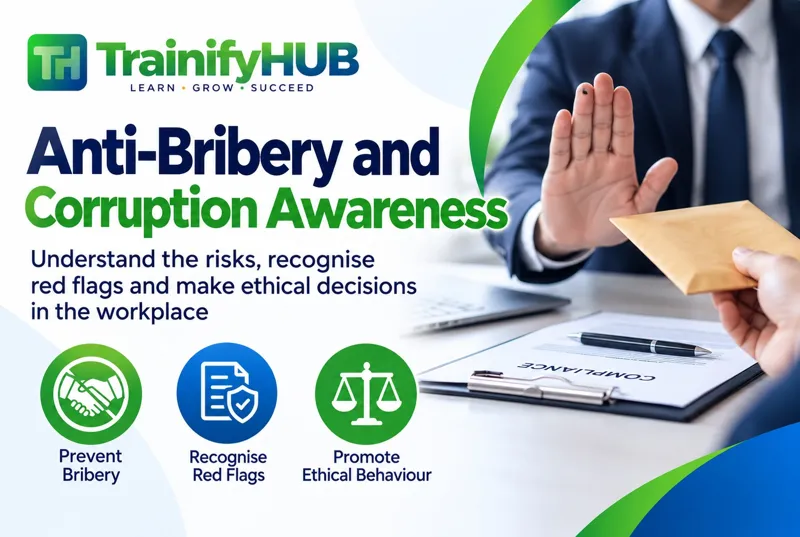
Anti-Bribery and Corruption Awareness
Practical UK workplace training to recognise bribery risks, respond appropriately and support an ethical, compliant business culture.
4.5 (20 reviews)
2.00 CPD Points
MODULES
9
DURATION
2h
STUDENTS
97+
LEVEL
beginner
Course Price
GBP 20.00
One-time payment - 9 months' access
Buying for your team?
Up to 30% off per seat: 10+ seats 10%, 25+ seats 20%, 50+ seats 30%.
This course includes:
9 comprehensive modules
2h of video content
PDF, PPT & Infographics included
Final assessment included
9 months' access on mobile & desktop
Certificate of completion
2.00 CPD Points
CATEGORY
ComplianceLAST UPDATED
Oct 2026
About this course
Anti-Bribery and Corruption Awareness gives learners a practical introduction to risks in everyday business relationships. It explains how concerns may arise through payments, gifts, hospitality, expenses, favours or third-party arrangements, including situations where an improper request is presented as normal business practice.
Across eight teaching modules, learners explore the Bribery Act framework at awareness level, the offering and receiving of advantages, overseas business and interactions with foreign public officials. The course also addresses facilitation payments, conflicts of interest, agents, intermediaries and due diligence.
Realistic situations help learners consider context, purpose, transparency and approval before acting. Examples encourage them to pause when a request appears unusual, keep accurate records and seek guidance when expectations or responsibilities are unclear.
Prevention and speaking up run throughout the course. Learners examine how policies, approvals and proportionate checks support ethical decisions, and how to report a concern without investigating independently or making unsupported allegations.
This introductory training is suitable for employees, contractors and supervisors, including people involved in purchasing, sales, supplier relationships or overseas activity. It supports induction or refresher learning and includes a separate final assessment. Local anti-bribery policies and reporting procedures remain essential to applying the learning at work.
Learning Outcomes
By completing this course, learners will be able to:
● Explain bribery and corruption in plain workplace terms.
● Identify warning signs in an offer, request or business arrangement.
● Recognise situations involving foreign public officials that need guidance.
● Assess a hospitality scenario against organisational approval procedures.
● Identify a potential conflict of interest and the route for declaring it.
● Recognise a request that may involve a facilitation payment.
● Describe why third-party relationships require proportionate checks.
● Explain the importance of transparent approvals and accurate records.
● Choose an appropriate reporting route without investigating independently.
● Apply an ethical decision-making approach to a realistic business scenario.
Module 1 - Understanding Bribery, Corruption and the Bribery Act 2010
Module Learning Outcomes
By the end of this Module, learners will be able to:
• Identify the four key offences under the Bribery Act 2010.
• Distinguish between individual criminal liability and corporate strict liability.
• Recognise the basic legal requirement for an adequate-procedures defence.
Module 2 - Offering, Promising, Giving, Requesting and Receiving Bribes
Module Learning Outcomes
By the end of this Module, learners will be able to:
• Distinguish the giver-side Section 1 offence from the receiver-side Section 2 offence at awareness level.
• Recognise that a bribe can involve a financial or other advantage, not only cash.
• Recognise that offers, promises, requests or agreements can create bribery risk even where money has not changed hands.
• Know to refuse private arrangements and escalate suspected bribery through authorised routes.
Module 3 - Foreign Public Officials and Overseas Business Risk
Module Learning Outcomes
By the end of this Module, learners will be able to:
• Identify who may fall within the foreign public official concept at awareness level.
• Explain that Section 6 focuses on influencing a foreign public official to obtain or retain business or a business advantage.
• Recognise that local custom does not by itself provide a defence where the written law does not permit the advantage.
• Apply heightened scrutiny to overseas public-sector interactions.
Module 4 - Gifts, Hospitality, Expenses and Conflicts of Interest
Module Learning Outcomes
By the end of this Module, learners will be able to:
• Distinguish genuine, proportionate business hospitality from an improper inducement.
• Recognise that the Bribery Act does not create one universal monetary threshold for gifts or hospitality.
• Consider purpose, timing, proportionality, transparency and legitimate business rationale when assessing risk.
• Follow organisation-specific declaration and approval controls for gifts, hospitality and conflicts.
Module 5 - Facilitation Payments and Other High-Risk Payments
Module Learning Outcomes
By the end of this Module, learners will be able to:
• Explain that facilitation payments have no general exemption under the Bribery Act 2010.
• Distinguish an unofficial facilitation payment from a genuine published official fee paid transparently to the proper authority.
• Recognise procurement, tendering, logistics and certain contributions as higher-risk payment contexts.
• Know to refuse and escalate requests for unofficial payments in line with authorised procedures.
Module 6 - Third Parties, Agents, Intermediaries and Due Diligence
Module Learning Outcomes
By the end of this Module, learners will be able to:
• Explain how associated persons and third parties can create Section 7 bribery risk for an organisation.
• Recognise third-party red flags such as unusually high commissions or unclear services.
• Understand the role of risk-based due diligence and appropriate record-keeping before engagement.
• Recognise that Section 7 is not a blanket rule making an organisation liable for every unrelated third-party act.
Module 7 - Organisational Prevention, Adequate Procedures and Speaking Up
Module Learning Outcomes
By the end of this Module, learners will be able to:
• Identify the six Ministry of Justice principles that support bribery prevention.
• Explain the Section 7 failure-to-prevent offence and the role of the adequate-procedures defence at awareness level.
• Use authorised internal reporting, ethics, compliance or Speak Up routes when concerns arise.
• Provide factual information and avoid conducting an unauthorised investigation.
Module 8 - Recognising Red Flags and Building an Anti-Bribery Culture
Module Learning Outcomes
By the end of this Module, learners will be able to:
• Recognise common bribery red flags such as cash requests, opaque invoices, offshore payments and disproportionate success fees.
• Explain why a strong Speak Up culture supports bribery prevention.
• Treat red flags as indicators requiring review rather than proof of bribery.
• Respond to concerns by recording facts accurately and escalating through authorised routes.
Accreditation & Recognition
This course is officially recognised and certified
2.00
CPD
Points Awarded
All accreditations are verified and recognised by relevant industry bodies. Upon successful completion, your certificate will display the appropriate accreditation marks.
Frequently Asked Questions
12 questions answered
This course is suitable for employees, workers, contractors and supervisors who need practical anti-bribery awareness but are not legal or compliance specialists.
Yes. The course is developed around UK workplace practice and authoritative UK sources, including the Bribery Act 2010 and official government guidance.
No. The course is introductory and explains the subject in clear, practical language.
Yes. It introduces the main Bribery Act offences and the principles organisations use to prevent bribery, without turning the training into a specialist legal course.
No. Genuine and proportionate business hospitality is not automatically prohibited. The course explains why context, purpose, transparency and organisational procedures matter.
Yes. Learners are introduced to facilitation-payment risks and why these payments do not have a general exemption under the Bribery Act 2010.
Yes. The course includes awareness of foreign public officials, international business activity and third-party risks.
Yes. The course focuses on recognising red flags, pausing before acting, following approval procedures and escalating concerns through appropriate workplace routes.
Yes. It explains how agents, consultants, suppliers and other associated third parties can create bribery risk and why proportionate due diligence matters.
Yes. The course includes a separate multiple-choice final assessment. The standard pass mark is 80%.
Yes. On successful completion of the course and final assessment, you will receive a TrainifyHub certificate of completion for your training records.
No. This is workplace awareness training and the completion certificate is not a regulated qualification or professional licence.
What You'll Learn
● What bribery and corruption mean in everyday business situations.
● The main Bribery Act topics addressed by the course at awareness level.
● Risks involving offers, promises, payments, requests and receipt of advantages.
● Why overseas activity and interactions with foreign public officials need care.
● How context and purpose affect gifts, hospitality and expenses decisions.
● Recognising and declaring potential conflicts of interest.
● Facilitation-payment requests and other unusual payment arrangements.
● Risks involving agents, consultants, suppliers and intermediaries.
● The purpose of proportionate due diligence, approvals and accurate records.
● How to pause, seek guidance, report concerns and support an ethical culture.
Why Take This Course
Bribery risks are not limited to obvious cash payments. Pressure to secure a contract, approve an expense or accept a favour can place staff in a difficult position, particularly when a request appears to come from a trusted business contact.
This course helps learners recognise those situations and respond with confidence. It connects awareness to practical actions such as checking approvals, declaring conflicts, recording decisions and asking for guidance.
The training supports a consistent approach across employees and business relationships. It complements organisational controls and specialist advice by making clear when a learner should pause and escalate a concern.
Certificate of Completion
On successful completion of Anti-Bribery and Corruption Awareness and its final assessment, learners will receive a TrainifyHub certificate of completion confirming completion of this awareness training.
The certificate can be used as evidence of learning for staff development, training records and ongoing professional development. It records course completion; it does not replace role-specific competence checks or organisational responsibilities.
Course Highlights
97+
Students Enrolled
4.5
20 Reviews
2h
Total Duration


Why book with TrainifyHUB
- CPD accredited training content
- Delivered UK-wide at your workplace
- Certificate of completion included
- Secure, encrypted online payments
Accredited & Trusted
 CPD Accredited Provider
 Secure Payments
Need help choosing a course?
+44 7405 005823 support@trainifyhub.co.uk
Our team can advise on the right training package for your organisation.
Keep learning
Related courses
Picked from what learners take alongside this course.
More in Compliance More in Compliance
 More in Compliance
 More in Compliance
 More in Compliance
 More in Compliance
Compliance
Professional Exam Invigilation Integrity and Quality Assurance
4.7(20)
11 modules4h64
GBP25.00
 More in Compliance
 More in Compliance
Student Reviews
4.5
5 stars
Based on 20 reviews
5
0
4
0
3
0
2
0
1
0
🔒 Log In to Review
You must be logged in to submit a review. Please log in or create an account.