 More in Compliance
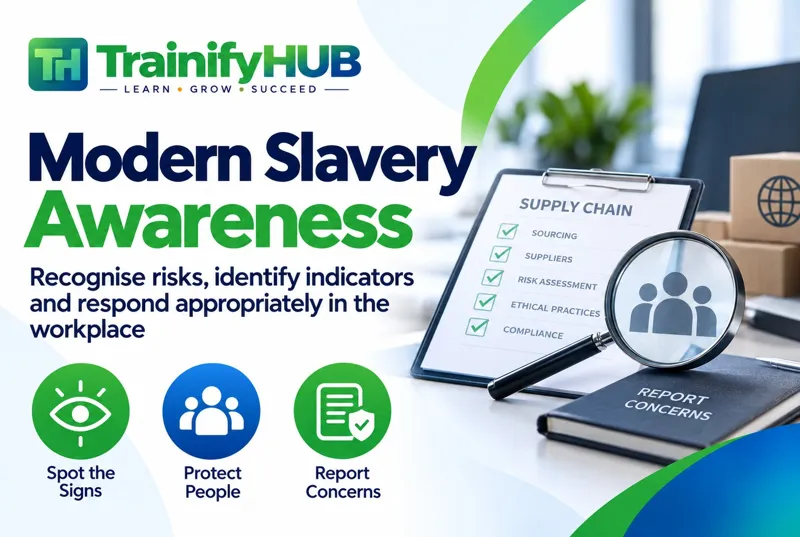
Modern Slavery Awareness
Learn to recognise indicators of modern slavery and respond safely to concerns in workplaces and supply chains.
4.8 (20 reviews)
2.00 CPD Points
MODULES
9
DURATION
2h
STUDENTS
82+
LEVEL
beginner
Course Price
Free
One-time payment - 9 months' access
This course includes:
9 comprehensive modules
2h of video content
PDF, PPT & Infographics included
Final assessment included
9 months' access on mobile & desktop
Certificate of completion
2.00 CPD Points
CATEGORY
ComplianceLAST UPDATED
Oct 2026
Course Price
Free
One-time payment - 9 months' access
This course includes:
9 comprehensive modules
2h of video content
PDF, PPT & Infographics included
Final assessment included
9 months' access on mobile & desktop
Certificate of completion
2.00 CPD Points
CATEGORY
ComplianceLAST UPDATED
Oct 2026
About this course
Modern Slavery Awareness helps learners recognise potential exploitation in workplaces and business relationships. It introduces the subject through practical situations and explains why a warning sign should lead to careful observation and an appropriate report, rather than an assumption or confrontation.
The eight teaching modules cover modern slavery, forced labour, servitude and human trafficking. Learners explore concerns linked to recruitment, debt, identity documents, accommodation, wages and control, together with risks in labour supply chains and subcontracting.
The course uses workplace examples to show how different indicators may appear together. It encourages factual reporting and sensitivity towards the person who may be affected, keeping personal safety and appropriate support at the centre of the response.
Business responsibilities, due diligence, supplier oversight and transparency statements are introduced at awareness level. Learners consider how these organisational processes connect with everyday purchasing, recruitment and reporting decisions, while specialist decisions remain with authorised roles.
This beginner-level course is suitable for staff, supervisors and people who encounter suppliers or labour providers. It supports induction and refresher training and includes a separate final assessment. Learners should apply the course alongside their organisation’s safeguarding and reporting arrangements.
Learning Outcomes
By completing this course, learners will be able to:
● Explain the main forms of exploitation introduced in the course.
● Identify potential indicators in workplace and supply-chain examples.
● Distinguish a factual observation from an unsupported conclusion.
● Recognise concerns involving recruitment, debt and control of documents.
● Choose a safe first response to a suspected exploitation concern.
● Identify when an urgent response or organisational escalation is needed.
● Describe useful information to include in a factual report.
● Explain the purpose of proportionate supplier and labour-provider checks.
● Describe the awareness-level role of transparency and organisational oversight.
● Apply a prevention-focused approach within the boundaries of their role.
Module 1 - Understanding Modern Slavery and Exploitation
Module Learning Outcomes
By the end of this Module, learners will be able to:
• Explain slavery, servitude, forced or compulsory labour and human trafficking at awareness level.
• Distinguish broader labour exploitation from the statutory modern slavery offences.
• Recognise that exploitation can be hidden within otherwise legitimate businesses and supply chains.
• Avoid assuming that one poor employment practice automatically proves modern slavery.
Module 2 - Forms of Modern Slavery: Forced Labour, Servitude and Human Trafficking
Module Learning Outcomes
By the end of this Module, learners will be able to:
• Distinguish slavery/servitude/forced labour from human trafficking.
• Understand that trafficking focuses on arranging or facilitating travel with a view to exploitation.
• Understand that consent to the travel does not prevent the section 2 offence where the statutory elements are met.
• Recognise that exploitation under section 3 covers several statutory forms and should not be reduced to an inaccurate short list.
Module 3 - Recognising Indicators in Workplaces and Supply Chains
Module Learning Outcomes
By the end of this Module, learners will be able to:
• Recognise physical, psychological, financial, movement and workplace indicators.
• Understand that a single indicator may have an innocent explanation.
• Recognise that clusters of indicators increase concern.
• Know what information to record without conducting an investigation.
Module 4 - Recruitment, Debt, Documents, Accommodation and Labour Exploitation
Module Learning Outcomes
By the end of this Module, learners will be able to:
• Recognise deceptive recruitment and worker-paid recruitment-fee risks.
• Recognise debt bondage and financial control.
• Recognise document withholding and restriction of movement as serious indicators.
• Recognise how employer-controlled accommodation can be used coercively.
Module 5 - Responding Safely and Reporting Concerns
Module Learning Outcomes
By the end of this Module, learners will be able to:
• Know what to do in an emergency and a non-emergency.
• Understand that ordinary staff are not automatically NRM First Responders.
• Avoid confrontation or amateur rescue attempts.
• Use internal reporting where appropriate while recognising official external reporting routes.
Module 6 - Business Responsibilities, Due Diligence and Supply-Chain Risk
Module Learning Outcomes
By the end of this Module, learners will be able to:
• Understand why labour supply chains can create modern slavery risk.
• Recognise recruitment, subcontracting, very low bids and opaque labour arrangements as risk factors.
• Understand proportionate due diligence and remediation at awareness level.
• Avoid converting good-practice measures into universal legal duties.
Module 7 - Section 54 Transparency Statements and Organisational Governance
Module Learning Outcomes
By the end of this Module, learners will be able to:
• Identify the four criteria that trigger the Section 54 statement requirement.
• Understand the £36 million turnover threshold.
• Understand annual statement, website, approval and sign-off requirements.
• Distinguish the six recommended content areas from strict mandatory section headings.
• Understand that government registry submission is currently encouraged, not yet mandatory.
Module 8 - Building a Prevention-Focused Workplace Culture
Module Learning Outcomes
By the end of this Module, learners will be able to:
• Understand why workers should feel able to raise concerns before they have proof.
• Use incidents, near misses and feedback to improve controls.
• Recognise the importance of leadership, procurement, HR and operational collaboration.
• Understand that training is one control, not the whole prevention system.
Accreditation & Recognition
This course is officially recognised and certified
2.00
CPD
Points Awarded
All accreditations are verified and recognised by relevant industry bodies. Upon successful completion, your certificate will display the appropriate accreditation marks.
Frequently Asked Questions
12 questions answered
It is suitable for employees, contractors, supervisors and people involved in recruitment, procurement or supply-chain activity.
No. The course is introductory workplace awareness.
It includes forced labour, servitude, human trafficking and related exploitation risks.
No. Indicators should be considered carefully and reported through appropriate routes.
No. An unsafe confrontation may increase risk. Follow emergency and organisational reporting arrangements.
Use the appropriate emergency service route and follow workplace procedures.
Yes. It introduces due diligence, risk indicators and organisational prevention.
It is a transparency measure relevant to organisations within the applicable requirements; the course explains its purpose at awareness level.
Yes. It uses UK sources while noting territorial limits where relevant.
Yes. The course includes a final multiple-choice assessment.
The standard pass mark is 80% unless the published settings state otherwise.
No. It supports awareness and appropriate escalation, not specialist investigation.
What You'll Learn
● The meaning of modern slavery, exploitation, forced labour, servitude and trafficking.
● How coercion, control and vulnerability can feature in exploitation.
● Workplace and supply-chain warning signs that may require attention.
● Recruitment-related concerns involving debt, documents and accommodation.
● Why indicators should be considered in context and are not proof on their own.
● Responding safely without confronting suspected exploiters or investigating alone.
● Recording factual observations and using appropriate reporting routes.
● The role of due diligence and labour-provider or supplier controls.
● Transparency statements and organisational governance as covered in the course.
● How staff can support prevention through everyday decisions and reporting.
Why Take This Course
Exploitation can be difficult to recognise when responsibility is spread across recruitment agencies, contractors and suppliers. People may notice something concerning without knowing whether it is relevant or how to raise it.
This course helps learners connect observations with an appropriate, safety-conscious response. It is useful for staff who interact with workers, labour providers or supply chains, as well as those who need general awareness.
The training supports responsible reporting and organisational prevention. It encourages care for potentially affected people while avoiding actions that could increase risk or interfere with specialist support.
Certificate of Completion
On successful completion of Modern Slavery Awareness and its final assessment, learners will receive a TrainifyHub certificate of completion confirming completion of this awareness training.
The certificate can be used as evidence of learning for staff development, training records and ongoing professional development. It records course completion; it does not replace role-specific competence checks or organisational responsibilities.
Course Highlights
82+
Students Enrolled
4.8
20 Reviews
2h
Total Duration

Why book with TrainifyHUB
- CPD accredited training content
- Delivered UK-wide at your workplace
- Certificate of completion included
- Secure, encrypted online payments
Accredited & Trusted
 CPD Accredited Provider
 Secure Payments
Need help choosing a course?
+44 7405 005823 support@trainifyhub.co.uk
Our team can advise on the right training package for your organisation.
Keep learning
Related courses
Picked from what learners take alongside this course.
More in Compliance More in Compliance
 More in Compliance
 More in Compliance
 More in Compliance
 More in Compliance
Compliance
Professional Exam Invigilation Integrity and Quality Assurance
4.7(20)
11 modules4h64
GBP25.00
 More in Compliance
 More in Compliance
Student Reviews
4.8
5 stars
Based on 20 reviews
5
0
4
0
3
0
2
0
1
0
🔒 Log In to Review
You must be logged in to submit a review. Please log in or create an account.