 More in Compliance
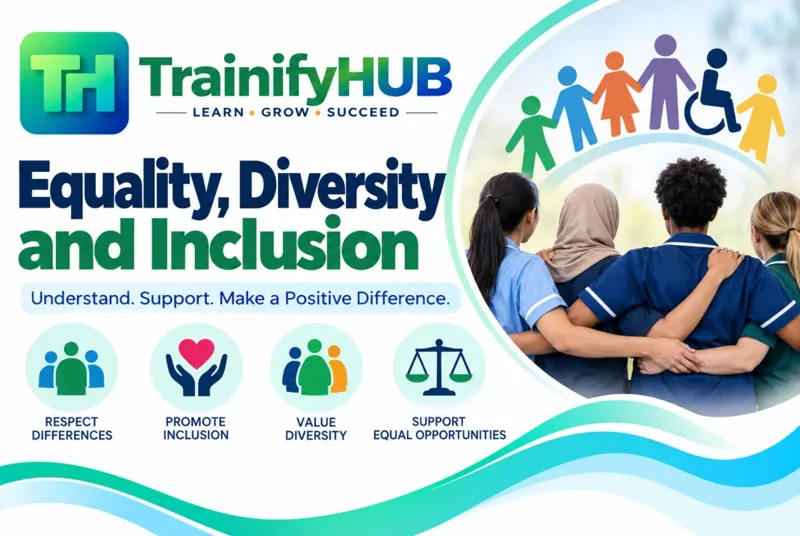
Equality, Diversity and Inclusion
Develop practical awareness of equality, diversity and inclusion in everyday UK workplace decisions and behaviour.
No ratings yet
2.00 CPD Points
MODULES
9
DURATION
2h
STUDENTS
0+
LEVEL
beginner
Course Price
GBP 20.00
One-time payment - 9 months' access
Buying for your team?
Up to 30% off per seat: 10+ seats 10%, 25+ seats 20%, 50+ seats 30%.
This course includes:
9 comprehensive modules
2h of video content
PDF, PPT & Infographics included
Final assessment included
9 months' access on mobile & desktop
Certificate of completion
2.00 CPD Points
CATEGORY
ComplianceLAST UPDATED
Oct 2026
About this course
Equality, Diversity and Inclusion introduces the everyday behaviours and decisions that shape a respectful workplace. It helps learners understand what these terms mean in practice and how colleagues, customers and applicants can experience barriers or unfair treatment.
The eight teaching modules explore protected characteristics, discrimination, harassment, bullying, victimisation and disability inclusion. Learners consider accessibility and reasonable adjustments alongside communication, recruitment, development and fair decision-making.
Workplace examples encourage learners to examine assumptions, language, routines and the impact of their decisions. The course asks how someone might be excluded by a process, how information could be made more accessible and when support or a different approach may be needed.
Learners also explore speaking up and using appropriate reporting routes. The emphasis is on recognising concerns, responding respectfully and seeking help within the limits of their role, rather than making unsupported findings about another person.
Suitable for employees, contractors and supervisors, this introductory course supports induction and refresher learning. It uses British English and workplace examples, with relevant legal context explained within the controlled teaching materials. A separate final assessment checks understanding of the course.
Learning Outcomes
By completing this course, learners will be able to:
Explain equality, diversity and inclusion using workplace examples.
Identify potential barriers to participation in a routine workplace process.
Recognise examples that may raise discrimination concerns.
Distinguish the course’s explanations of harassment, bullying and victimisation.
Describe why accessibility and reasonable adjustments matter.
Choose more inclusive language and communication methods.
Identify assumptions that may affect recruitment or development decisions.
Respond respectfully when a colleague raises an inclusion concern.
Use the appropriate workplace route for advice, support or reporting.
Suggest practical changes that support fair participation within their role.
Course Content
Module 1 - Understanding Equality, Diversity and Inclusion
Module Learning Outcomes
By the end of this Module, learners will be able to:
• Define equality, diversity and inclusion in plain workplace language.
• Explain why equal opportunity does not always mean identical treatment.
• Recognise inclusive and exclusionary everyday behaviour.
• Identify when a concern should be raised rather than ignored.
Module 2 - Protected Characteristics and the Equality Act 2010
Module Learning Outcomes
By the end of this Module, learners will be able to:
• Name the nine protected characteristics.
• Understand that everyone has protected characteristics.
• Recognise that pregnancy and maternity has specific rules on unfavourable treatment.
• Know that association and perception do not apply to marriage/civil partnership or pregnancy/maternity.
Module 3 - Direct and Indirect Discrimination
Module Learning Outcomes
By the end of this Module, learners will be able to:
• Recognise direct discrimination at awareness level.
• Recognise indirect discrimination at awareness level.
• Understand association and perception.
• Understand objective justification without attempting to make legal decisions themselves.
Module 4 - Harassment, Bullying and Victimisation
Module Learning Outcomes
By the end of this Module, learners will be able to:
• Recognise harassment and sexual harassment at awareness level.
• Understand that not all bullying is Equality Act harassment.
• Recognise victimisation and protected acts.
• Know that anyone can report harassment they have seen or heard at work.
Module 5 - Disability Inclusion, Accessibility and Reasonable Adjustments
Module Learning Outcomes
By the end of this Module, learners will be able to:
• Understand what reasonable adjustments are.
• Recognise that the duty can arise when an employer knows or could reasonably be expected to know someone is disabled.
• Understand that adjustments are individual and fact-specific.
• Know that employers pay for reasonable adjustments and Access to Work does not replace that duty.
Module 6 - Inclusive Communication, Respect and Everyday Behaviour
Module Learning Outcomes
By the end of this Module, learners will be able to:
• Recognise stereotype-based assumptions.
• Use respectful, person-focused communication.
• Understand unconscious bias at awareness level.
• Challenge exclusionary behaviour safely and appropriately.
Module 7 - Fair Decisions, Recruitment, Development and Positive Action
Module Learning Outcomes
By the end of this Module, learners will be able to:
• Use objective job-related criteria.
• Understand that advertising widely can reduce discrimination risk.
• Distinguish positive action from unlawful preferential treatment.
• Know that a protected characteristic can only be used as a recruitment tie-break in narrow circumstances.
Module 8 - Speaking Up, Reporting Concerns and Building an Inclusive Culture
Module Learning Outcomes
By the end of this Module, learners will be able to:
• Know common informal and formal ways to raise a concern.
• Understand the importance of full and fair procedures.
• Recognise protection from victimisation.
• Understand that inclusive culture depends on everyday behaviour and leadership, not policy wording alone.
Accreditation & Recognition
This course is officially recognised and certified
2.00
CPD
Points Awarded
All accreditations are verified and recognised by relevant industry bodies. Upon successful completion, your certificate will display the appropriate accreditation marks.
Frequently Asked Questions
11 questions answered
It is suitable for employees, workers, contractors and supervisors across different sectors.
Yes. It uses British English and a UK workplace context.
Inclusion means creating conditions in which people can participate, contribute and be treated with dignity.
Yes. It introduces protected characteristics and their relevance to workplace treatment.
Not always. Fair treatment may require consideration of different needs and reasonable adjustments.
It can arise when a provision, criterion or practice disadvantages a group and cannot be objectively justified.
Yes. Both are covered at an awareness level.
Yes. The course explains their purpose and the importance of following an appropriate organisational process.
Yes. The course includes a final multiple-choice assessment.
The standard pass mark is 80% unless the published course settings state otherwise.
No. It is awareness training and does not replace case-specific professional advice or workplace procedures.
What You'll Learn
The practical meaning of equality, diversity and inclusion.
Protected characteristics and their relevance to workplace treatment.
How direct and indirect discrimination can arise in decisions and processes.
Recognising harassment, bullying and victimisation as distinct topics.
Accessibility, disability inclusion and the purpose of reasonable adjustments.
How assumptions and language can affect participation and dignity.
Inclusive approaches to meetings, written communication and everyday interactions.
Fair decisions in recruitment, development and opportunities at work.
Using appropriate routes to raise concerns and request support.
How individuals contribute to a respectful and inclusive workplace culture.
Why Take This Course
Inclusion is affected by small decisions as well as formal policies: who can access information, whose views are heard and how opportunities are offered. Staff need enough awareness to recognise when a familiar way of working creates a barrier.
This course helps learners approach those situations thoughtfully and communicate with greater care. It gives supervisors and team members a shared starting point for discussing respect, accessibility and fair treatment.
The training supports organisational policies by helping people recognise concerns and seek the right support. It encourages practical improvements while keeping case-specific decisions with the appropriate responsible people.
Certificate of Completion
On successful completion of Equality, Diversity and Inclusion and its final assessment, learners will receive a TrainifyHUB certificate of completion confirming completion of this awareness training.
The certificate can be used as evidence of learning for staff development, training records and ongoing professional development. It records course completion; it does not replace role-specific competence checks or organisational responsibilities.
Course Highlights
0+
Students Enrolled
New
Be the first!
2h
Total Duration

Why book with TrainifyHUB
- CPD accredited training content
- Delivered UK-wide at your workplace
- Certificate of completion included
- Secure, encrypted online payments
Accredited & Trusted
 CPD Accredited Provider
 Secure Payments
Need help choosing a course?
+44 7405 005823 support@trainifyhub.co.uk
Our team can advise on the right training package for your organisation.
Keep learning
Related courses
Picked from what learners take alongside this course.
More in Compliance More in Compliance
 More in Compliance
 More in Compliance
 More in Compliance
 More in Compliance
 More in Compliance
Compliance
Professional Exam Invigilation Integrity and Quality Assurance
4.7(20)
11 modules4h64
GBP25.00
 More in Compliance
Student Reviews
0.0
0 stars
Based on 0 reviews
5
0
4
0
3
0
2
0
1
0
🔒 Log In to Review
You must be logged in to submit a review. Please log in or create an account.