 More in Compliance
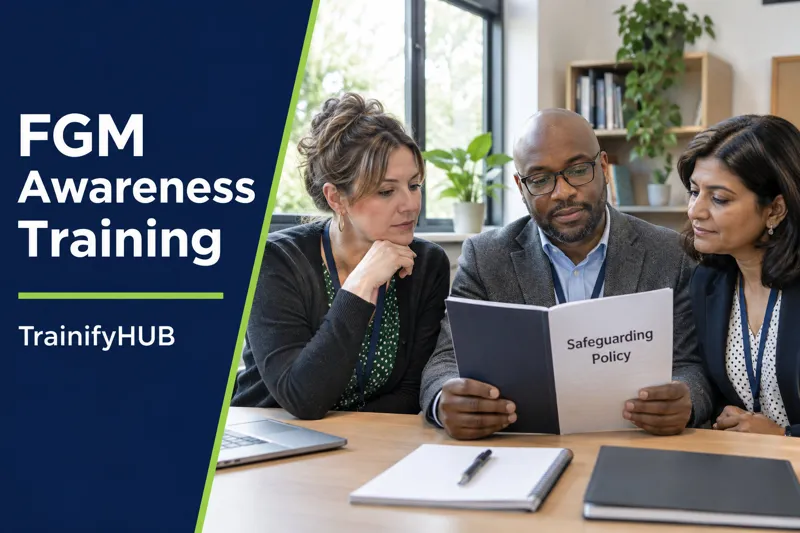
FGM Awareness Training
Recognise FGM safeguarding concerns, distinguish future risk from a known-case disclosure and take prompt, factual action within your school role.
No ratings yet
2.00 CPD Points
MODULES
9
ESTIMATED DURATION
2h 20m
STUDENTS
0+
LEVEL
beginner
Course Price
£20.00
One-time payment - 9 months' access
Buying for your team?
Up to 30% off per seat: 10+ seats 10%, 25+ seats 20%, 50+ seats 30%.
This course includes:
9 comprehensive modules
8 video lessons
1 downloadable resource (PDF)
Final assessment included
9 months’ access on mobile & desktop
Certificate of completion
2.00 CPD Points
CATEGORY
ComplianceLAST UPDATED
Nov 2026
About this course
FGM is abuse. This course helps teachers and other school staff in England recognise relevant concerns, listen sensitively, keep accurate records and use appropriate safeguarding help. It explains the specific personal police-notification duty without applying it automatically to every worker or every concern.
Eight teaching Modules and purposeful written activities explore future risk, specified professional roles, direct disclosure, prompt notification, immediate danger, adult support, proportionate information sharing and follow-up. Fictional briefs ask you to distinguish supplied facts from unknowns and explain a defensible next action. Wales comparisons identify important differences in professional scope and safeguarding arrangements.
This is non-regulated staff awareness. It complements current KCSIE Part one, relevant further reading, school policies and local induction. It does not qualify a designated safeguarding lead, authorise clinical examination or investigation, or certify legal compliance. The core safeguarding framework is England-specific; online availability does not make national duties identical.
Allow approximately 2 hours 20 minutes, including video learning, independent learning and the final assessment.
💻 What you need
✓ Read or access the learning in a suitable supported format; no prior DSL qualification is required.
✓ Use an internet-connected device and allow time for teaching, eight written activities, official reading and the separate assessment.
✓ Have access to current school safeguarding policies, DSL or deputy contacts and local emergency, recording and escalation arrangements.
✓ Use fictional information only in activities. Do not include real child details or seek intimate evidence.
Learning Outcomes
📘 Module 1 – Understanding FGM and the Safeguarding Role
Understand FGM as abuse and place recognition within the school safeguarding role. Consider why a holiday or demographic characteristic alone does not prove an individual case, while remaining alert to genuine information that may require action.
By the end of this Module, learners will be able to:
✓ Explain FGM as abuse and a safeguarding concern without graphic anatomical teaching.
✓ Distinguish school awareness from clinical assessment and criminal investigation.
✓ Recognise that nationality, religion or travel alone does not establish an individual case.
✓ Identify the limits of an England school course and the need to check jurisdiction and role.
Fictional workplace application: A staff training discussion describes a pupil whose family plans a holiday. No concern, disclosure, physical sign, destination or reason for travel is supplied.
Written reflection: Separate the supplied fact from assumptions. Explain why the school should remain alert without labelling the family or diagnosing FGM.
📘 Module 2 – Recognising Risk and Acting on Concerns
Work with a time-sensitive report about a feared future procedure. Practise recording the child’s own words, seeking appropriate safeguarding help promptly and keeping anticipated risk distinct from a known completed act.
By the end of this Module, learners will be able to:
✓ Distinguish risk of future FGM from a discovery that it appears to have happened.
✓ Recognise a child’s expressed fear as information needing a prompt safeguarding response.
✓ Describe proportionate school reporting without waiting for a checklist or proof.
✓ Keep observations, attributed words and unknowns separate.
Fictional workplace application: Leila, 13, tells a teaching assistant, “They said I must have a procedure during the trip next week and I am frightened.” No past FGM, destination, person, injury or completed referral is known.
Written reflection: Record the words, identify time sensitivity and set out prompt DSL/deputy and local safeguarding action. Explain why this is not yet a known-case s5B notification trigger.
📘 Module 3 – Knowing Who Has the Personal Reporting Duty
Check the professional and setting definitions behind the personal duty. Compare England school teaching work with assistant and ordinary general FE descriptions, note that QTS is not a separate requirement for covered teaching work, and identify the materially different Welsh scope.
By the end of this Module, learners will be able to:
✓ Identify the specified professional roles in section 5B rather than applying it to all staff.
✓ Distinguish England school teaching roles from teaching-assistant and ordinary FE roles.
✓ Explain the material Wales education-role and local-authority reporting differences.
✓ Check a real job and setting against current sources without guessing a person’s registration.
Fictional workplace application: A fictional training roster lists an England school teacher carrying out teaching work, an England teaching assistant, an England general FE lecturer and a Welsh FE learning-support worker. All work with under-18 learners. No individual disclosure has occurred.
Written reflection: Map roles to the current source-defined duty and mark what must be checked locally. Explain that every role still has safeguarding responsibilities.
📘 Module 4 – Responding to a Known Under Eighteen Disclosure
Apply the direct-disclosure route to a covered teacher hearing from a girl who is under 18 at discovery. Explain why an earlier childhood act does not remove this route and why diagnosis or intimate proof is not a prerequisite to applicable notification.
By the end of this Module, learners will be able to:
✓ Recognise direct disclosure by an under-18 girl as the relevant discovery route for a covered professional.
✓ Explain that the girl’s age at discovery matters even if the alleged FGM occurred years earlier.
✓ Distinguish direct disclosure from third-party information and unsupported suspicion.
✓ Describe a personal police notification alongside continuing school safeguarding action.
Fictional workplace application: Mina, 16, tells her England school teacher during work, “I was cut when I was little.” No examination, clinical diagnosis, perpetrator, date or previous report is known. The teacher is within section 141A’s teaching-work scope.
Written reflection: Identify the discovery route and explain the personal notification action, DSL discussion and local safeguarding response. State what is not known and must not be invented.
📘 Module 5 – Reporting Promptly and Keeping Accurate Records
Prepare a prompt, factual notification and record. Distinguish next-working-day best practice from the one-month legal outer limit, routine police contact from an emergency, and a reasoned same-profession same-act exception from an unsupported assumption.
By the end of this Module, learners will be able to:
✓ Distinguish the legal one-month outer limit from guidance to report promptly and next-working-day best practice.
✓ Describe the recommended non-emergency police notification route and relevant information.
✓ Explain the same-profession previous-notification exception without assuming a report exists.
✓ Record actual actions and reference details without fabricating a police response.
Fictional workplace application: The covered teacher in Module 4 has told the DSL. A colleague says, “Someone probably reported it.” No reporter, profession, police reference or completed notification is known. There is no stated immediate threat.
Written reflection: Explain why “probably” is insufficient. Draft factual preparation for the personal notification, relevant identifiers and reason, then record only real reporting details when available.
📘 Module 6 – Taking Immediate Safeguarding Action
Prioritise urgent help where a child describes an imminent serious threat. Consider emergency police assistance, available school support and calm supervision without waiting for an unreachable DSL or inventing a rescue, court order or police outcome.
By the end of this Module, learners will be able to:
✓ Identify immediate protection needs from an imminent threat in a factual brief.
✓ Explain why urgent help must not wait for a DSL reply or routine notification timetable.
✓ Describe emergency and school-support routes without assuming police powers or outcomes.
✓ Distinguish a protection-order possibility from a guaranteed order or teacher investigation role.
Fictional workplace application: Nadia, 14, tells a school staff member, “They are collecting me now to take me to be cut.” The DSL cannot be reached immediately. No vehicle, weapon, person, completed call or official decision is supplied.
Written reflection: Write immediate actions in priority order using emergency police help where risk of serious immediate harm is present, available safeguarding leadership and supportive supervision. List actions staff must not invent or perform.
📘 Module 7 – Supporting Adults and Sharing Information Proportionately
Respond sensitively when an adult asks for support concerning historical FGM. Keep the under-18 discovery trigger distinct from adult support, consider actual current child concerns individually, and use appropriate independent language support and proportionate sharing.
By the end of this Module, learners will be able to:
✓ Distinguish an adult’s historical disclosure from the under-18 personal notification trigger.
✓ Consider current support needs and possible child concerns without assuming every relative is at risk.
✓ Describe proportionate information sharing within current applicable safeguarding guidance.
✓ Use sensitive listening and appropriate independent language support without clinical questioning.
Fictional workplace application: A parent, aged 29, tells a school pastoral worker she underwent FGM as a child and asks where to seek support. Her daughter attends the school. No threat, plan, symptom, diagnosis or concern about her daughter is supplied.
Written reflection: Explain why the historical adult disclosure does not itself trigger s5B. Plan respectful support/signposting and appropriate safeguarding advice, recording only supplied information and avoiding automatic labels for the daughter.
📘 Module 8 – Following Up and Applying Local Safeguarding Arrangements
Bring together factual updating, follow-up and local escalation when circumstances change. Distinguish a school report, a police notification and an external referral; identify current contacts and continuing-learning actions without assuming a protective outcome.
By the end of this Module, learners will be able to:
✓ Follow up unresolved concerns and new information through appropriate local routes.
✓ Distinguish a police notification, a school report and a social-care referral.
✓ Avoid assuming a completed protective response or applying a deadline to an unconfirmed referral.
✓ Identify local contacts, role checks and continuing-learning actions needed after this course.
Fictional workplace application: A concern about anticipated FGM was passed to the DSL last week. No police notification or external referral is confirmed. Today the pupil says the planned journey is tomorrow. No new injury or disclosure of completed FGM is supplied.
Written reflection: Prepare a factual update and urgent follow-up/escalation plan, distinguishing known school reporting from unknown agency actions. Locate the current local policy and a role-specific contact.
Accreditation & Recognition
This course is officially recognised and certified
2.00
CPD
Points Awarded
All accreditations are verified and recognised by relevant industry bodies. Upon successful completion, your certificate will display the appropriate accreditation marks.
Frequently Asked Questions
15 questions answered
Teachers, teaching assistants, pastoral, administrative, site, supply and other relevant school staff who need FGM safeguarding awareness in England. The actual statutory role and setting determine any personal police-notification duty.
It means recognising concerns, listening sensitively, recording accurately and using appropriate safeguarding help. FGM is abuse. This course does not authorise clinical examination, diagnosis, investigation or specialist practice.
No. Travel, nationality, religion or family background alone is not proof of an individual case. Consider genuine words and circumstances without stereotypes; do not invent information or ignore a real concern.
Take the account seriously, record the words and timing, and seek prompt safeguarding help through the DSL or deputy and local arrangements. Future risk is actionable even though it is different from discovery of a known completed act.
No. Section 5B applies to defined professional roles and discovery conditions. For England teaching work, check the actual statutory setting and role. Qualified teacher status is not a separate requirement for a person carrying out covered teaching work.
No. Those job descriptions alone do not automatically establish the England teacher scope. Check the real work, setting and any other relevant professional capacity. All staff still have safeguarding responsibilities.
No. Defined Welsh education categories differ, including relevant further-education teaching and learning-support categories. Welsh local-authority partner reporting arrangements also have their own scope and conditions; do not turn them into a blanket personal duty on every worker.
A direct disclosure to a covered professional during work can meet the known-case route where she is under 18 at discovery, even if the alleged act happened earlier. Do not examine her or seek intimate proof; take applicable personal notification and safeguarding action.
A report from a parent, peer or other person is not the girl’s own direct disclosure to the professional. It can still need prompt safeguarding action, including appropriate police or emergency help where circumstances require it. The narrow trigger is not a ban on other police contact.
No. Where the personal duty applies and no statutory exception is established, the covered professional makes the police notification personally. DSL discussion and continuing safeguarding action run alongside it.
Act promptly. Official advice identifies close of the next working day as best practice, with exceptional-case advice where relevant; the legal one-month outer limit is not a reason to wait. Official advice recommends 101 for routine notification. Immediate serious danger needs emergency help through 999 without delay.
No. The exception requires reason to believe another person in the same profession previously notified the same act. A vague suggestion, an internal report or an unrelated earlier act does not establish that exception. Seek prompt advice if unsure.
The adult disclosure alone does not meet the under-18-at-discovery trigger. Offer sensitive support and suitable signposting. Consider any actual current child concern individually without assuming every daughter or relative is at risk; arrange appropriate independent professional language support where needed.
Use the secure school process, attribute words and observations, keep unknowns explicit and record actual actions only when completed. Share relevant information proportionately and follow up new or unresolved concerns. A school report does not itself establish an external referral or completed protection.
Complete eight fictional written activities before consulting the separate review guides. The workbook has 64 planned minutes, counted once including matching video pauses. The separate assessment has a 30-minute allocation and 15 single-answer questions with four options each. Pass with 12 correct answers, or 80%. Official reading and local induction are additional. The fee is £20 GBP. Access lasts nine months from assignment; unassigned company-purchased entitlements do not expire. Certificate validity is one year from passing under TrainifyHUB policy. Online access is available across the UK, while the core school framework remains England-specific. Completion is awareness learning, not a qualification or legal-compliance certificate.
What You'll Learn
✓ Recognise FGM as abuse without stereotyping a family or community.
✓ Distinguish feared future harm from the narrow discovery routes for a known case.
✓ Check the actual statutory role and setting instead of assuming every staff member has the same personal duty.
✓ Respond to a child’s words without seeking intimate proof or making a clinical diagnosis.
✓ Separate prompt routine notification from urgent emergency help and continuing school safeguarding.
✓ Support adults sensitively, share relevant information proportionately and follow up changing concerns.
Why Take This Course
✓ Practise the distinctions that affect a school response to FGM concerns.
✓ Avoid assumptions about families, professional coverage, previous reports or completed protection.
✓ Connect sensitive listening and factual recording with timely safeguarding action.
✓ Use the learning alongside the actual contacts, policies and responsibilities in your setting.
🌍 Available Online Across the UK
Study FGM Awareness Training online from anywhere in England, Scotland, Wales or Northern Ireland, including:
✓ London ✓ Birmingham ✓ Leicester
✓ Coventry ✓ Nottingham ✓ Derby
✓ Manchester ✓ Liverpool ✓ Leeds
✓ Sheffield ✓ Bradford ✓ Newcastle
✓ Bristol ✓ Southampton ✓ Portsmouth
✓ Brighton ✓ Oxford ✓ Cambridge
✓ Norwich ✓ Glasgow ✓ Edinburgh
✓ Aberdeen ✓ Dundee ✓ Cardiff
✓ Swansea ✓ Newport ✓ Wrexham
✓ Belfast ✓ Derry/Londonderry
Online access does not imply local classroom delivery. The core school framework remains England-specific; apply the appropriate national framework and current employer arrangements in your setting.
Certificate of Completion
✓ Complete the teaching, all eight workbook activities and the separate Final Assessment.
✓ The assessment contains 15 single-answer questions with four options each. Pass mark: 80%, or 12 correct answers.
✓ Certificate validity is one year from passing under TrainifyHUB policy.
✓ Completion records awareness learning. It is not a regulated qualification, DSL qualification, clinical competence, legal-compliance certification or proof that required official reading is complete.
This CPD-accredited awareness course carries 2 CPD points.
Course Highlights
0+
Students Enrolled
New
Be the first!
2h 20m
Estimated Duration


Why book with TrainifyHUB
- CPD accredited training content
- Delivered UK-wide at your workplace
- Certificate of completion included
- Secure, encrypted online payments
Accredited & Trusted
 CPD Accredited Provider
 Secure Payments
Need help choosing a course?
+44 7405 005823 support@trainifyhub.co.uk
Our team can advise on the right training package for your organisation.
Keep learning
Related courses
Picked from what learners take alongside this course.
More in Compliance More in Compliance
 More in Compliance
 More in Compliance
 More in Compliance
 More in Compliance
 More in Compliance
 More in Compliance
Student Reviews
0.0
0 stars
Based on 0 reviews
5
0
4
0
3
0
2
0
1
0
🔒 Log In to Review
You must be logged in to submit a review. Please log in or create an account.