 More in Health & Social Care
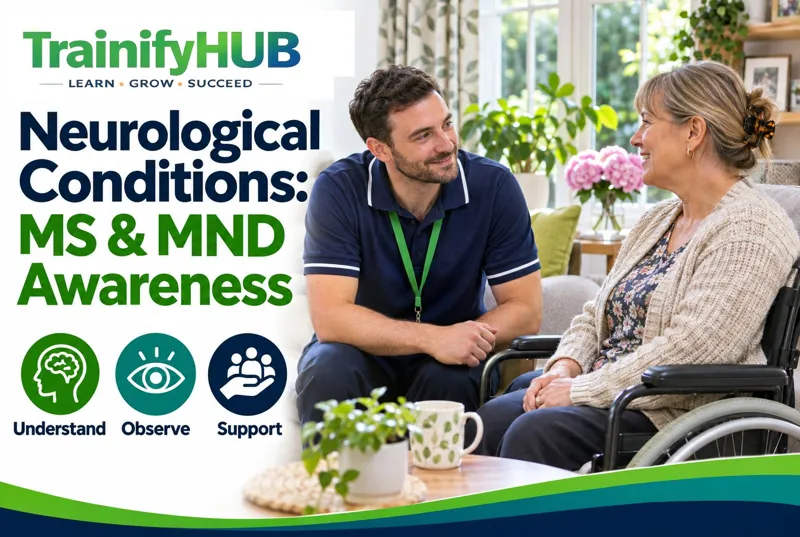
Neurological Conditions: MS & MND Awareness
Develop adult-care awareness to understand everyday support needs associated with MS and MND. Explore eight Modules with fictional examples, independent activities and a final knowledge assessment.
No ratings yet
2.00 CPD Points
MODULES
9
ESTIMATED DURATION
2h 29m
STUDENTS
1+
LEVEL
beginner
Course Price
£20.00
One-time payment - 9 months' access
Buying for your team?
Up to 30% off per seat: 10+ seats 10%, 25+ seats 20%, 50+ seats 30%.
This course includes:
9 comprehensive modules
8 video lessons
1 downloadable resource (PDF)
Final assessment included
9 months’ access on mobile & desktop
Certificate of completion
2.00 CPD Points
CATEGORY
Health & Social CareLAST UPDATED
Nov 2026
About this course
Explore how multiple sclerosis and motor neurone disease can affect daily life, communication and participation differently. Learn to listen to individual goals, follow current plans, notice changes and seek appropriate help without diagnosing, prescribing treatment or assuming that every change is part of a known condition.
Learn through adult-care examples in an England core context, using official source guidance. This self-paced, non-regulated awareness course supports person-centred thinking and communication within role; it does not award legal, clinical or practical competence.
Learning Outcomes
Module 1 - Understanding MS and MND as Distinct Conditions
Multiple sclerosis (MS) and motor neurone disease (MND) are distinct conditions affecting the nervous system. The NHS MS page describes a condition affecting the brain and spinal cord, with symptoms that vary between people. The NHS MND page describes a condition affecting the brain and nerves, causing weakness that can worsen over time. This awareness course does not teach the cellular mechanism, diagnostic tests, prognosis or treatment. A worker should understand the distinction well enough to avoid treating the names as interchangeable.
Explain that MS and MND affect the nervous system differently.
Recognise variation in presentation and progression.
Distinguish awareness from clinical diagnosis.
Avoid assumptions about individuals from a condition label.
Applied fictional scenario: Two care plans give different diagnoses, MS and MND. A colleague says both people will deteriorate in the same way and need identical support. Explain why the assumption is unsafe and identify the individual care information required. Use only the supplied facts, identify unknowns and distinguish proposed actions from completed events. Explain your reasoning and check it against the learner workbook review guide; do not add a diagnosis, permission or outcome.
Module 2 - MS, Fatigue and Everyday Fluctuation
MS can affect everyday activities in different ways. The NHS describes symptoms including fatigue and difficulties affecting movement, balance, sensation, vision or thinking; a person does not have to experience all of them. Fatigue can affect participation and the support a person wants. It should not be dismissed as laziness or assumed to mean that the person cannot express a preference. Discuss what the person is experiencing using clear, respectful language.
Recognise common effects of MS on everyday activities.
Explain why fatigue and changes need individual discussion.
Support paced choice within the agreed plan.
Report new or worsening changes without assuming relapse.
Applied fictional scenario: Anika has MS and prefers a shorter activity today. She reports new tiredness. Its cause has not been assessed, but staff call her unmotivated. Draft a respectful response and a factual change handover that retains unknowns. Use only the supplied facts, identify unknowns and distinguish proposed actions from completed events. Explain your reasoning and check it against the learner workbook review guide; do not add a diagnosis, permission or outcome.
Module 3 - MND, Changing Needs and Coordinated Support
MND can affect movement and everyday function, and the NHS describes possible effects on speech, swallowing and breathing as well as weakness. Experiences and support requirements differ. Awareness means recognising that a change may need review, not predicting the person’s progression or life expectancy. Do not assume that a symptom is absent, present or explained by MND simply because the diagnosis appears in a care plan.
Recognise how MND may affect movement, communication, swallowing and breathing.
Explain why current plans and specialist support remain central.
Respect changing preferences and care goals.
Identify when prompt advice about new needs is required.
Applied fictional scenario: Ben has MND, finds his usual cup harder to hold and needs more time to answer. No revised feeding or equipment plan is authorised. Identify observations and questions for appropriate professional support without changing diet or equipment. Use only the supplied facts, identify unknowns and distinguish proposed actions from completed events. Explain your reasoning and check it against the learner workbook review guide; do not add a diagnosis, permission or outcome.
Module 4 - Communication, Choice and Decision Support
Communication differences must be separated from assumptions about understanding or capacity. Quiet, slow or unclear speech does not by itself show that someone cannot understand or decide. The OPG guide explains the presumption of capacity, the need to support decision-making and the importance of considering the particular decision at the relevant time. An unwise choice alone is not proof of lack of capacity. Workers should obtain appropriate advice when a genuine capacity question arises rather than issue a blanket judgement.
Recognise that unclear speech does not alone mean poor understanding.
Support assessed communication methods and allow time.
Check preferences for involving relatives or carers.
Seek appropriate speech, language or capacity advice.
Applied fictional scenario: Leo uses a letter board. Visiting staff address his brother because Leo’s voice is quiet. Leo indicates that he wants to answer himself. Plan an accessible conversation and record Leo’s preference without inventing a communication technique. Use only the supplied facts, identify unknowns and distinguish proposed actions from completed events. Explain your reasoning and check it against the learner workbook review guide; do not add a diagnosis, permission or outcome.
Module 5 - Everyday Support Within the Individual Plan
Everyday neurological support may involve personal care, mobility, equipment and daily activities. The relevant starting point is the current individual plan, the person’s wishes and the worker’s actual training. Awareness of an issue is different from competence to carry out a handling, clinical or technical procedure. Do not improvise a method because the usual colleague is absent or because a task appears simple.
Use current plans for personal care, mobility and daily activities.
Recognise equipment and support concerns within your role.
Respect privacy, dignity and the right to decline.
Seek review rather than improvise a handling or clinical procedure.
Applied fictional scenario: A wheelchair footrest is loose and the usual trained colleague is absent. The person wants to go outside. No alternative transfer method is approved. Separate personal choice from unsafe improvisation and prepare a support or review request. Use only the supplied facts, identify unknowns and distinguish proposed actions from completed events. Explain your reasoning and check it against the learner workbook review guide; do not add a diagnosis, permission or outcome.
Module 6 - Recognising Changes and Obtaining Urgent Help
Compare a change with the person’s usual presentation, but do not use a known neurological diagnosis to explain it away. Record what happened, when it began if known, what was observed or reported and why you are concerned. Workers do not need to diagnose the cause before obtaining appropriate help. A care plan may identify routes for non-emergency concerns, but it must not be used as a reason to delay emergency action.
Compare changes with the person’s usual presentation.
Recognise sudden stroke or severe breathing signs requiring 999.
Use authorised urgent-contact and emergency arrangements.
Avoid delaying help for a diagnosis or completed record.
Applied fictional scenario: Priya has known MS and suddenly develops slurred speech and one-sided weakness. A colleague suggests waiting for her usual nurse because it is probably MS. Choose immediate action and a factual emergency handover without extra examination or scoring. Use only the supplied facts, identify unknowns and distinguish proposed actions from completed events. Explain your reasoning and check it against the learner workbook review guide; do not add a diagnosis, permission or outcome.
Module 7 - Records, Families and Multidisciplinary Handover
Accurate records and handovers support continuity when several people contribute to care. Separate the person’s report, a relative’s request, direct observations and professional advice. State what was actually done, who was contacted and what response is known. An unanswered request is not proof of a completed review. Avoid judgemental labels, invented measurements, fabricated times or claims that treatment or a care-plan change was approved when it was not.
Record changes, preferences, actions and advice accurately.
Distinguish reported information from direct observations.
Share relevant information with appropriate care-team roles.
Follow up concerns without inventing clinical outcomes.
Applied fictional scenario: A relative says staff must double an exercise programme. The current plan does not show this. An earlier request for review has no documented response. Write a factual handover and follow-up questions with confidentiality considerations. Use only the supplied facts, identify unknowns and distinguish proposed actions from completed events. Explain your reasoning and check it against the learner workbook review guide; do not add a diagnosis, permission or outcome.
Module 8 - Person-Centred Neurological Care Scenarios
Person-centred neurological awareness brings together individual support, accessible communication and timely escalation. MS and MND are not interchangeable, but neither condition label supplies an entire support plan. A calm scenario should show workers checking the current information, listening to the person and distinguishing what is known from what needs professional advice. It must not create dramatic medical facts or imply that the course teaches clinical treatment.
Apply awareness without confusing MS and MND.
Support communication and the person’s choices.
Select timely escalation for a change or unsafe plan.
Produce a factual handover with clear role limits.
Applied fictional scenario: A handover contains two separate fictional adults: Ada, with MS and recent fatigue, and Mo, with MND and changed communication needs. No new treatment is provided. A separate brief introduces sudden one-sided weakness without stating its cause. Create individual support and escalation maps, compare urgency and flag unknowns. Use only the supplied facts, identify unknowns and distinguish proposed actions from completed events. Explain your reasoning and check it against the learner workbook review guide; do not add a diagnosis, permission or outcome.
Accreditation & Recognition
This course is officially recognised and certified
2.00
CPD
Points Awarded
All accreditations are verified and recognised by relevant industry bodies. Upon successful completion, your certificate will display the appropriate accreditation marks.
Frequently Asked Questions
16 questions answered
No. They are distinct conditions and experiences differ between people. Avoid assuming a fixed set of symptoms, abilities or outcomes from a diagnostic label.
No. It supports adult-care awareness, observation, communication and agreed everyday support. Clinical diagnosis, medicines, therapy and specialist equipment decisions remain outside this learning.
No. Notice and communicate changes from the person’s usual presentation, follow the current plan and seek appropriate advice or urgent help rather than explaining a new concern away.
Ask how the person prefers to communicate, allow time and use agreed aids or accessible support. A speech or communication difference does not itself establish lack of capacity.
No. Follow current specialist plans and role-specific practical training. Do not introduce food or fluid changes, ventilation settings, handling or exercises from an awareness lesson.
Use the appropriate current NHS emergency route immediately where the signs require it. A known MS or MND diagnosis must not delay urgent help or make staff wait for a routine review or manager.
Record actual observations and contribute to an authorised review. Do not independently change care, clinical treatment, equipment or commissioned support, and do not promise a recovery outcome.
Adult care workers, agency staff and support workers in care homes, nursing homes, home care and supported living. The main legal and provider context is England; online availability does not make England law uniform across the UK.
No formal qualification is required for this awareness learning. You need suitable access to the teaching and written activities and must follow your employer’s current arrangements in real work.
Eight teaching Modules are paired with complete fictional briefs, independent written activities and source-aligned review in a learner workbook, followed by a separate final knowledge assessment. No real care records, employer visit or practical test is required.
The estimated total is approximately 2 hours 29 minutes. You can pause the teaching, complete the written activities and review your learning at your own pace.
There are 15 single-answer multiple-choice questions with four options each. Pass with at least 12 correct answers out of 15 (80%). The assessment allows 30 minutes per attempt and up to 10 attempts, with randomised questions; follow the actual on-screen instructions.
Yes. Complete your own answers after learning, read every option, use a quiet place and a working device and connection, and use only permitted resources. Another person must not answer for you.
Learner access is nine months from assignment. Company entitlements that have not been assigned do not expire.
A TrainifyHUB certificate of completion follows a passing knowledge assessment, with platform validity of one year from passing. This non-regulated awareness course awards no RQF level, accreditation, registration or clinical or practical competence.
Ask for accessible support or an alternative format if needed, and take time to pause and review. Actual captions, playback and available support arrangements must be checked when access is arranged.
What You'll Learn
Explain that MS and MND affect the nervous system differently.
Recognise common effects of MS on everyday activities.
Recognise how MND may affect movement, communication, swallowing and breathing.
Recognise that unclear speech does not alone mean poor understanding.
Use current plans for personal care, mobility and daily activities.
Compare changes with the person’s usual presentation.
Record changes, preferences, actions and advice accurately.
Apply awareness without confusing MS and MND.
Why Take This Course
Use realistic fictional decisions to practise clear observations, respectful communication and appropriate review or escalation. Complete the written activities to distinguish facts from assumptions and recognise the limits of your authority.
Use current individual plans and authorised professional advice. The course does not teach swallowing, ventilation, moving-and-handling or exercise techniques, and urgent concerns must not wait for routine review.
🌍 Available Online Across the UK
This course is available online from England, Scotland, Wales and Northern Ireland using a suitable device and internet connection. Locations include:
✓ London ✓ Birmingham ✓ Leicester
✓ Coventry ✓ Nottingham ✓ Derby
✓ Manchester ✓ Liverpool ✓ Leeds
✓ Sheffield ✓ Bradford ✓ Newcastle
✓ Bristol ✓ Southampton ✓ Portsmouth
✓ Brighton ✓ Oxford ✓ Cambridge
✓ Norwich ✓ Glasgow ✓ Edinburgh
✓ Aberdeen ✓ Dundee ✓ Cardiff
✓ Swansea ✓ Newport ✓ Wrexham
✓ Belfast ✓ Derry/Londonderry
Online access does not extend the course’s stated legal or care-setting scope. Follow applicable local requirements, employer policies and role boundaries; practical training, assessment and authorisation remain separate.
Certificate of Completion
A TrainifyHUB certificate of completion follows a passing knowledge assessment: at least 12 correct answers out of 15 (80%). Certificate validity is one year from passing. This non-regulated awareness course awards no RQF level, accreditation, registration or clinical or practical competence.
Learner access is nine months from assignment. Unassigned company entitlements do not expire.
Course Highlights
1+
Students Enrolled
New
Be the first!
2h 29m
Estimated Duration


Why book with TrainifyHUB
- CPD accredited training content
- Delivered UK-wide at your workplace
- Certificate of completion included
- Secure, encrypted online payments
Accredited & Trusted
 CPD Accredited Provider
 Secure Payments
Need help choosing a course?
+44 7405 005823 support@trainifyhub.co.uk
Our team can advise on the right training package for your organisation.
Keep learning
Related courses
Picked from what learners take alongside this course.
More in Health & Social Care More in Health & Social Care
Health & Social Care
Diabetes Awareness: Essential Knowledge for Care Professionals
4.8(20)
11 modules3h97
£20.00
 More in Health & Social Care
 More in Health & Social Care
Health & Social Care
Care Certificate Standard 16: Awareness of Learning Disability and Autism
4.7(20)
11 modules4h93
£20.00
 More in Health & Social Care
 More in Health & Social Care
Health & Social Care
Dementia Care Awareness Training – CPD Certified (Updated 2026)
4.6(20)
11 modules3h83
£20.00
 More in Health & Social Care
 More in Health & Social Care
Student Reviews
0.0
0 stars
Based on 0 reviews
5
0
4
0
3
0
2
0
1
0
🔒 Log In to Review
You must be logged in to submit a review. Please log in or create an account.