 More in Compliance
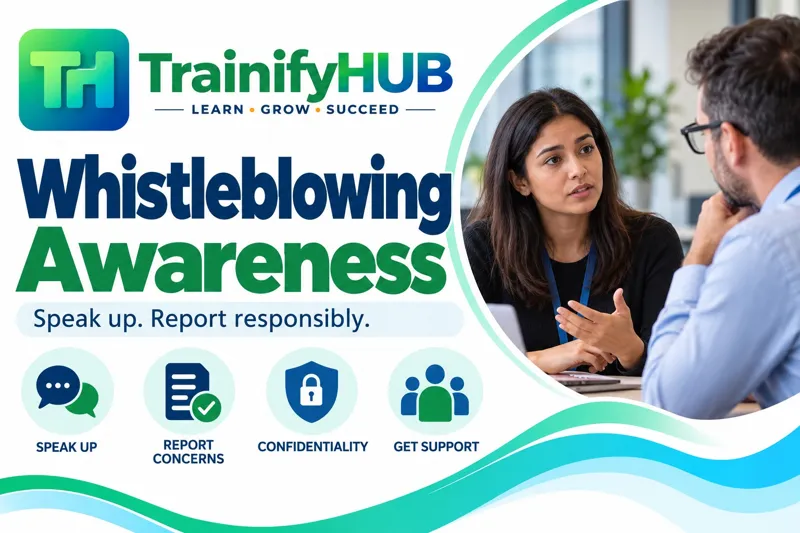
Whistleblowing Awareness
Learn how to raise workplace concerns responsibly with online whistleblowing training covering protected disclosures, reporting routes and speaking up safely.
No ratings yet
2.00 CPD Points
MODULES
9
DURATION
1h 47m
STUDENTS
1+
LEVEL
beginner
Course Price
GBP 20.00
One-time payment - 9 months' access
Buying for your team?
Up to 30% off per seat: 10+ seats 10%, 25+ seats 20%, 50+ seats 30%.
This course includes:
9 comprehensive modules
1h 47m of video content
PDF, PPT & Infographics included
Final assessment included
9 months' access on mobile & desktop
Certificate of completion
2.00 CPD Points
CATEGORY
ComplianceLAST UPDATED
Oct 2026
About this course
Whistleblowing Awareness is an online workplace compliance course for people who want to understand how to recognise and raise concerns about wrongdoing responsibly. It explains public-interest disclosures, who may be protected, appropriate internal and external reporting routes, and the importance of factual communication.
Speaking up can help an organisation identify risks to colleagues, customers, the public or the environment. Yet staff may be uncertain about whether an issue is whistleblowing, who should receive it or what might happen afterwards. This course makes the process easier to understand through eight teaching Modules, practical examples and a final assessment.
👥 Who This Course Is For
This introductory whistleblowing training is suitable for employees, workers, contractors and supervisors across a range of workplaces. It is useful for staff induction, refresher learning and continuing professional development, as well as for supervisors who may be the first person a colleague approaches with a concern.
You do not need a specialist qualification to begin. You should have sufficient English to follow the teaching and assessment, a suitable device and a reliable internet connection. Your organisation’s whistleblowing policy and reporting contacts are useful references during self-study.
🛡️ Protected Disclosures and Responsible Reporting
The course introduces the Great Britain framework under the Employment Rights Act 1996, as amended by the Public Interest Disclosure Act 1998, and explains that Northern Ireland has separate arrangements. You will explore the public-interest and reasonable-belief tests, types of wrongdoing, the role of prescribed persons and why the choice of reporting route matters.
Practical learning distinguishes whistleblowing from personal grievances and confidential reporting from anonymity. It also covers responsible handling of information, the risks of retaliation and the support available when a concern is difficult to raise. Learners are encouraged to report what they reasonably know through appropriate channels and leave formal investigations to authorised people.
💻 How You Will Learn
Work through eight video Modules covering the subject from recognising a concern to handling disclosures fairly. Each Module has a clear focus, complete learning outcomes and a workplace scenario. The course content below explains what each Module covers so you can see how the learning builds.
Self-study gives you time to review the teaching, reflect on examples and relate the learning to your workplace. A final multiple-choice assessment checks understanding of reporting routes, role boundaries, confidentiality and constructive responses.
🕒 Learning Time and CPD
Allow approximately 1 hour 47 minutes to complete the course, including video learning, self-study and the final assessment. You can take longer where needed. The course carries 2 CPD points.
Learning Outcomes
Follow eight connected Modules covering public-interest concerns, protected disclosures, reporting routes, confidentiality and fair responses. Each Module includes focused learning outcomes and a workplace example to help you apply the subject.
📘 Module 1 - Understanding Whistleblowing and the Public Interest
Start with the purpose of workplace whistleblowing: raising information about specified wrongdoing in the public interest. This Module explains why a concern is not protected simply because someone calls it whistleblowing, and how reasonable belief differs from having to prove a case. You will compare public-interest concerns with personal grievances and consider factors that help explain why the distinction matters.
By the end of this Module, learners will be able to:
✓ Explain whistleblowing as reporting specified wrongdoing in the public interest.
✓ Distinguish a qualifying/protected disclosure from a purely personal grievance.
✓ Explain the reasonable-belief test without requiring the learner to prove wrongdoing.
✓ Use the four public-interest factors as guidance rather than a guaranteed legal formula.
💬 Workplace application: A production worker reports that safety interlocks are being bypassed to increase output. The concern may affect colleagues and customers, rather than only the worker’s own employment situation.
📘 Module 2 - Qualifying Disclosures and Types of Wrongdoing
Explore the categories of wrongdoing that can form the basis of a qualifying disclosure, including criminal offences, breaches of legal obligations, health and safety dangers, environmental damage and concealment. Concerns may relate to something that happened in the past, is happening now or is likely to happen. The Module explains the sexual-harassment change in Great Britain and keeps Northern Ireland’s separate framework clear.
By the end of this Module, learners will be able to:
✓ Recognise the statutory categories of wrongdoing at awareness level.
✓ Understand that concerns can relate to past, present or likely future wrongdoing.
✓ Explain the 6 April 2026 sexual-harassment change in Great Britain.
✓ Avoid applying that Great Britain change automatically to Northern Ireland.
💬 Workplace application: A worker believes that a repeatedly bypassed food-safety control could put customers at risk. The concern is about a likely future danger, even if harm has not yet occurred.
📘 Module 3 - Who Is Protected and What Protection Means
Understand why whistleblowing protection is broader than permanent employment, while still depending on legal status and the circumstances of the disclosure. The Module introduces the difference between protection from detriment and protection from automatic unfair dismissal. It also considers groups that are usually outside statutory protection and why a person may need advice about their own position.
By the end of this Module, learners will be able to:
✓ Recognise that whistleblowing protection extends beyond permanent employees.
✓ Identify groups that are usually outside statutory protection.
✓ Explain detriment and automatic unfair dismissal at awareness level.
✓ Understand that protection starts from the beginning of employment for those covered.
💬 Workplace application: An agency worker raises a serious safety concern and then loses shifts. Agency status does not automatically remove protection, but the person’s legal status affects the remedies that may be available.
📘 Module 4 - Raising a Concern Internally
Learn how an organisation’s whistleblowing policy can help you identify the right contact and raise a clear, factual concern. This Module considers situations where the usual manager is involved or another authorised route is more appropriate. It explains the value of a written record without presenting writing as a universal legal requirement, and keeps the reporter’s role separate from a formal investigation.
By the end of this Module, learners will be able to:
✓ Use an employer's whistleblowing policy where appropriate.
✓ Know when an alternative internal contact may be needed.
✓ Understand why a written disclosure is often useful without treating writing as a universal legal condition.
✓ Avoid unlawful or unsafe evidence gathering.
💬 Workplace application: A worker suspects their line manager is falsifying safety records. They use an alternative contact in the policy, explain what they reasonably know and avoid accessing records without authorisation.
📘 Module 5 - External Disclosures, Prescribed Persons and Appropriate Routes
Explore external reporting routes, including disclosures to a legal adviser and to a prescribed person or body. You will learn why the body’s official remit matters and why the conditions for a protected disclosure depend on the route used. The Module distinguishes appropriate external reporting from wider public or media disclosures, where stricter conditions can apply.
By the end of this Module, learners will be able to:
✓ Understand what a prescribed person/body is.
✓ Select a prescribed person whose official remit matches the concern.
✓ Explain the additional substantially-true belief test for prescribed-person disclosures.
✓ Recognise that media/public disclosures are subject to stricter legal conditions.
💬 Workplace application: Before reporting a tax-related concern externally, a worker checks the current prescribed-person list and the relevant body’s remit, rather than sending allegations to several unrelated organisations.
📘 Module 6 - Confidentiality, Anonymity, Evidence and Responsible Communication
Understand the practical difference between a confidential disclosure and an anonymous report. This Module explores how information may be restricted, why anonymity can make follow-up difficult and why absolute secrecy cannot always be promised. It also covers clear, factual communication and responsible handling of information already held lawfully, without unnecessary sharing or independent evidence gathering.
By the end of this Module, learners will be able to:
✓ Distinguish confidential from anonymous reporting.
✓ Understand why anonymity can make follow-up and protection more difficult.
✓ Avoid guarantees that identity can never be inferred or disclosed.
✓ Communicate factual information and respect data/security controls.
💬 Workplace application: A worker asks for their identity to remain confidential. The receiving manager explains who may need information to handle the concern and avoids promising that nobody could ever infer the reporter’s identity.
📘 Module 7 - Detriment, Dismissal, Retaliation and Getting Support
Recognise adverse treatment that may follow a disclosure, such as bullying, reduced hours or exclusion from development opportunities. This Module explains why employment status matters when considering dismissal and detriment, and identifies routes to support. It stresses the need for prompt, current advice about legal procedures and deadlines rather than relying on a remembered time limit or waiting for an internal process to finish.
By the end of this Module, learners will be able to:
✓ Recognise common forms of detriment.
✓ Distinguish employee automatic unfair dismissal from worker detriment protection.
✓ Know where to obtain support in Great Britain and Northern Ireland.
✓ Understand that tribunal and interim-relief deadlines can be strict and date-sensitive.
💬 Workplace application: After reporting a safety concern, a worker is removed from training without a credible explanation. They keep a factual record and promptly seek appropriate advice about their situation.
📘 Module 8 - Handling Concerns and Building a Speak-Up Culture
Bring the learning together by considering how organisations and supervisors should receive and respond to concerns. This Module explores clear policies, appropriate escalation, fair handling, protection from retaliation and communication with the person who spoke up. It explains why the response must fit the concern, rather than promising an unsupported investigation deadline or a predetermined outcome.
By the end of this Module, learners will be able to:
✓ Understand the role of a clear whistleblowing policy.
✓ Respond promptly and fairly to disclosures.
✓ Protect workers from detriment and avoid retaliation.
✓ Maintain appropriate communication and learn from concerns.
💬 Workplace application: A supervisor receives a concern about suspected fraudulent expenses. They thank the worker, record the disclosure, explain the next steps and refer it appropriately while protecting information and avoiding retaliation.
📝 Final Assessment and Self-Study
The course includes self-study and a final multiple-choice assessment. Revisit key points, reflect on the workplace examples and locate the appropriate reporting contacts in your organisation’s policy. The assessment pass mark is 80%.
Accreditation & Recognition
This course is officially recognised and certified
2.00
CPD
Points Awarded
All accreditations are verified and recognised by relevant industry bodies. Upon successful completion, your certificate will display the appropriate accreditation marks.
Frequently Asked Questions
16 questions answered
This beginner-level online course is for employees, workers, contractors and supervisors who want to understand workplace whistleblowing and responsible reporting routes.
Whistleblowing involves reporting specified wrongdoing that you reasonably believe is in the public interest. Whether a disclosure receives legal protection depends on the circumstances and the reporting route.
A grievance usually concerns a personal employment issue. A concern may involve whistleblowing when it also relates to qualifying wrongdoing in the public interest; the label given to a complaint does not decide its legal status.
You are not expected to investigate or prove wrongdoing before speaking up. Report factual information you reasonably know through an appropriate route, and avoid unsafe or unlawful evidence gathering.
Protected external routes can include a legal adviser or an appropriate prescribed person. Different conditions apply to different routes, and wider public or media disclosures have stricter conditions. Seek advice where needed.
No. In a confidential report, the recipient knows your identity and restricts it appropriately. An anonymous report withholds your identity. Neither approach guarantees that your identity can never be inferred or disclosed.
The course focuses on the Great Britain framework and explains relevant distinctions. Northern Ireland has separate employment-law arrangements; do not assume the rules and procedures are identical.
No specialist qualification is required. You need sufficient English to follow the training, internet access and a suitable device. Your organisation’s whistleblowing policy is a useful reference.
Yes. Complete the eight teaching Modules and pass the final multiple-choice assessment with at least 80% to receive a TrainifyHUB certificate of completion.
The course provides general awareness training. For a specific disclosure, dismissal, detriment or legal deadline, obtain prompt advice from an appropriate adviser, union or support service.
Allow approximately 1 hour 47 minutes to complete the course, including video learning, self-study and the final assessment. You can take longer where needed.
The Whistleblowing Awareness course fee is £20 GBP. Review the booking terms and refund policy before completing your purchase.
This course carries 2 CPD points. The estimated course duration includes video learning, self-study and the final assessment.
Review the Modules, reflect on the workplace examples and locate your organisation’s whistleblowing policy and reporting contacts. Note any questions that require specialist advice.
The course introduces criminal offences, breaches of legal obligations, miscarriages of justice, health and safety dangers, environmental damage and concealment. It also explains sexual harassment as an express Great Britain category from 6 April 2026 and distinguishes Northern Ireland’s separate framework.
Not necessarily. An employer’s policy is often a useful starting point, but protected external routes also exist. The applicable conditions depend on the route; check the current guidance and obtain advice where needed.
What You'll Learn
By the end of Whistleblowing Awareness, learners will be able to:
✓ Explain whistleblowing and public-interest concerns in workplace language.
✓ Distinguish a potential whistleblowing concern from a routine workplace issue.
✓ Identify the course’s main categories of wrongdoing.
✓ Locate an appropriate internal reporting route.
✓ Explain why external disclosures require careful consideration of the route.
✓ Prepare a factual account without speculation or unsupported allegations.
✓ Distinguish confidentiality from anonymity.
✓ Describe responsible boundaries when handling information.
✓ Recognise when support or specialist advice should be sought.
✓ Demonstrate a constructive response when a colleague raises a concern.
Why Take This Course
A concern may go unreported when someone is unsure whether it is serious enough, does not know the correct contact or fears being treated unfairly. Understanding whistleblowing helps staff make informed decisions and helps supervisors listen and respond responsibly.
✓ Recognise the right type of concern: understand public-interest wrongdoing and how it differs from an ordinary personal grievance.
✓ Choose an appropriate reporting route: identify internal contacts and understand why external routes have their own conditions.
✓ Communicate clearly: describe relevant facts and dates without speculation, unsupported allegations or unsafe evidence gathering.
✓ Understand privacy limits: distinguish confidentiality from anonymity and recognise why neither should be promised absolutely.
✓ Recognise retaliation: understand examples of detriment and know when to seek prompt advice and support.
✓ Support a speak-up culture: respond constructively, follow the organisation’s policy and escalate concerns to authorised people.
The course supports staff development and workplace reporting arrangements. It complements your organisation’s policy and role-specific training.
Certificate of Completion
Successful learners receive a TrainifyHUB Whistleblowing Awareness certificate of completion after completing the teaching Modules and passing the final assessment.
✓ Assessment pass mark: 80%.
✓ CPD allocation: 2 CPD points.
✓ Accreditation route: CPD, as displayed in the course’s accreditation section.
✓ Training record: retain your certificate as evidence of completed awareness learning for staff development and continuing professional development.
The certificate records completion of this course. It is not a professional qualification, a role-specific competence assessment or a guarantee that a particular disclosure will receive legal protection.
Course Highlights
1+
Students Enrolled
New
Be the first!
1h 47m
Total Duration


Why book with TrainifyHUB
- CPD accredited training content
- Delivered UK-wide at your workplace
- Certificate of completion included
- Secure, encrypted online payments
Accredited & Trusted
 CPD Accredited Provider
 Secure Payments
Need help choosing a course?
+44 7405 005823 support@trainifyhub.co.uk
Our team can advise on the right training package for your organisation.
Keep learning
Related courses
Picked from what learners take alongside this course.
More in Compliance More in Compliance
 More in Compliance
 More in Compliance
 More in Compliance
 More in Compliance
 More in Compliance
Compliance
Professional Exam Invigilation Integrity and Quality Assurance
4.7(20)
11 modules4h64
GBP25.00
 More in Compliance
Student Reviews
0.0
0 stars
Based on 0 reviews
5
0
4
0
3
0
2
0
1
0
🔒 Log In to Review
You must be logged in to submit a review. Please log in or create an account.