Working at Height Regulations 2005: UK Requirements, Duties and Safe Practice
Peter Traynor Sime
Author
The Working at Height Regulations 2005 set out what UK employers and those who control work must do to prevent falls from height. They apply when someone could fall a distance liable to cause personal injury if proper precautions are not in place. This guide is prepared for learners and employers comparing training options on TrainifyHUB.
This guide explains what the regulations cover, who has responsibilities, how risks should be controlled, and how working at height training can support safer work without replacing proper planning, supervision, and equipment.
Key Takeaways
The working at height regulations apply to many everyday tasks, not only construction work.
Duty holders should avoid work at height where reasonably practicable, prevent falls where it cannot be avoided, and minimise the distance and consequences of a fall where risk remains.
Employers must make sure work at height is properly planned, supervised, and carried out safely by competent people.
Ladders are not banned, but they must be suitable for the task and used only where the risk assessment supports their use.
Training supports safer decisions, but compliance also depends on risk assessment, equipment, supervision, inspection, and workplace procedures.
What Are the Working at Height Regulations 2005?
The Work at Height Regulations 2005 are UK regulations designed to reduce death and injury caused by falls from height. They apply to employers, the self-employed, and people who control work at height, such as facilities managers or contractors responsible for the task. For related TrainifyHUB guidance, see CITB test guide for CSCS cards. For official context, see Work at Height Regulations 2005.
HSE guidance explains that work at height means work in any place where a person could fall a distance liable to cause personal injury if precautions were not in place. That includes work above ground level, work near an edge, work on fragile surfaces, and work where someone could fall from ground level into an opening.
What Work Is Covered by the Regulations?
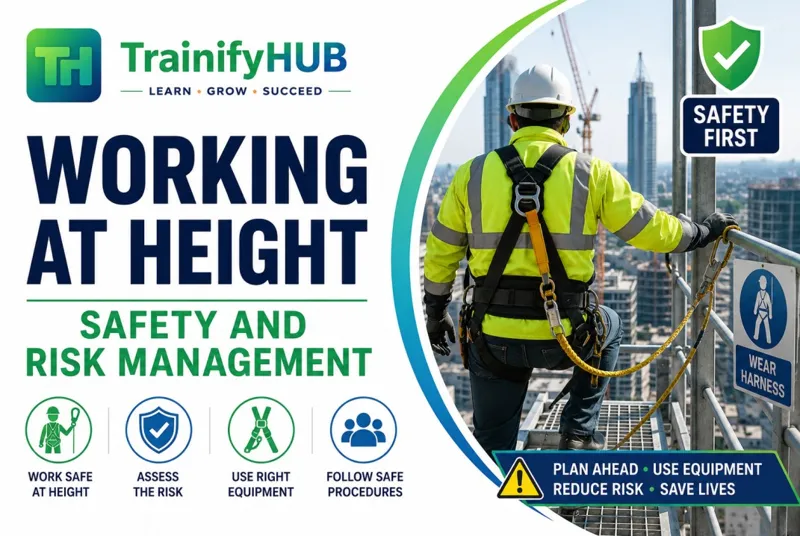
The working at height regulations 2005 cover activities such as: For structured learning on this topic, review the Working at Height Safety and Risk Management course.
Roof work
Gutter cleaning and repairs
Scaffold and mobile tower work
Ladder and stepladder tasks
Work on mezzanines or loading bays
Maintenance above machinery or equipment
Window cleaning
Construction, fit-out, and refurbishment tasks
Stock picking or access tasks in warehouses
Work near fragile surfaces, openings, or excavations
The regulations are not limited to high-rise work. A fall from a relatively low height can still cause serious injury, so the key question is whether the task creates a foreseeable fall risk.
Who Has Responsibilities Under the Regulations?
Working at height regulations duty holders responsibilities depend on who controls the work. Employers, the self-employed, contractors, site managers, and building or facilities managers may all have duties depending on the situation. A useful source for checking this point is HSE work at height guidance.
In plain terms, duty holders should make sure:
Work at height is avoided where reasonably practicable.
The task is properly planned and supervised.
Workers are competent for the work they are doing.
Suitable equipment is selected and used correctly.
Fragile surfaces and edges are controlled.
Weather and site conditions are considered.
Equipment is inspected where required.
Emergency and rescue arrangements are realistic.
Regulation 4 covers organisation and planning. Regulation 5 covers competence. Regulation 6 sets out the duty to avoid risks from work at height where reasonably practicable.
How Should Employers Avoid, Prevent and Minimise Risks?
HSE's approach is often summarised as avoid, prevent, and minimise. A related TrainifyHUB option is the Asbestos Awareness Construction Site Safety course.
Avoid Working at Height Where Possible
If the work can be done safely from ground level, it should be. For example, a telescopic tool may remove the need to climb, or a component may be assembled at ground level before installation.
Prevent Falls When Work at Height Cannot Be Avoided
If work at height cannot be avoided, duty holders should use suitable measures to prevent falls. Examples may include properly erected scaffolding, guardrails, mobile elevating work platforms, or other collective protection.
Minimise the Consequences of a Fall
If some fall risk remains, controls should minimise the distance and consequences of a fall. This may include nets, airbags, fall arrest systems, or carefully planned personal protective equipment where appropriate.
Regulation 7 also makes clear that collective protection should be prioritised over personal protection when selecting work equipment.
What Should a Working at Height Risk Assessment Include?
A working at height risk assessment should be specific to the task, location, people, equipment, and conditions. A generic checklist is rarely enough for higher-risk work. For further reading, see the CITB test guide for CSCS cards.
Useful questions include:
Can the task be done without working at height?
What could someone fall from, through, or into?
Are there fragile surfaces, openings, skylights, or unprotected edges?
What equipment is suitable for the task duration and risk?
Are workers trained and competent for the equipment?
How will the work be supervised?
What weather, lighting, or ground conditions could affect safety?
How will tools and materials be prevented from falling?
What rescue arrangements are in place if something goes wrong?
The risk assessment should lead to practical controls, not just paperwork.
Do the Regulations Ban Ladders?
No. The UK working at height regulations do not ban ladders or stepladders. They do require duty holders to choose suitable equipment and use it safely. You can compare this with HSE working at height brief guide.
A ladder may be appropriate for short-duration, low-risk work where a risk assessment shows it is suitable. It may be unsuitable where the task is prolonged, requires heavy materials, involves overreaching, or takes place on unstable ground.
The better question is not "Can we use a ladder?" but "Is this the safest reasonably practicable method for this task?"
What Training Should Workers and Supervisors Receive?
Working at height training should help people understand the regulations, spot hazards, follow control measures, inspect equipment where relevant, and know when to stop work. Teams may also find the First Aid Awareness for Construction Sites course relevant.
Training should usually cover:
What counts as work at height
Employer and worker responsibilities
Avoid, prevent, minimise principles
Risk assessment basics
Ladder and access equipment safety
Fragile surfaces and edge protection
Weather and environmental factors
Falling objects
Emergency arrangements
Reporting defects or unsafe work
Supervisors may need additional training on planning, supervision, permit systems, equipment selection, and contractor control.
Can Online Working at Height Training Support Compliance?
Online working at height training can support awareness, induction, refresher learning, and training records. It is useful for explaining the regulations and helping learners make safer day-to-day decisions. For another source on this area, see HSE ladder guidance.
It does not replace practical instruction where equipment use requires hands-on competence. It also does not remove the need for task-specific risk assessments, supervision, inspection, rescue planning, and suitable access equipment.
For higher-risk work, employers should combine awareness training with practical assessment and site-specific procedures.
How TrainifyHUB Supports Working at Height Safety Training
TrainifyHUB offers flexible online training for UK learners and organisations. The Working at Height Safety and Risk Management course is designed to help learners understand core safety principles and risk management responsibilities before they carry out or supervise work at height.
Individual learners can study online around site work, maintenance duties, or shifts. Employers can use training records to support induction and refresher programmes alongside workplace assessments and local procedures.
You can also browse the TrainifyHUB course catalogue or review TrainifyHUB accreditation information when comparing certificate and assurance details.
Conclusion
The Working at Height Regulations 2005 are practical: avoid work at height where possible, prevent falls where it cannot be avoided, and minimise harm where risk remains. Training helps people understand those duties, but safe work still depends on planning, supervision, equipment, and competence.
Ready to strengthen working at height awareness? View TrainifyHUB's Working at Height Safety and Risk Management course.
Frequently Asked Questions
They cover work where a person could fall a distance liable to cause personal injury if precautions were not in place. This can include ladders, roofs, scaffolds, fragile surfaces, openings, and some ground-level work near drops.
No. Ladders are not banned, but they must be suitable for the task and used safely following a risk assessment.
Employers, the self-employed, contractors, and anyone who controls work at height may have duties. The exact responsibility depends on who plans, manages, supervises, or carries out the work.
The regulations require people involved in work at height to be competent. Training is one way to support competence, but employers must also consider experience, supervision, practical ability, and task-specific risks.
No course by itself makes a workplace compliant. Online training can support awareness and records, but compliance also depends on risk assessment, equipment, procedures, supervision, inspection, and rescue planning.