 More in Health & Social Care
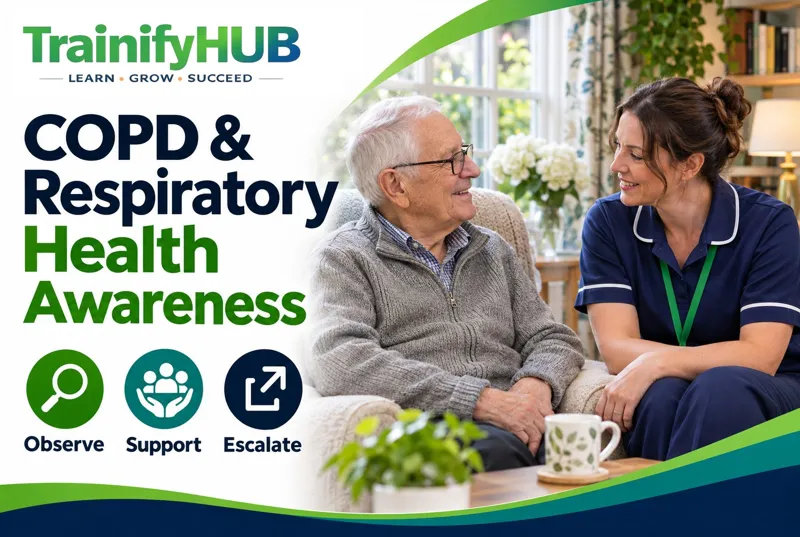
COPD & Respiratory Health Awareness
Recognise changes in breathing, communicate factual concerns and seek timely help while respecting respiratory treatment boundaries. Explore eight Modules with fictional examples, written activities and a final knowledge assessment.
No ratings yet
2.00 CPD Points
MODULES
9
ESTIMATED DURATION
2h 25m
STUDENTS
1+
LEVEL
beginner
Course Price
£20.00
One-time payment - 9 months' access
Buying for your team?
Up to 30% off per seat: 10+ seats 10%, 25+ seats 20%, 50+ seats 30%.
This course includes:
9 comprehensive modules
8 video lessons
1 downloadable resource (PDF)
Final assessment included
9 months’ access on mobile & desktop
Certificate of completion
2.00 CPD Points
CATEGORY
Health & Social CareLAST UPDATED
Nov 2026
Course Price
£20.00
One-time payment - 9 months' access
Buying for your team?
Up to 30% off per seat: 10+ seats 10%, 25+ seats 20%, 50+ seats 30%.
This course includes:
9 comprehensive modules
8 video lessons
1 downloadable resource (PDF)
Final assessment included
9 months’ access on mobile & desktop
Certificate of completion
2.00 CPD Points
CATEGORY
Health & Social CareLAST UPDATED
Nov 2026
About this course
People living with COPD have individual symptoms, preferences and support plans. Explore observation of changes, everyday agreed support, environmental concerns, medicines and oxygen boundaries, and current NHS urgent or emergency help.
Learn through adult-care examples using official sources in an England core context. This self-paced non-regulated awareness course supports safe observation, communication and role-appropriate support; it does not confer clinical or hands-on competence.
Learning Outcomes
Module 1 - Understanding COPD and Respiratory Awareness
COPD is a long-term condition affecting the lungs and breathing. The current NHS page describes coughing with mucus, shortness of breath and frequent chest infections. Symptoms may develop gradually, but a person can also become more unwell. Awareness means recognising and describing concerns, supporting the current plan and obtaining appropriate help. A cough or breathlessness does not establish COPD, infection or any other diagnosis; different causes need healthcare assessment.
Describe COPD in clear everyday language.
Recognise effects on daily life.
Avoid diagnosing the cause of breathlessness.
State awareness and professional assessment boundaries.
Fictional brief: Harper has a recorded COPD diagnosis and says daily tasks take longer. Another person has new breathlessness without a diagnosis. Compare the two briefs; distinguish known diagnosis, factual impact and information requiring medical assessment. In your response, distinguish known facts from proposed actions and identify missing information. Explain the basic symptom awareness and limits; choose emergency help for supplied severe signs, without inventing a diagnosis. Explain why the next step stays within role; do not add consent, a diagnosis, measurements, contacts, treatment or outcomes that are not supplied. Review your reasoning against the source-based teaching and current individual support arrangements.
Module 2 - Knowing Usual Breathing and Recognising Change
A useful baseline is a factual picture of what is usual for this person: how breathing affects everyday activities, their known symptoms and the support described in the current plan. Listen to the person and distinguish their report from direct observations or a colleague’s account. Baseline information helps communicate a change; it is not a scoring system or a reason to normalise new distress. If the usual pattern or onset is unknown, say so.
Identify useful usual-pattern information.
Describe observed breathing changes factually.
Listen to the person’s account of increased symptoms.
Avoid relying on a single device reading.
Fictional brief: Indy says today’s breathlessness is worse than usual. A colleague says a previous normal reading means there is no concern. Draft a baseline/change/missing-information table and a factual handover; explain why the earlier reading cannot dismiss new symptoms. In your response, distinguish known facts from proposed actions and identify missing information. Compare the stated usual presentation with the changed observation and onset. Distinguish direct observation from reported information. Explain why the next step stays within role; do not add consent, a diagnosis, measurements, contacts, treatment or outcomes that are not supplied. Review your reasoning against the source-based teaching and current individual support arrangements.
Module 3 - Everyday Support and Personalised Plans
Person-centred support starts with the person’s own goals, choices and current authorised plan. COPD can affect daily tasks and confidence, but people’s preferences and abilities differ. Ask how they wish to participate and use agreed assistance or rest arrangements within your role. CQC Regulation 9 concerns care reflecting assessed needs and preferences; Regulation 11 supports ongoing consent. These registered-provider duties do not become a worker’s independent authority to rewrite a clinical or commissioned plan.
Follow the current individual support plan.
Offer time and accessible communication.
Recognise opportunities for supported participation.
Refer changing activity tolerance for appropriate advice.
Fictional brief: Jules wants to continue a familiar activity at their own pace. The existing plan provides rest opportunities; no new exercise prescription is supplied. Propose role-appropriate communication and pacing support; identify which proposed changes need professional advice. In your response, distinguish known facts from proposed actions and identify missing information. Use the person’s goals and current plan, and identify who must clarify missing authority. Do not initiate or alter a rescue pack. Explain why the next step stays within role; do not add consent, a diagnosis, measurements, contacts, treatment or outcomes that are not supplied. Review your reasoning against the source-based teaching and current individual support arrangements.
Module 4 - Triggers, Environment and Infection Awareness
The NHS describes several possible flare-up triggers, including chest infections, smoke, strong smells and some weather conditions. A worker can notice an apparent link and report it, but a trigger list is not a diagnostic test. A person exposed to perfume or cleaning spray may also have an urgent medical problem. Do not decide that the presence of a plausible trigger makes chest tightness or severe breathing difficulty safe to observe for a fixed period.
Recognise source-listed possible flare-up triggers.
Report smoke or strong-product exposure concerns.
Follow local infection-prevention arrangements.
Avoid claiming every deterioration has the same cause.
Fictional brief: Kai reports symptoms after a strong-smelling cleaning product was used. No clinician has established the cause. Write observations and immediate environmental concerns for the team; distinguish a reported association from a clinical diagnosis. In your response, distinguish known facts from proposed actions and identify missing information. List the supplied possible trigger and a proportionate safe report. Avoid a diagnosis, chemical improvisation or guaranteed prevention. Explain why the next step stays within role; do not add consent, a diagnosis, measurements, contacts, treatment or outcomes that are not supplied. Review your reasoning against the source-based teaching and current individual support arrangements.
Module 5 - Medicines, Oxygen and Competence Boundaries
Medicines and home oxygen are prescribed treatments. Awareness of their presence helps staff understand why current directions, competence and fire-safety arrangements matter; it does not authorise administering, selecting or changing them. The NHS warns against unprescribed oxygen and tells people to follow their GP or specialist guidance. NICE notes harm from inappropriate oxygen and the need for professional assessment and risk management. Do not choose oxygen settings, targets or equipment from this course.
Distinguish prescription decisions from support duties.
Check authorised medicine and oxygen plans.
Recognise oxygen-related fire and equipment hazards.
Reject independent oxygen or rescue-pack changes.
Fictional brief: Lee’s prescribed oxygen plan is available. A visitor suggests increasing flow and someone is smoking nearby; no new prescription exists. Identify safe escalation and environmental actions within role; explain why flow changes and a generic rescue-pack decision are outside this course. In your response, distinguish known facts from proposed actions and identify missing information. Keep oxygen and medicines prescribed and within assessed roles. Identify fire risk and seek advice without choosing flows or doses. Explain why the next step stays within role; do not add consent, a diagnosis, measurements, contacts, treatment or outcomes that are not supplied. Review your reasoning against the source-based teaching and current individual support arrangements.
Module 6 - Urgent Deterioration and Emergency Help
Use the current NHS adult emergency guidance for the signs actually present. Call 999 or seek A&E immediately for severe breathing difficulty such as gasping, choking or inability to get words out; a tight or heavy chest; pain spreading to arms, back, neck or jaw; lips or skin becoming very pale, blue or grey; or sudden confusion. In these adult-care emergency scenarios, call 999 and follow the dispatcher. Do not wait for all signs, a diagnosis, a measurement, a manager or the next visit.
Recognise adult NHS emergency warning signs.
Distinguish emergency from separate 111/urgentGP advice.
Avoid delaying help for a manager or reading.
Give location, symptoms and change information.
Fictional brief: Morgan is gasping and cannot get words out. A colleague wants to wait for a routine review before calling. Write the first actions and an emergency handover; explain why waiting or independently adjusting oxygen is unsafe. In your response, distinguish known facts from proposed actions and identify missing information. Prioritise 999 for severe breathing, sudden confusion or other supplied emergency signs. Never delay for a checklist or manager. Explain why the next step stays within role; do not add consent, a diagnosis, measurements, contacts, treatment or outcomes that are not supplied. Review your reasoning against the source-based teaching and current individual support arrangements.
Module 7 - Recording, Handover and Coordinated Support
An accurate record distinguishes what the worker observed, what the person or another source reported, who was contacted, actual advice and action taken. Include known timing and usual presentation where relevant, stating uncertainty rather than filling it. CQC Regulation 17 requires secure, accurate, complete and contemporaneous records; Regulation 12 supports timely coordination when care is shared. These are provider responsibilities to which workers contribute through their authorised system and role.
Record observations and the person’s words.
Document contacts and advice actually received.
Keep treatment decisions attributed to professionals.
Communicate continuing concerns during handover.
Fictional brief: A note says an infection was treated successfully, but only increased breathlessness and a telephone contact are known. The advice/outcome is not supplied. Correct the note, mark unknown advice/outcome and draft a handover with follow-up questions. In your response, distinguish known facts from proposed actions and identify missing information. Record the actual observations, contacts and advice, explicitly leaving unknown actions and outcomes unconfirmed. Explain why the next step stays within role; do not add consent, a diagnosis, measurements, contacts, treatment or outcomes that are not supplied. Review your reasoning against the source-based teaching and current individual support arrangements.
Module 8 - Applying Learning to Respiratory Scenarios
Apply awareness by separating the person’s known baseline, supplied change and missing information. A respiratory scenario may name a possible trigger, but that is not proof of the cause. Check the actual signs against current NHS urgent/emergency guidance: a tight/heavy chest or severe breathing difficulty already calls for emergency action, without waiting for gasping, collapse or a colour change. Never create a staged story that delays action until a later dramatic moment.
Apply immediate escalation to severe symptoms.
Respond to non-emergency change using source guidance.
Identify an unauthorised treatment change.
Explain a supervision learning point.
Fictional brief: One adult is unable to speak because of severe breathing difficulty. Another reports increased breathlessness without the listed emergency features; no assessment outcome is known. Complete two scenario decision trails with reasons, source route, missing information and role limits; no diagnosis or saturation target. In your response, distinguish known facts from proposed actions and identify missing information. Separate urgent from emergency response using supplied signs. Do not create measurements, diagnoses, treatment or an assumed recovery. Explain why the next step stays within role; do not add consent, a diagnosis, measurements, contacts, treatment or outcomes that are not supplied. Review your reasoning against the source-based teaching and current individual support arrangements.
Accreditation & Recognition
This course is officially recognised and certified
2.00
CPD
Points Awarded
All accreditations are verified and recognised by relevant industry bodies. Upon successful completion, your certificate will display the appropriate accreditation marks.
Frequently Asked Questions
16 questions answered
No. Breathlessness has different possible causes. The course supports observation and appropriate advice rather than diagnosis.
Use current NHS emergency guidance for severe breathing difficulty, a tight or heavy chest, spreading pain, very pale/blue/grey skin or lips, or sudden confusion. Call 999 promptly in these adult-care emergencies and follow dispatcher instructions.
Follow current urgent GP/111 advice and the individual plan. Respond immediately if emergency signs appear; an earlier call does not cover all later deterioration.
No. Oxygen is prescribed treatment and this awareness course does not authorise flow, target, equipment or treatment changes.
This course does not authorise initiating or changing antibiotics, steroids or other medicines. Follow current individual professional directions and your assessed role, seeking advice if unclear.
No. It does not assess or teach practical inhaler coaching, spirometry, breathlessness scores or physiological treatment thresholds.
No. A possible trigger such as perfume must not downgrade a listed emergency sign or create a waiting period before help.
Listen to the person and follow agreed support, rest and communication arrangements. Report changed needs without prescribing exercise, diet, fluid or treatment.
Adult care workers, agency staff and support workers in care homes, home care and supported living who need role-appropriate awareness.
No. It is a self-paced non-regulated awareness course and does not award RQF credit, clinical competence or practical authorisation.
The course uses an England core provider context. Other UK nations have different arrangements, so follow the relevant local law, regulator and employer guidance.
There are 15 single-answer multiple-choice questions with four options each. Pass with 12 of 15 correct (80%); planned settings are 30 minutes, up to 10 attempts and randomised questions, as shown in the assessment instructions.
The course includes source-based teaching and a learner workbook with fictional written activities and review guidance. Use no real confidential or personal information in the activities.
Learner access is nine months from assignment under the platform terms.
Unassigned company course entitlements do not expire under the platform terms; the learner access period begins when an entitlement is assigned.
A passing learner receives an awareness completion certificate valid for one year from passing under the platform terms. It does not establish clinical or practical competence; follow employer requirements for further training or review.
What You'll Learn
Explain the condition without diagnosing.
Notice change from the person’s baseline.
Support routines within authorised arrangements.
Notice preventable concerns without prescribing.
Recognise safe limits around treatment.
Use the correct current NHS escalation route.
Record facts and unresolved concerns accurately.
Choose timely action without clinical assumptions.
Why Take This Course
Build a consistent, person-centred awareness approach through clear teaching, realistic fictional briefs and source-based reflection. Connect everyday observations with communication, appropriate advice and accurate records while recognising the boundaries of your role.
🌍 Available Online Across the UK
This course is available online from England, Scotland, Wales and Northern Ireland using a suitable device and internet connection. Locations include:
✓ London ✓ Birmingham ✓ Leicester
✓ Coventry ✓ Nottingham ✓ Derby
✓ Manchester ✓ Liverpool ✓ Leeds
✓ Sheffield ✓ Bradford ✓ Newcastle
✓ Bristol ✓ Southampton ✓ Portsmouth
✓ Brighton ✓ Oxford ✓ Cambridge
✓ Norwich ✓ Glasgow ✓ Edinburgh
✓ Aberdeen ✓ Dundee ✓ Cardiff
✓ Swansea ✓ Newport ✓ Wrexham
✓ Belfast ✓ Derry/Londonderry
Online access does not extend the course’s stated legal or care-setting scope. Follow applicable local requirements, employer policies and role boundaries; practical training, assessment and authorisation remain separate.
Certificate of Completion
On passing the knowledge assessment, learners receive a TrainifyHUB awareness completion certificate. Certificate validity is one year from passing under the platform terms; it is separate from practical competence, employer authorisation and any further review or training requirements.
Course Highlights
1+
Students Enrolled
New
Be the first!
2h 25m
Estimated Duration


Why book with TrainifyHUB
- CPD accredited training content
- Delivered UK-wide at your workplace
- Certificate of completion included
- Secure, encrypted online payments
Accredited & Trusted
 CPD Accredited Provider
 Secure Payments
Need help choosing a course?
+44 7405 005823 support@trainifyhub.co.uk
Our team can advise on the right training package for your organisation.
Keep learning
Related courses
Picked from what learners take alongside this course.
More in Health & Social Care More in Health & Social Care
 More in Health & Social Care
 More in Health & Social Care
 More in Health & Social Care
Health & Social Care
Diabetes Awareness: Essential Knowledge for Care Professionals
4.8(20)
11 modules3h97
£20.00
 More in Health & Social Care
Health & Social Care
Level 2 Food Safety and Hygiene for Health and Social Care
4.7(20)
6 modules2h67
£30.00
 More in Health & Social Care
Health & Social Care
Meaningful Activities & Activity Co-ordinator Awareness
New course
9 modules2h 26m1
£20.00
 More in Health & Social Care
Student Reviews
0.0
0 stars
Based on 0 reviews
5
0
4
0
3
0
2
0
1
0
🔒 Log In to Review
You must be logged in to submit a review. Please log in or create an account.